Sugon 8000 helps advance China’s AI infrastructure frontier
Small build, massive computing
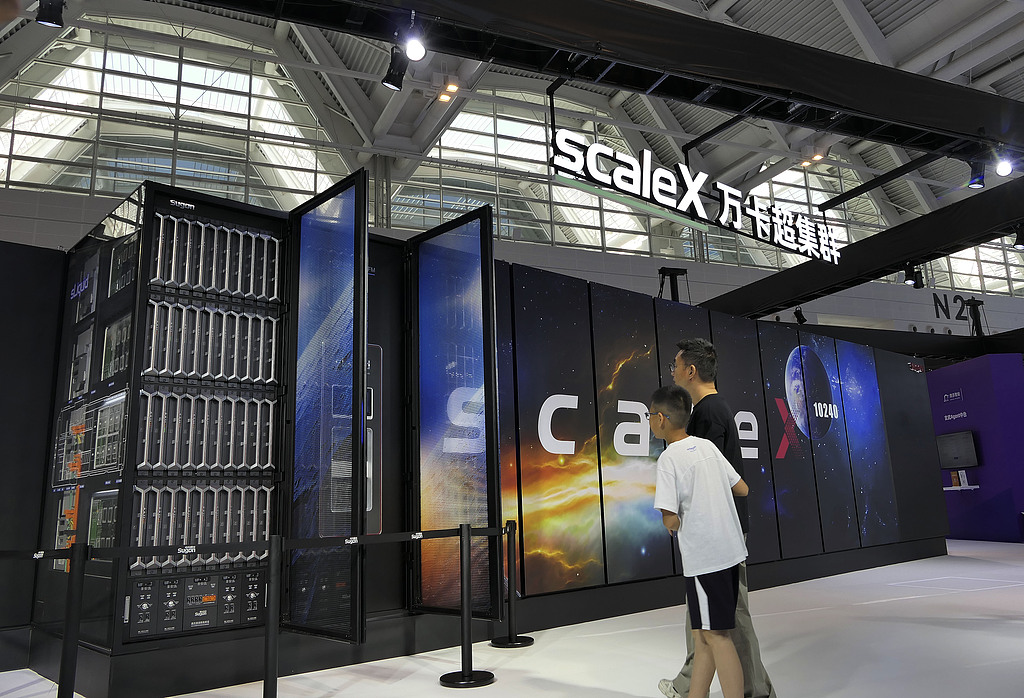
Visitors look at the Sugon scaleX 10,000-card supercluster prototype displayed in the exhibition area at the World Intelligence Expo 2026 in North China's Tianjin on May 30, 2026. Photo: VCG
Stepping into the machine room of Sugon 8000 (Dengfeng), China's first domestically developed 100,000-card AI supercluster, the scene was far less imposing than expected — but behind the compact space lies an extraordinary concentration of computing power.
Rows of towering cabinets painted with galaxy patterns stood quietly inside the 2,000-square-meter facility. The system packs 3 billion electronic components, more than 1,600 kilometers of cables and 1,500 tons of hardware into the compact space, making compact design key to overcoming the engineering challenges of 100,000-card clusters, Li Bin, chief designer of Sugon 8000, told the Global Times.
Officially completed on July 10 and connected to a core node of the National Supercomputing Internet, Sugon 8000 comes as rapid advances in AI are driving demand for computing power from large models, scientific intelligence and AI agents, pushing infrastructure from thousand-card and 10,000-card clusters toward larger 100,000-card systems.
A 10,000-card supercluster refers to an advanced computing infrastructure that deploys 10,000 or more AI accelerators within a single cluster. It provides large-scale parallel computing capabilities, serving as a core foundation for the training and inference of trillion-parameter AI models, while also supporting scientific computing applications such as climate modeling, biomedicine and industrial simulation.
As 100,000-card AI infrastructure moves from landmark projects toward broader deployment, it is providing new support for the development of the national integrated computing network, scientific breakthroughs and industrial intelligence upgrades, Chinese experts said.
Compact design
The impression that "Sugon 8000 is not as large as expected" is indeed accurate. The facility occupies just 2,000 square meters, far smaller than other computing clusters of comparable scale, according to Li.
Unlike traditional large-scale data center designs that rely on expanding physical footprints, Sugon 8000 takes a more compact approach. It concentrates massive computing power within a single large brown-red building in Zhengzhou, Central China's Henan Province, which serves as a core node of the National Supercomputing Internet.
Li highlighted a set of figures to illustrate the immense engineering challenge behind Sugon 8000.
The system brings together 3 billion electronic components that must work in precise coordination, more than 1,600 kilometers of interconnection cables — enough to stretch from Zhengzhou to Harbin — and 1,500 tons of hardware, roughly equivalent to the weight of three fully loaded Boeing 747 aircraft. Despite its enormous scale, every structural assembly process is controlled within a precision margin of just 0.05 millimeters.
Traditional data centers typically rely on air cooling, using high-powered air conditioning systems to cool the entire room in order to remove heat generated by computing equipment as efficiently as possible. Sugon 8000, however, adopts advanced phase-change immersion cooling technology, achieving a PUE of below 1.04. This means that nearly all of the electricity consumed is used for computing rather than cooling, Li said.
Supercomputing is no longer limited to traditional scientific research or AI model training. The two are increasingly converging, especially with the rise of "AI for Science," which uses AI methods to accelerate scientific discovery. This requires computing systems to seamlessly switch between high-precision scientific calculations and lower-precision AI workloads within the same task — a demand that Sugon 8000 was designed to meet.
Beyond its technical capabilities, Sugon 8000 reflects a broader shift in China's computing infrastructure — from standalone clusters toward interconnected computing networks.
Computing integration
The achievement of Sugon 8000 is not only a technological milestone, but also an important step in building the nation's computing power network infrastructure system.
"If all of Sugon 8000's computing resources were dedicated to model inference, it could support 5 to 10 percent of China's current token demand," Li told the Global Times. To some extent, he added, Sugon 8000 could help ease the shortage of inference computing capacity and improve the response speed of large AI models.
At the start of the nation's 15th Five-Year Plan period (2026-30), the computing power network was included in China's broader "six networks" framework outlined in the nation's top-level development guidelines this year. Alongside water networks and new-type power grids, computing power network has been designated as a major infrastructure project.
The computing power network is regarded as the digital equivalent of national water and power grids. Building a nationwide integrated computing network is an important marker of national modernization, according to Xinhua.
As the digital era advances, the explosive growth of AI applications has driven China's daily token usage to surpass 140 trillion in March, more than 1,000 times the level of two years ago, Xinhua reported.
However, computing infrastructure had previously been built largely through regional initiatives, resulting in fragmented "computing islands" with scattered resources and inconsistent standards. Ensuring a stable, continuous and accessible supply of computing power has become an urgent priority, according to Xinhua.
Beyond Sugon 8000, China's computing power landscape has been rapidly taking shape. China has now established a computing power layout centered on eight national computing hubs, 10 national computing clusters and three regions for coordinated development of computing power and energy, per Xinhua.
By the end of March this year, the country's installed intelligent computing capacity had reached 2.5 times the level recorded during the same period last year, the report said, noting that the national integrated computing network monitoring and scheduling platform has connected to around 70 percent of the country's intelligent computing resources.
From a compact machine room in Zhengzhou to a nationwide computing network, Sugon 8000 reflects China's accelerating efforts to build the infrastructure foundation for the AI era.
"Sugon 8000 marks a shift in China's supercomputing development — from pursuing raw performance to building a more integrated infrastructure system," Chen Jing, vice president of the Technology and Strategy Research Institute, told the Global Times on Tuesday. "The project also shows that China is capable of developing next-generation AI infrastructure through its own technologies and supply chains."
According to Xinhua, the development and construction of a second fully domestically developed 100,000-card supercomputing-intelligent computing system has been launched. As related projects advance, 100,000-card AI infrastructure is moving from landmark projects toward continuous deployment, providing further support for the development of a nationwide integrated computing network, cutting-edge scientific breakthroughs and industrial intelligent transformation.
China's computing network is also becoming more interconnected, moving away from isolated, point-to-point links toward coordinated scheduling across regions, Chen noted.
"A nationwide pool of computing resources would make advanced computing capacity easier to access, particularly for smaller companies and research institutions," he said.
RELATED ARTICLES