China launches multilateral Earth-Moon cube satellite constellation science program
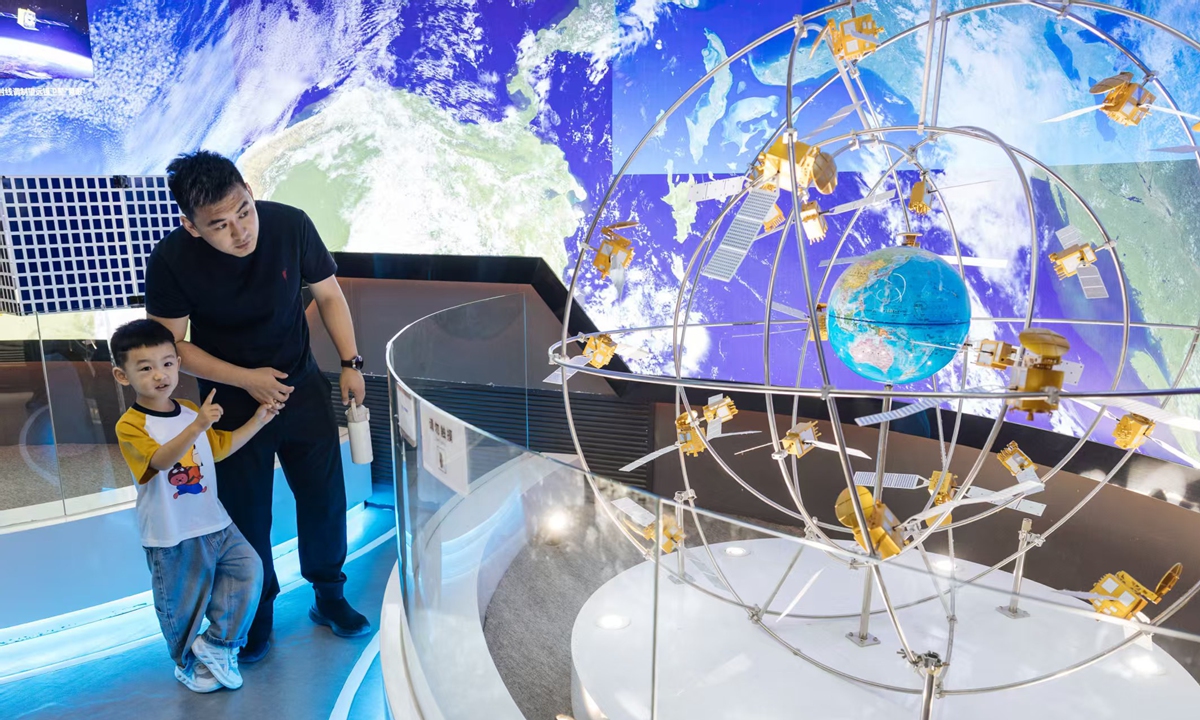
A man and a child observe a model of satellite constellations on display, featuring orbiting spacecraft encircling a miniature Earth, at the China Space Museum in Beijing, China, on April 24, as the day marks the 11th China Space Day, which this year coincides with the 70th anniversary of China's space program. Photo: Li Hao/GT
China has launched an international science program to deploy a constellation of cube satellites - small, standardized satellites built in compact modular units - across Earth-Moon space, with research institutions from Thailand, Serbia, Egypt, Senegal, Indonesia and other countries already on board, according to an announcement at the 4th International Deep Space Exploration Conference (Tiandu Forum) held in Hefei, East China's Anhui Province, CCTV News reported on Friday.
The program aims to work with multiple countries on networked monitoring of the space environment, detection of gamma-ray bursts and surveying of lunar resources, with all satellites expected to be launched and deployed by around 2030, filling a global gap in systematic observation of Earth-Moon space, organizers said.
The first phase of engineering development has begun, and the overall design review for the satellite, payload, and tracking, telemetry and control systems is nearing completion. Once completed, the program will shift Earth-Moon space exploration from a single-point, intermittent model to networked, continuous observation, providing core data support for the life safety of crewed lunar missions and for frontier scientific research on the Earth-Moon space environment, said the report.
Earth-Moon space, stretching from Earth's low orbit to about 2 million kilometers away, is a new frontier for human activity and will be the core operating zone for future crewed lunar landings and moon base construction.
Under the program, satellite clusters will be deployed in a 1:3 Earth-Moon resonant elliptical orbit and in lunar orbit, among other positions. Thirty 12U cubesats - each about the size of a large suitcase, built from a dozen 10cm cube units - and weighing no more than 30 kilograms, will be deployed in six batches to the resonant elliptical orbit to form a constellation for space environment monitoring and gamma-ray burst detection, according to the report.
Synchronized observation from multiple satellites at multiple points will allow the full evolution of space weather events to be captured and will improve the positioning accuracy of gamma-ray bursts to the sub-arcsecond level, said the report.
Under the program, China will develop three sets of standardized payloads - for high-energy particle imaging, space magnetometry and gamma-ray burst detection - and provide them free of charge to partners. The program will also offer technical training and establish unified interface standards to help developing countries take part in deep space exploration.
Global Times
RELATED ARTICLES