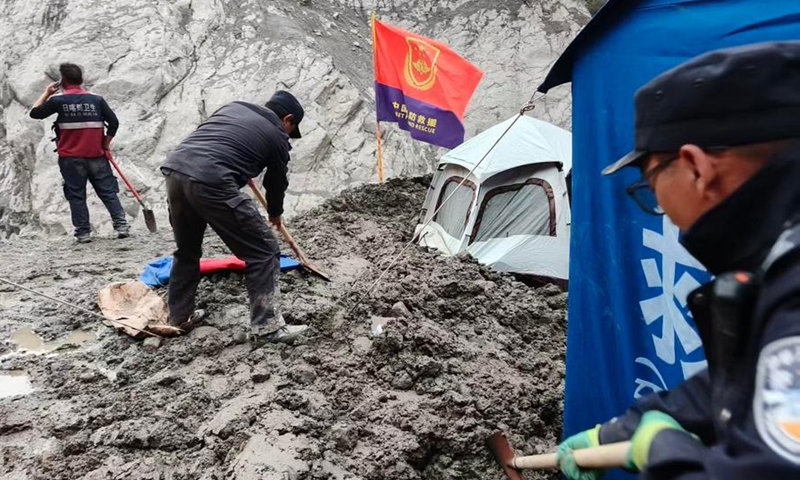
Rescuers set up tents before nightfall in Gyirong County, southwest China's Xizang Autonomous Region, Aug. 31, 2026. (Xinhua/Jigme Dorje)
As dusk settled on Aug. 31, our helicopter arrived at the destination. I jumped from the hovering aircraft a few meters above the ground, clutching my camera bag tightly against my chest, into a vast stretch of mud.
Here I was, right in the heart of the disaster-hit zone, five days after a fast-moving chain mudslide, triggered by a high-altitude glacier collapse in Nepal, struck Gyirong Port on the China-Nepal border in southwest China's Xizang Autonomous Region on Aug. 26, claiming 21 lives and leaving 541 others missing as of midday Sept. 2.
I came with a colleague. As a photojournalist, reporting from the scene is my professional calling.
The moment my feet touched the ground, they sank deep into the mud. My legs were locked in place, while my upper body swayed for a moment before I regained my balance.
A moment before, as the helicopter was descending, I looked through the window and saw what appeared to be a stretch of flat ground completely covered in mud. Only after landing did I realize just how deep it was.
I tried to pull my legs free. The mud seemed to pull back. I struggled for a while, but could barely move.
We were among the few reporters flown by helicopter directly into the disaster zone. At that time, the overland route into the core affected area remained inaccessible due to serious damages caused by the mudslide. Excavators were working around the clock to clear and reopen the lifeline.
The first team of 141 rescuers, as well as a high-altitude helicopter, arrived at the port on the morning of Aug. 27. The next day, two teams, comprising 21 people and a search dog, became the first professional rescue teams to reach the core rescue zone at the border gate.
"You're reporters, right?" a firefighter asked. "This is the last helicopter today. You're not going back tonight?" "Yes," I told him. "We're reporters."
When I looked around, it struck me that I had lost count of how many times I had been to Gyirong Port.
One visit remains particularly vivid in my memory. On that trip, I stayed at a small guesthouse run by villagers in Jifu Village, halfway up a mountain in Gyirong Town. I woke up the next morning to the chirping of birds. Still half asleep, I looked out the window to see a sea of clouds stretching across the valley below. I could hear people chatting and laughing nearby, including a Nepali staff member speaking Mandarin in a slightly halting voice.
That was Gyirong Port as I remembered it.
Now, in the middle of the devastated landscape, a square concrete platform appeared to be the only remaining structure left visible. It was the reservoir that had supplied drinking water to port staff members and residents.
On the lid of the former reservoir, covering several dozen square meters, firefighters who had been among the first to reach the disaster zone had pitched a small red tent. It was barely large enough for the temporary camp of more than a dozen firefighters.
With a shovel in hand, my colleague and I dug out a patch of relatively level ground beside the firefighters' tent, just large enough for a single-person tent. That was where we spent the night.
Then we picked up our cameras and got back to work.
Rescuers were spread across the disaster zone, searching through the mud. We interviewed and photographed several of them as they worked.
As darkness fell, rescuers gradually returned to the tents, exhausted. I looked toward the foot of the mountain. One rescuer was still there, head bowed, moving slowly through the darkness, searching.
By 9 p.m., it was completely dark. More and more rescuers returned to the camp to rest. Some sat down and began scraping mud from their boots.
When an ethnic Tibetan firefighter sat down and pulled off his socks, we saw that his feet had been soaked in muddy water for so long that the skin had turned pale and wrinkled.
Heavy machinery rumbled through the night, clearing and repairing the road, while the headlamps of crews working to restore power and communications flickered continuously in the distance.
The rescuers were getting ready to eat and invited us to join them. They had pan-fried buns with braised meat. Drones had been employed to air-drop supplies to these rescuers. "This is our first meal today," an immigration police officer said.
As we talked, they recalled what had happened the night before.
A huge boulder had fallen from the mountain across the Gyirong Zangbo River. They had heard a deep, muffled cracking sound. Then came a loud crash as the rock plunged into the river.
"The noise was enormous," one of the rescuers said. "And the splash from the rock hitting the water scared us so much that none of us dared to sleep that night."
Before we went to bed, another immigration police officer pointed toward a place not far from our tent.
"If anything happens, climb up this way immediately," he told us. "Grab that metal railing over there." It was the escape route.
Our little patch of level ground had been carved out of the mud by hand. However, a downpour that night turned our tent into a small pond.
I woke suddenly in the middle of the night, and found there was water everywhere. I shifted my body, pulled the opening of my sleeping bag tightly around me and forced myself to go back to sleep.
The next morning, when we got up, the rescuers were already preparing to head out. We emptied the water from our tent and began clearing our things. The clothes we had used as pillows the night before were completely soaked.
Seeing this, a firefighter brought us a set of rescue clothes and urged us to put them on.
I stepped outside and looked back toward Gyirong Town. Six or seven hundred meters away, excavators were already at work.
Another day had begun. In the heart of the disaster zone, rescuers once again scoured areas they had already searched several times for the missing.
They were firefighters in orange, immigration police in dark blue uniforms, disinfection workers in disease-control gear, and police officers carrying cameras and notebooks.
At first, everyone was searching for survivors. They called out again and again. They turned over debris and dug through the mud, searching every possible place. Then, slowly, painfully, everyone began to confront a reality that no one wanted to accept.
At around 10 a.m., rescuers paused their work and stood in silence in a brief memorial service to mourn the victims. Then, they put on their safety helmets and marched again into the mud.
