China-Russia first Arctic on-site sea-ice observation sheds light on climate change, shipping prospects: Chinese expert
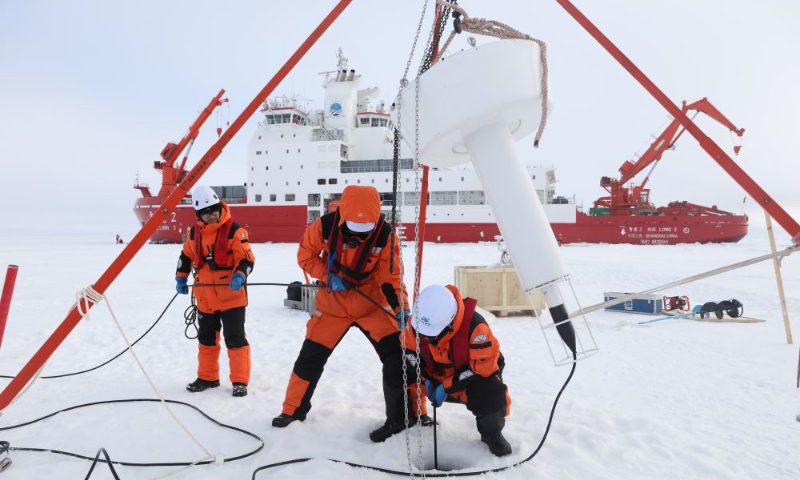
Members of the Xuelong 2 crew of China's 16th Arctic expedition deploy an ice-based buoy on August 9, 2026. Photo: Wen Jinghua/Xinhua
Chinese and Russian researchers have conducted their first joint on-site observation of Arctic sea ice, an effort a Chinese expert says could help improve understanding of changes in the Arctic environment and provide data relevant to future activities in the region, including exploring shipping routes.
The observation was conducted during China's 16th Arctic scientific expedition aboard the research icebreaker Xuelong 2, according to a report from Xinhua News Agency on Saturday. Two Russian researchers from the Russian Arctic and Antarctic Research Institute joined their Chinese counterparts in the observation work.
Before entering the sea-ice area, the Chinese and Russian researchers compared their observation methods and agreed on a joint approach. They subsequently conducted observations of sea-ice concentration, type, size, thickness, and snow depth, Xinhua reported.
The researchers also carried out detailed visual observations during the expedition, recording changes in sea-ice conditions and thickness, atmospheric environmental elements, vessel dynamics and large marine animals observed in the area.
According to Xinhua, compared with satellite remote sensing, on-site observations allow researchers to directly examine sea-ice conditions and collect detailed measurements in the field. The observations can provide data for further understanding of Arctic sea ice and complement satellite-based monitoring.
Lin Long, a member of the Chinese expedition team, said the observations were conducted throughout the day and may provide more practical information for vessel design and navigability assessments. The summer sea-ice data collected during the expedition will provide further information for research into changes in Arctic sea ice and the broader Arctic environment, the Xinhua report noted.
Zhang Hong, a research fellow at the Institute of Russian, Eastern European and Central Asian Studies at the Chinese Academy of Social Sciences, told the Global Times on Saturday that the significance of the joint observation is closely linked to the changes taking place in the Arctic. Climate change and melting sea ice have extended the navigable period and area in the Arctic, creating opportunities for the opening of Arctic shipping routes, he said.
According to the Chinese scholar, joint China-Russia research in the Arctic could provide important support for future operations in the Arctic and along Arctic shipping routes. “From this perspective, such Arctic scientific research can serve practical needs and contribute to economic cooperation between the two countries.”
It is also a concrete reflection of the long-standing good-neighborly relationship between the two countries, Zhang added.
The first joint on-site sea-ice observation also adds a new dimension to the ongoing China-Russia Arctic scientific cooperation, allowing researchers from the two countries to exchange observation methods and obtain first-hand information on sea-ice conditions. Evgeniy Kozlovskiy, a senior engineer from the Russian Arctic and Antarctic Research Institute, told Xinhua that the Russian team had learned from China's experience and methods in sea-ice observation. The exchange could help improve observation methods and assessments of sea-ice conditions.
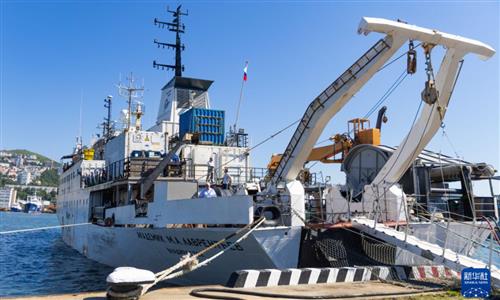
The latest observation is part of a broader China-Russia program of joint Arctic scientific research. The fourth China-Russia joint Arctic scientific expedition was launched in Vladivostok on August 20 and is expected to last 62 days. The expedition covers areas including the Chukchi Sea, East Siberian Sea, Lomonosov Ridge, Makarov Basin and Amundsen Basin, with researchers conducting multidisciplinary studies.
As the Arctic continues to experience environmental changes, continued observation and research will be important for improving scientific understanding of the region and providing information for activities such as Arctic navigation, the Chinese expert noted.
RELATED ARTICLES