China, Russia launch fourth joint Arctic scientific expedition, process lasts about 62 days: report
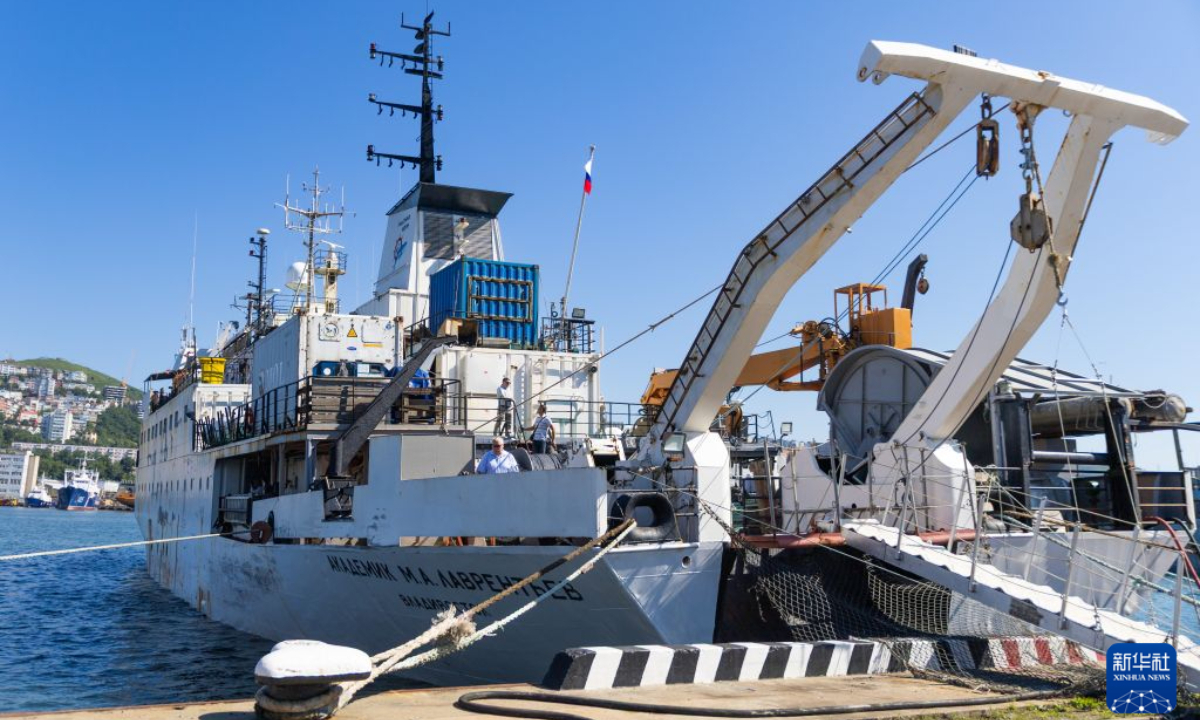
A Russian scientific expedition vessel docks at the port in Russia’s Far Eastern city of Vladivostok. Photo: Xinhua
The fourth China-Russia joint Arctic expedition was launched on Thursday in Russia’s Far Eastern city of Vladivostok. Scientists from both countries will conduct major frontier basic research on the rapid climate changes in the Arctic region, focusing on the area from the Northwest Pacific to the Arctic Ocean, Xinhua News Agency reported on Thursday. Nine people from China will participate in the voyage.
At the launch ceremony, Wei Zexun, director of the First Institute of Oceanography, Ministry of Natural Resources (MNR), said the joint expedition will focus on the waters of the Northwest Pacific and the Arctic Ocean, further deepening scientific understanding of ocean dynamic processes, climate change patterns, and marine ecosystems in the study areas. It is not only a concrete measure to implement the cooperation consensus between China and Russia in the marine field, but also a vivid example of the two countries’ comprehensive strategic partnership of coordination in marine science and technology in the new era.
According to Du Libin, executive dean of the College of Ocean Science and Engineering, Shandong University of Science and Technology, the Arctic is highly sensitive to global climate change, and a frontier for ocean science, playing a key role in the “Polar Silk Road” initiative and China-Russia polar marine cooperation.
The joint expedition will highlight deeper marine research cooperation and innovation, while advancing polar scientific exploration and practical collaboration between the two countries, Du said.
According to Zou Jianjun, chief Chinese scientist of the scientific expedition team and a researcher at the First Institute of Oceanography, MNR, the expedition will last about 62 days. The scientists will conduct multidisciplinary surveys in the Chukchi Sea, East Siberian Sea, Lomonosov Ridge, Makarov Basin, and Amundsen Basin to study changes in the marine environment of these regions amid rapid climate change and reveal their response processes and feedback mechanisms in relation to global climate change.
A representative from the Pacific Oceanological Institute (POI), Far Eastern Branch of the Russian Academy of Sciences, said during the ceremony that the joint expedition is expected to strengthen Russia-China ties and expand cooperation in the Arctic and Pacific regions.
As freight volumes along the Arctic shipping route are steadily increasing, and the role of Arctic shipping route in the global economy is becoming increasingly important, comprehensive scientific research of the region has become necessary.
Global Times
RELATED ARTICLES