French-American duck robot’s ‘Chinese brain’ reveals deep integration of global supply chains
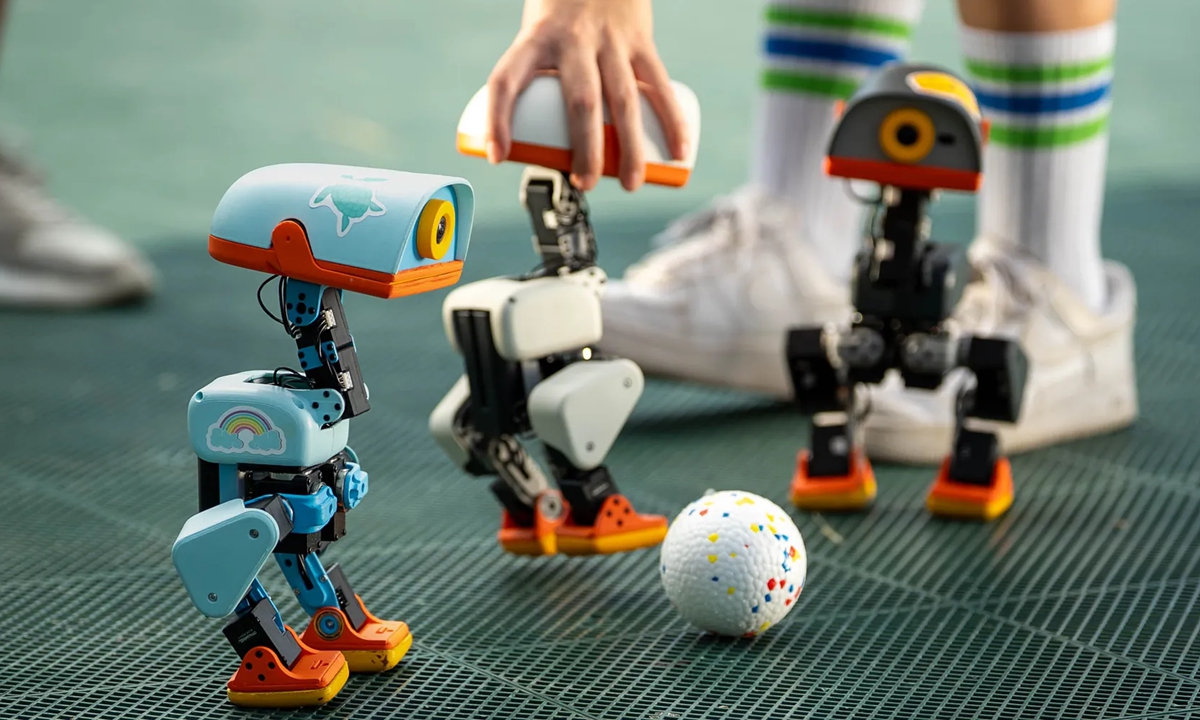
The Microduck, a new programmable personal robot with pre-installed actions, from Hugging Face's French subsidiary Pollen Robotics Photo: Screenshot from Pollen Robotics
A $399 desktop duck-shaped robot named Microduck from a French-American company has become an unlikely lens through which to view the deep integration of global technology supply chains.
Its "brain" - the main control chip - comes from Shanghai-listed Rockchip. Given long waiting times for delivery, many developers who want to build their own replicas of the duck robot said that the Rockchip-based control boards were in short supply.
Standing 25 centimeters tall and weighing less than 800 grams, the duck robot ships with pre-trained behaviors and serves as a full development platform with an open-source software stack that covers robot control, simulation, reinforcement learning. Each unit is equipped with sensors, motors, and on-device computing power from Rockchip's RK3566 chip, according to official information.
The robot was developed by Pollen Robotics, a French subsidiary of the US-based artificial intelligence (AI) and machine-learning platform company Hugging Face. Its China-made main control chip is built on architecture licensed from the British company ARM. Shenzhen-based Seeed Studio handled final assembly, while another Shenzhen firm, Radxa, supplied the main control board carrying Rockchip's RK3566 chip. The servomotors come from South Korea's ROBOTIS, according to media reports.
"One small personal robot says a lot about how intertwined global supply chains have become," Zhang Xiaorong, director of the Beijing-based Cutting-Edge Technology Research Institute, told the Global Times.
"Chinese chips have already been embedded into an irreplaceable position in supply chains of embodied AI - AI systems that interact with the physical world through robots -, and this global cooperation is turning robots from luxury goods into fast-moving consumer products." He added that China's edge lies in precise performance calibration, extreme cost control, and mature manufacturing scale.
According to Rockchip, the RK3566 handles nearly every core task on Microduck - running AI models for decision-making, controlling movement, processing sensor data, handling audio and video, and managing connections. The chip packs a four-core Cortex-A55 processor and a 1 trillion operations per second neural processing unit (a specialized circuit for AI calculations). Its power consumption of around 3 watts makes it especially suitable for a compact, lightweight, battery-powered device.
"The RK3566 wasn't designed as a high-end robotics chip - it's a general-purpose artificial intelligence of things processor commonly found in tablets and e-paper devices. Yet its low power draw and mature software ecosystem made the aggressive $399 price point and mass production possible," a Chinese developer, who goes by the online handle Asher on GitHub, told the Global Times. He is part of a group of hobbyist developers who decided to build their own duck robot replicas before the official delivery begins.
The market widely attributes the $399 price tag - for a robot with 15 degrees of freedom, a camera, and 15 servomotors - to China's increasingly complete robotics industrial chain.
The Microduck went viral soon after it was released, with more than 10,000 units of pre-orders in just four days. The first batches of products are scheduled to be delivered to customers in North America, Europe and the UK before late December.
Asher said that the duck robot's affordable price and open platform have sparked a wave of DIY replication among software engineers eager to get hands-on with embodied AI before official deliveries begin.
Developers on GitHub have already reverse-engineered the assembly drawings from the officially released simulation models.
"The Radxa main control board with the RK3566 has become scarce. A 1-gigabyte random-access memory version that once sold for 135 yuan ($20.10) jumped to more than 700 yuan within days - more than a fivefold increase," the Chinese developer said.
The sudden surge in orders has strained the supply chain. Seeed Studio acknowledged that Microduck's complexity has created significant challenges and that it is working closely with multiple chip suppliers.
Yet the very shortage of Rockchip-based boards underscores a deeper reality: In the race to bring embodied AI from labs to living rooms, Chinese chips have become an indispensable pillar of the global supply chain, analysts noted.
RELATED ARTICLES