ARTS / CULTURE & LEISURE
Chinese esports clubs go beyond physical contests to claim relatively ‘static’ gaming titles
New horizon of competition
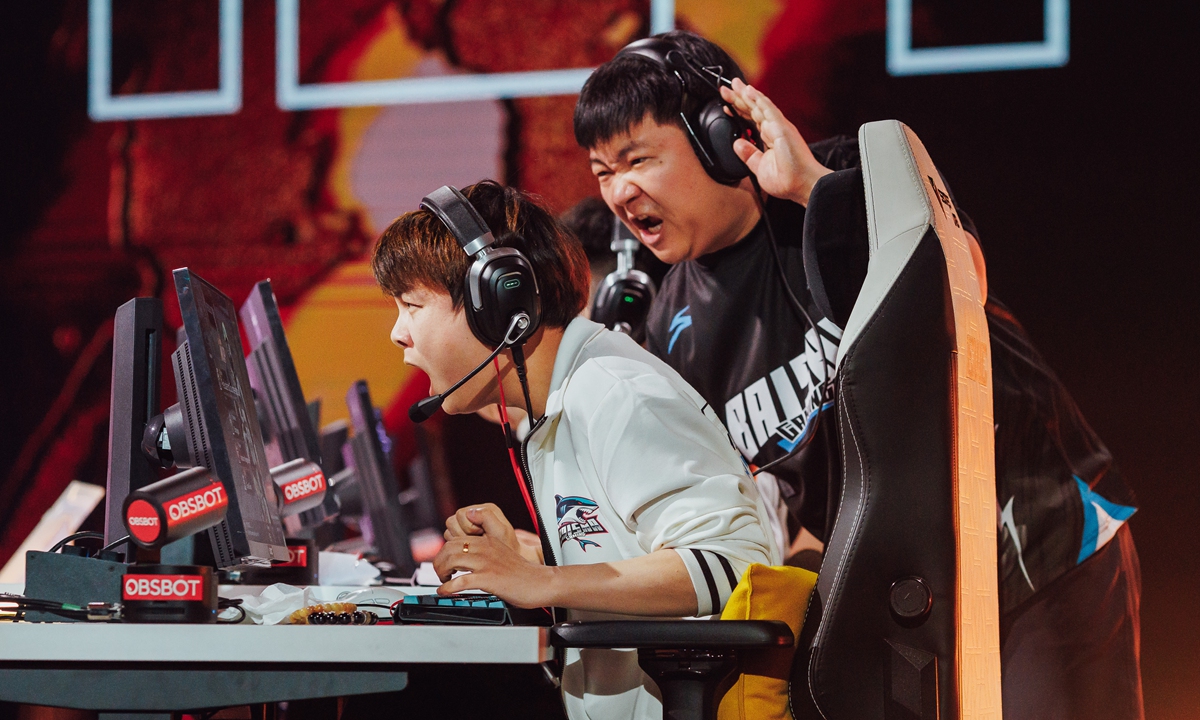
Chinese players from esports club BaiSha Gaming celebrate during a match at the Esports World Cup. Photo: Courtesy of the organizers
At the 2026 Esports World Cup in Paris, France, 28 Chinese clubs competed across 24 titles during this year's seven-week tournament.Chinese esports club AG.AL claimed the overall championship, while KSG won the Honor of Kings World Cup, BaiSha Gaming took the CrossFire title and JDG finished third in Call of Duty: Warzone.
For Chinese esports, the tournament was another demonstration of its growing competitive strength overseas. But the significance of the victory went beyond the results on screen.
Away from the contest itself, the tournament also created opportunities for Chinese esports practitioners to interact with people from France's traditional sporting and veterans' communities. For them, the similarities between esports and conventional sports were not necessarily about the physical movements involved, but about the discipline, repetition, pressure, and teamwork that are required to perform at the highest level.
Common ground
As Chinese clubs and game titles increasingly enter overseas markets, international competitions are becoming places where esports professionals encounter not only rival teams, but also athletes, clubs and fans from different cultures.
In Paris, one of the unexpected points of connection came through CrossFire, the first-person shooter whose competitive format provided common ground for conversations between esports and traditional shooting sports.
For BaiSha Gaming's Wang Hao, better known as N9, the path to the title offered a lesson in what high-level competition has in common with other sports, as he said it calls for preparation, pressure, trust, and the ability to remain composed when the outcome is uncertain.
BaiSha entered the tournament as China's top seed but suffered an early group-stage defeat before fighting through the playoffs. The team eliminated defending champions AG.AL en route to the final and then swept Netherlands-based Team Liquid 3-0 in the final.
"We went from being underestimated to winning the championship but ultimately we did what needed to be done. Everyone brought out their abilities to the fullest," Wang told the Global Times.
Asked what he was most satisfied with at the EWC, he did not point first to his aim or individual statistics.
"The thing I'm most satisfied with in this tournament is my mentality," he said. "I feel that I kept my mindset in a good place and stayed relatively calm throughout the matches."
The emphasis on composure and repetition also resonated with people outside esports.
Bertrand Guillaume, a French Shooting Federation-certified shooting instructor, sees an important similarity between elite esports players and traditional shooting athletes: neither reaches a high level simply through talent.
"Repetition creates more neural connections, allowing electrical signals in the brain to travel more quickly and send commands to the muscles more rapidly," Guillaume said through an interpreter.
The comparison, however, does not necessarily mean that esports should seek to imitate traditional sports. Guillaume said the exchange can work in both directions.
"I think esports could, in some ways, help us improve our speed of decision-making," Guillaume said.
At the same time, he sees a lesson traditional sports can offer esports players, as he said that physical preparation should not be overlooked simply because the competition takes place behind a screen.
"Above all, make sure to maintain real physical activity alongside your esports training, because esports is, after all, a relatively static activity," he said. "They need to be in excellent physical condition. They certainly shouldn't neglect it."
But the similarities they found were not limited to training methods or physical preparation.
For Manuel Fabas Vinsonnaud, an official with French veterans association Vétérans de France, the more fundamental connection lies in something less visible: how people deal with fear and pressure when they know they cannot succeed alone.
Discussing the similarities between military experience and esports, he argued that fear is not something that disappears simply because a person is well trained. "Everyone is afraid on the battlefield. But, in fact, we overcome fear through habits," Fabas Vinsonnaud said.
He noted that repeated practice can make responses more familiar, while the people around you provide the confidence needed to deal with pressure.
"What's important, and you can see this very clearly in the military, is the person beside you, that is the person who protects you," Fabas Vinsonnaud said. "And in video games, just as in the military, the people beside us are our brothers in arms, and we can always count on them."
That idea of trust is also central to N9's understanding of his own championship.
Despite being named the tournament's MVP, he rejected the idea that the award represented an individual achievement.
"Without the help of my teammates, I couldn't have won this MVP, and I couldn't have lifted this trophy," he said. "The game is, after all, a team game. I just did what I was supposed to do."
These similarities offered a starting point for a conversation that went beyond the game itself. The exchange was no longer simply about what esports could learn from traditional sports, but about what people from different sporting cultures could learn from one another.
Mutually beneficial
For Chinese esports, such encounters suggest that going overseas is no longer only about bringing games to new players.
International competitions are also putting Chinese clubs and their overseas counterparts in the same room, where conversations can extend from tactics and training to the broader culture surrounding sports.
The benefits may not always be visible on the scoreboard, but the exchange gives both sides a chance to see familiar aspects of competition from a different perspective.
The value of such encounters may not be immediately visible on a scoreboard, but they can create connections that a game alone cannot.
Guillaume sees the next step not as finding immediate answers, but as keeping that conversation going.
"We would need to spend some time exchanging ideas with esports performers and champions so that we could better understand each other and perhaps find ways to help one another," he said. "The first thing we need to do is simply have more exchanges."
RELATED ARTICLES