IN-DEPTH / IN-DEPTH
Soy milk time: Chinese agricultural experts spent a decade in Tanzanian fields until development effort became village’s quiet morning ritual
Editor's Note
Five years ago, China launched the Global Development Initiative, a people-centered call for inclusive, shared prosperity. Today that vision is visible in everyday lives across the Global South.
In a Tanzanian village, primary school children now enjoy daily "soya milk time" - a cup of fresh soy milk from local beans. Chinese agricultural cooperation has linked higher yields, farmer incomes and better child nutrition. In Peru's Andes, a small "warm-heart boat" powered by a Chinese-built hydropower station has shortened a day-and-a-half mountain trek to 40 minutes. In Cambodia, shrimp-farming techniques refined on Shanghai's Chongming Island are transforming rice fields in Takeo province, lifting both survival rates and household incomes.
These modest projects show how the Global Development Initiative reaches ordinary people. This week, we invite readers to follow the soybeans, the boat and the shrimp.
For the children, it is breakfast. For their parents, it is one less daily expense. For the farmers who grow the soybeans, it is a reliable buyer. For the Chinese researchers who have spent more than a decade walking these fields, it is quiet proof that a development project can stop being a project and start becoming daily life.
"With soy milk and snacks available at school, children are healthier, and the program has genuinely eased the burden on families," a student's mother told the Global Times.
The soy milk program is one of the latest initiatives promoted by Chinese researchers from China Agricultural University, led by prominent poverty reduction expert Li Xiaoyun, the chair professor of China Agricultural University and honorary dean of College of International Development and Global Agriculture (CIDGA), who have spent a decade working to improve people's lives in the region.
"I kept thinking whether we could take the actual local conditions into account and adopt the simplest, most basic experiences and techniques that local farmers would most readily accept," Li told the Global Times. No capital investment is required - just some "small technology" - yet farmers can still achieve a "big harvest," he explained.
From 10 households to a thousand
In 2011, when Chinese agricultural specialists from China Agricultural University first arrived in Peapea village in Tanzania's Morogoro Region, the local approach to maize was straightforward and primitive. Farmers just scattered seed by hand across large plots. Average yields hovered between 250 and 500 kilograms per acre. In a normal year the figure sat around 9.7 bags per acre; in poorer seasons it dropped to 7.2.
Many villagers had reached a bleak conclusion: better not to plant at all than to labor for so little.
The Chinese team brought a different memory - one shaped by China's own earlier decades of labor-intensive, low-capital farming. They proposed denser planting guided by measuring ropes, careful thinning, improved seed and at least three rounds of weeding. The method required more work. Villagers were unconvinced.
Only three farmers, including the local agricultural extension officer Bishanga, agreed to test the techniques on their private plots. Bishanga's reasoning was simple: China is a large agricultural country, and these experts kept coming to the village and working in the fields. He decided to trust them once.
The project gradually expanded. From Peapea it moved to Mtego wa Simba. By 2018 the team was speaking of a "1,000-household, 10,000-mu maize yield demonstration program" across 10 villages. The core techniques - row spacing, plant density, timely weeding - had entered the local agricultural extension system. Villagers could identify Chinese-method fields simply by walking past: the maize stood in straight, dense ranks.
Yet success created its own fatigue. After nearly a decade of the same message, farmers grew weary. Continuous maize also exhausted the soil. The team looked for the next step.
Creating a new market
Soybeans offered a new solution. Intercropped with maize they fix nitrogen, improve soil and produce a higher-value crop. Chinese specialists knew the plant intimately. Tanzanian farmers did not. Local markets for soy were almost nonexistent. Without demand, the incentive to plant would wither.
Therefore, the third phase of the work began not in the fields but in a primary school. In 2024 the team launched a school soy-milk nutrition program at Juhudi Primary School.
Public schools in the area typically provided no meals. Some children arrived with 500 Tanzanian shillings to buy something on the roadside; many arrived with nothing. Teachers reported that hungry students struggled to concentrate.
The model was deliberately closed-loop. The project supplied initial funds so the school could buy soybeans from local farmers. Farmers formed a soy-milk group, elected coordinators and organized shifts to process the beans. Health and hygiene protocols were trained and enforced. The school handled organization and the daily distribution. A district nutrition officer oversaw safety.
Within weeks the children's response settled the first question. They liked the soy milk, and parents noticed, with one parent saying that the program had reduced the burden of contributing money or food for school meal times. Meanwhile, attendance at the Juhudi school improved relative to a control school.
More importantly, "soy milk time" became ordinary. The children no longer treated the drink as a foreign novelty. It had entered the rhythm of the school day. The same demand began to stabilize soybean production in the village.
Making the translation possible
None of this happened through blueprints alone. It happened through the accumulation of specific human encounters.
Professor Tang Lixia, the vice dean of CIDGA at China Agricultural University, still remembers walking into Peapea and noticing something that contradicted her own rural Chinese upbringing. Villagers with little cash still hired labor for planting. A five-person "bean-pointing group" could plant several acres in a day. When she asked what they needed most, the answer was consistent: agricultural machinery.
"This question is really a form of direct interaction," Tang told the Global Times. "We go to understand their production conditions, and they actively tell us their needs. It is not that we presuppose what they require. They tell us on the spot what most affects their farming and what can most reduce their labor. Cooperation with the Tanzanian side cannot be judged only by China's past experience. We need to re-understand, through repeated village exchanges, what local farmers truly want."
Liao Lan, an expert from the team, also noted the importance of mutual understanding when institutional practices differ.
"In working with the Tanzanian side, we often encounter different rules," Liao said. "Generally, they need a budget in place before any activity moves forward. Occasionally, urgent or time-sensitive tasks arise. In these rare cases, we hope to move the work forward first and complete the necessary procedures as soon as possible afterward. Because a foundation of cooperation already existed, they were willing to understand our difficulty, and we kept pressing to finish the paperwork. This kind of interaction is a true picture of the project: we inevitably carry Chinese working methods and rules, and when those do not match local practice we coordinate, negotiate and still manage to advance the work."
The three young PhD students still remember setting up a display platform beside the village office. Piles of maize and soybeans shone in the sun. A hand-cranked sheller was fixed in place; maize cobs went into the chute, the drum turned, the screen shook and kernels fell free. Villagers did not come merely to watch. They calculated - labor, time, risk - and judged whether the techniques could fit inside the structure of their existing lives.
Later, they brought an old stone mill onto the platform and ground soy milk on the spot. In places where electricity is unreliable, a machine that needs none is not a return to the past but a practical future. Fresh soy milk passed from hand to hand; praise and discussion rose quickly. For the first time the young researchers felt with force what "small and beautiful" truly meant: not small and light, but small and stable, small enough to keep running.
When the provincial administrative secretary tasted the soy milk from the stone mill, he told his deputy the technology should appear at the national Nane Nane agricultural exhibition.
A parallel effort has later begun in Uganda's Busoga region, working with high-level local partners, three demonstration villages and a primary school of roughly 800 students. There the model already includes students growing soybeans on school land and parents contributing additional beans - an early attempt at greater self-sufficiency.
However, the difficulties remain real: malaria risk, power instability, the friction of cross-border travel, the absence of traditional soy markets and the tendency of many externally funded projects to fade once the money stops. But the team's answer has been continuity and the patient building of local capacity rather than spectacular one-time transfers.
In the fields around Mtego wa Simba, the maize now grows in orderly rows that villagers recognize as "Chinese method." Soybeans share the same land. Stone mills turn. Children queue for soy milk without ceremony.
A 70-year-old former power-company worker named Omary Jayo sells spiced soy milk from his roadside shop near the railway bridge in Tanzania. When his own harvest runs short, he buys extra beans. Besides the fresh soy milk he prepares each day, he also stocks soybean oil and powdered soy in the shop so that villagers who want to make their own can take the ingredients home.
"The powder is convenient," Jayo said, "but the ratio of water to powder is hard to get right. Sometimes it comes out too thin."
When the Chinese team brought a traditional stone mill to the village demonstration site, Jayo's wife hurried over at once. She watched carefully, then took over the handle herself and quickly mastered the rhythm. After tasting the fresh soy milk that came off the mill, she simply said it tasted better than anything made from powder.
None of these ordinary scenes was inevitable. They grew from repeated visits, from small adjustments when earlier methods lost their novelty and from the slow work of making different tempos and different ways of working fit together. Muddy roads, delayed payments and language that refused to translate smoothly were treated as part of the work rather than interruptions of it.
What remains is quieter than most development stories. An external idea has been turned into something local people can run, judge and keep.
Five years ago, China launched the Global Development Initiative, a people-centered call for inclusive, shared prosperity. Today that vision is visible in everyday lives across the Global South.
In a Tanzanian village, primary school children now enjoy daily "soya milk time" - a cup of fresh soy milk from local beans. Chinese agricultural cooperation has linked higher yields, farmer incomes and better child nutrition. In Peru's Andes, a small "warm-heart boat" powered by a Chinese-built hydropower station has shortened a day-and-a-half mountain trek to 40 minutes. In Cambodia, shrimp-farming techniques refined on Shanghai's Chongming Island are transforming rice fields in Takeo province, lifting both survival rates and household incomes.
These modest projects show how the Global Development Initiative reaches ordinary people. This week, we invite readers to follow the soybeans, the boat and the shrimp.
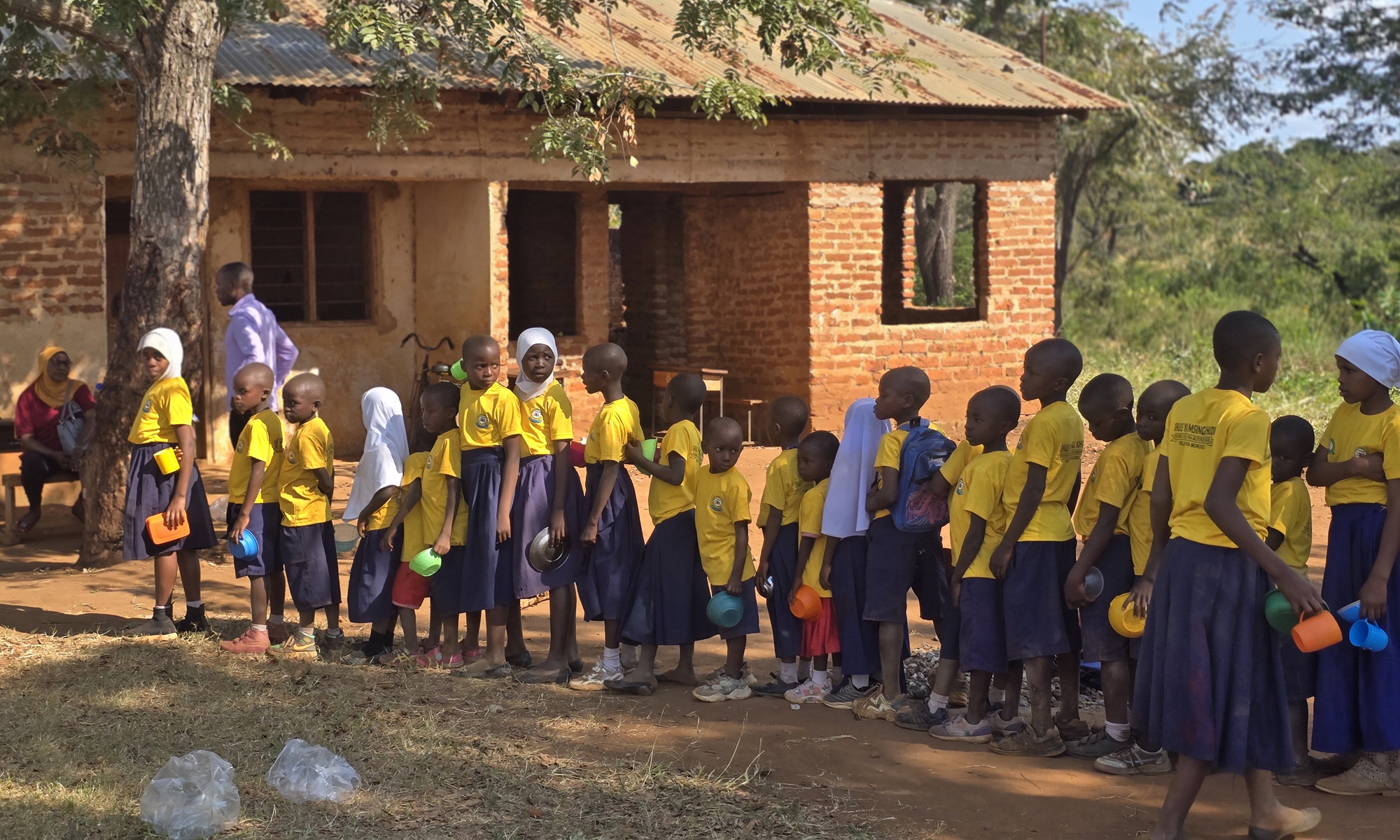
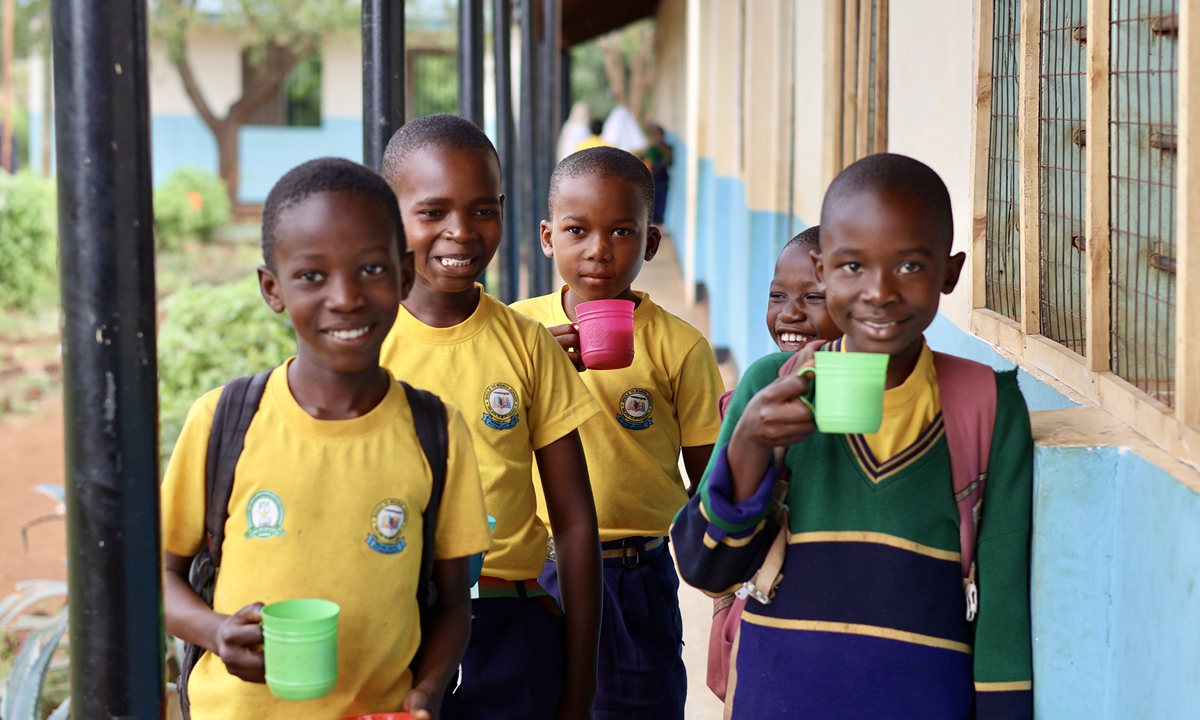
Tanzanian primary school students line up to receive soy milk in July 2025. Photo: Courtesy of Xu Jin
In the morning light of Mtego wa Simba village in Tanzania, children line up outside Juhudi Primary School. They do not rush. Teachers organize them by class. One by one they step forward, receive a cup of warm soy milk and a small snack, then return to their place. The ritual has become so ordinary that no one announces it anymore. Locals simply call it "soy milk time."For the children, it is breakfast. For their parents, it is one less daily expense. For the farmers who grow the soybeans, it is a reliable buyer. For the Chinese researchers who have spent more than a decade walking these fields, it is quiet proof that a development project can stop being a project and start becoming daily life.
"With soy milk and snacks available at school, children are healthier, and the program has genuinely eased the burden on families," a student's mother told the Global Times.
The soy milk program is one of the latest initiatives promoted by Chinese researchers from China Agricultural University, led by prominent poverty reduction expert Li Xiaoyun, the chair professor of China Agricultural University and honorary dean of College of International Development and Global Agriculture (CIDGA), who have spent a decade working to improve people's lives in the region.
"I kept thinking whether we could take the actual local conditions into account and adopt the simplest, most basic experiences and techniques that local farmers would most readily accept," Li told the Global Times. No capital investment is required - just some "small technology" - yet farmers can still achieve a "big harvest," he explained.
From 10 households to a thousand
In 2011, when Chinese agricultural specialists from China Agricultural University first arrived in Peapea village in Tanzania's Morogoro Region, the local approach to maize was straightforward and primitive. Farmers just scattered seed by hand across large plots. Average yields hovered between 250 and 500 kilograms per acre. In a normal year the figure sat around 9.7 bags per acre; in poorer seasons it dropped to 7.2.
Many villagers had reached a bleak conclusion: better not to plant at all than to labor for so little.
The Chinese team brought a different memory - one shaped by China's own earlier decades of labor-intensive, low-capital farming. They proposed denser planting guided by measuring ropes, careful thinning, improved seed and at least three rounds of weeding. The method required more work. Villagers were unconvinced.
Only three farmers, including the local agricultural extension officer Bishanga, agreed to test the techniques on their private plots. Bishanga's reasoning was simple: China is a large agricultural country, and these experts kept coming to the village and working in the fields. He decided to trust them once.
Students at Juhudi Primary School, Tanzania enjoy soy milk in June 2026. Photo: Courtesy of Zhang Yao
By 2013, measured yields on demonstration plots reached 16.7 bags per acre - more than double the earlier local average. Word moved faster than any extension bulletin. A woman named Ahsa Usseni, who had worked as a casual laborer on a demonstration farm, watched the denser stands and higher harvests. The next season, she borrowed a rope and began planting her own fields the same way. She also started buying fertilizer.The project gradually expanded. From Peapea it moved to Mtego wa Simba. By 2018 the team was speaking of a "1,000-household, 10,000-mu maize yield demonstration program" across 10 villages. The core techniques - row spacing, plant density, timely weeding - had entered the local agricultural extension system. Villagers could identify Chinese-method fields simply by walking past: the maize stood in straight, dense ranks.
Yet success created its own fatigue. After nearly a decade of the same message, farmers grew weary. Continuous maize also exhausted the soil. The team looked for the next step.
Creating a new market
Soybeans offered a new solution. Intercropped with maize they fix nitrogen, improve soil and produce a higher-value crop. Chinese specialists knew the plant intimately. Tanzanian farmers did not. Local markets for soy were almost nonexistent. Without demand, the incentive to plant would wither.
Therefore, the third phase of the work began not in the fields but in a primary school. In 2024 the team launched a school soy-milk nutrition program at Juhudi Primary School.
Public schools in the area typically provided no meals. Some children arrived with 500 Tanzanian shillings to buy something on the roadside; many arrived with nothing. Teachers reported that hungry students struggled to concentrate.
The model was deliberately closed-loop. The project supplied initial funds so the school could buy soybeans from local farmers. Farmers formed a soy-milk group, elected coordinators and organized shifts to process the beans. Health and hygiene protocols were trained and enforced. The school handled organization and the daily distribution. A district nutrition officer oversaw safety.
Within weeks the children's response settled the first question. They liked the soy milk, and parents noticed, with one parent saying that the program had reduced the burden of contributing money or food for school meal times. Meanwhile, attendance at the Juhudi school improved relative to a control school.
More importantly, "soy milk time" became ordinary. The children no longer treated the drink as a foreign novelty. It had entered the rhythm of the school day. The same demand began to stabilize soybean production in the village.
Making the translation possible
None of this happened through blueprints alone. It happened through the accumulation of specific human encounters.
Professor Tang Lixia, the vice dean of CIDGA at China Agricultural University, still remembers walking into Peapea and noticing something that contradicted her own rural Chinese upbringing. Villagers with little cash still hired labor for planting. A five-person "bean-pointing group" could plant several acres in a day. When she asked what they needed most, the answer was consistent: agricultural machinery.
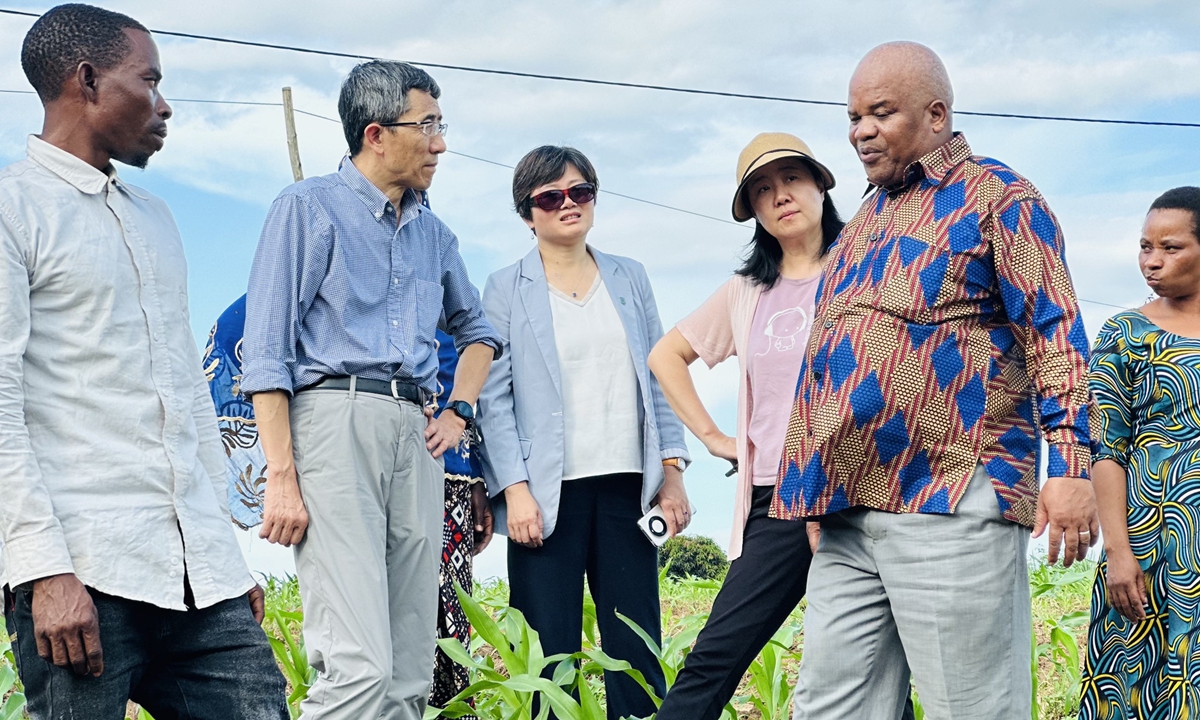
Chinese and local experts led by Professor Li Xiaoyun (second from left) discuss the condition of corn crop in Tanzania. Photo: Courtesy of China Agricultural University
"This question is really a form of direct interaction," Tang told the Global Times. "We go to understand their production conditions, and they actively tell us their needs. It is not that we presuppose what they require. They tell us on the spot what most affects their farming and what can most reduce their labor. Cooperation with the Tanzanian side cannot be judged only by China's past experience. We need to re-understand, through repeated village exchanges, what local farmers truly want."
Liao Lan, an expert from the team, also noted the importance of mutual understanding when institutional practices differ.
"In working with the Tanzanian side, we often encounter different rules," Liao said. "Generally, they need a budget in place before any activity moves forward. Occasionally, urgent or time-sensitive tasks arise. In these rare cases, we hope to move the work forward first and complete the necessary procedures as soon as possible afterward. Because a foundation of cooperation already existed, they were willing to understand our difficulty, and we kept pressing to finish the paperwork. This kind of interaction is a true picture of the project: we inevitably carry Chinese working methods and rules, and when those do not match local practice we coordinate, negotiate and still manage to advance the work."
The three young PhD students still remember setting up a display platform beside the village office. Piles of maize and soybeans shone in the sun. A hand-cranked sheller was fixed in place; maize cobs went into the chute, the drum turned, the screen shook and kernels fell free. Villagers did not come merely to watch. They calculated - labor, time, risk - and judged whether the techniques could fit inside the structure of their existing lives.
Later, they brought an old stone mill onto the platform and ground soy milk on the spot. In places where electricity is unreliable, a machine that needs none is not a return to the past but a practical future. Fresh soy milk passed from hand to hand; praise and discussion rose quickly. For the first time the young researchers felt with force what "small and beautiful" truly meant: not small and light, but small and stable, small enough to keep running.
When the provincial administrative secretary tasted the soy milk from the stone mill, he told his deputy the technology should appear at the national Nane Nane agricultural exhibition.
A parallel effort has later begun in Uganda's Busoga region, working with high-level local partners, three demonstration villages and a primary school of roughly 800 students. There the model already includes students growing soybeans on school land and parents contributing additional beans - an early attempt at greater self-sufficiency.
However, the difficulties remain real: malaria risk, power instability, the friction of cross-border travel, the absence of traditional soy markets and the tendency of many externally funded projects to fade once the money stops. But the team's answer has been continuity and the patient building of local capacity rather than spectacular one-time transfers.
In the fields around Mtego wa Simba, the maize now grows in orderly rows that villagers recognize as "Chinese method." Soybeans share the same land. Stone mills turn. Children queue for soy milk without ceremony.
A 70-year-old former power-company worker named Omary Jayo sells spiced soy milk from his roadside shop near the railway bridge in Tanzania. When his own harvest runs short, he buys extra beans. Besides the fresh soy milk he prepares each day, he also stocks soybean oil and powdered soy in the shop so that villagers who want to make their own can take the ingredients home.
"The powder is convenient," Jayo said, "but the ratio of water to powder is hard to get right. Sometimes it comes out too thin."
When the Chinese team brought a traditional stone mill to the village demonstration site, Jayo's wife hurried over at once. She watched carefully, then took over the handle herself and quickly mastered the rhythm. After tasting the fresh soy milk that came off the mill, she simply said it tasted better than anything made from powder.
None of these ordinary scenes was inevitable. They grew from repeated visits, from small adjustments when earlier methods lost their novelty and from the slow work of making different tempos and different ways of working fit together. Muddy roads, delayed payments and language that refused to translate smoothly were treated as part of the work rather than interruptions of it.
What remains is quieter than most development stories. An external idea has been turned into something local people can run, judge and keep.
RELATED ARTICLES