China’s air best on record, delivers $715 billion in health benefits: officials
By Published: Sep 07, 2026 06:29 PM
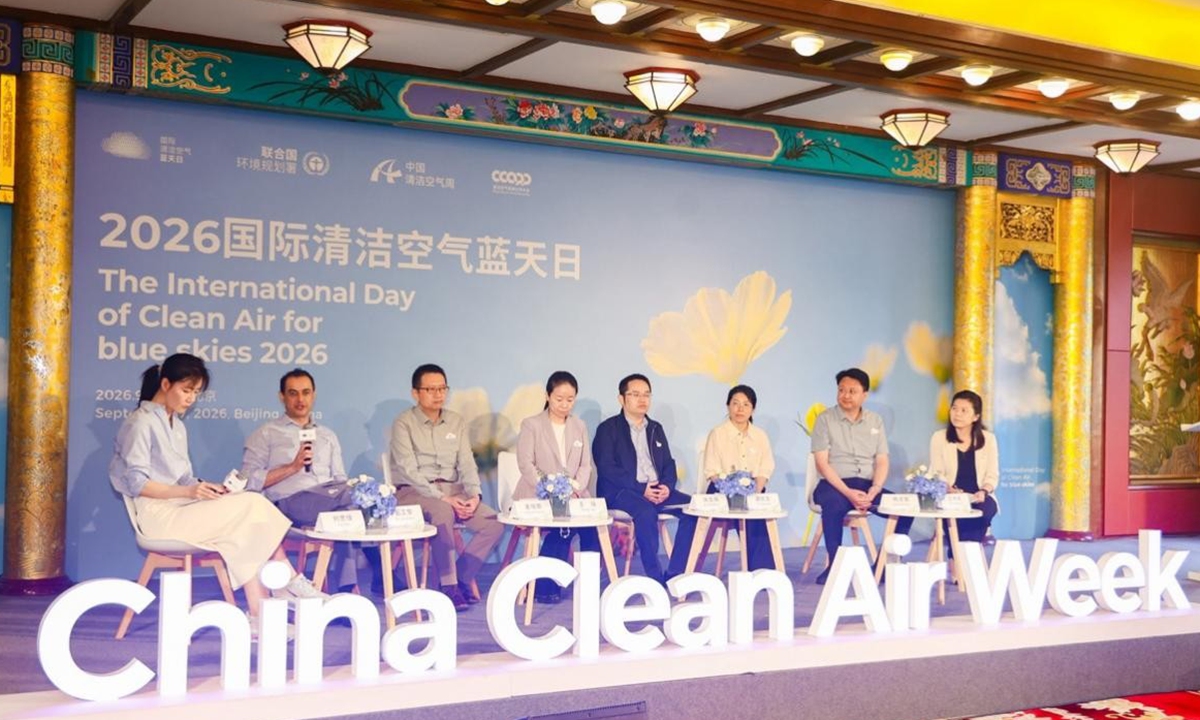
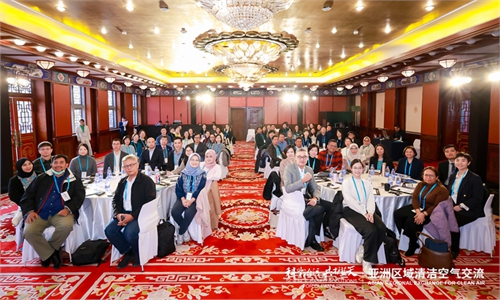
An event marks International Day of Clean Air is held by the UN Environment Programme in Beijing on September 7, 2026. Photo: UN Environment Programme
More than a decade after China launched an aggressive campaign against the choking smog, the country's air quality has reached its best level on record, with the cleanup generating an estimated 4.8 trillion yuan ($715 billion) in health benefits, a Chinese official and an academician said at a UN Environment Programme event in Beijing on Monday.
The transformation is now attracting interest from neighboring countries seeking to learn from China's experience, a World Health Organization official said at the UN event marking the International Day of Clean Air on Monday.
China's air quality reached its best level on record in 2025, the final year of the country's 14th Five-Year Plan, said Tong Yanchao, a second-level inspector with the Department of Atmospheric Environment at China's Ministry of Ecology and Environment.
Tong said that the national average concentration of PM2.5, the fine particulate matter considered particularly harmful to human health, fell to 28 micrograms per cubic meter, while the share of days with good air quality and the prevalence of polluted days also reached their best levels since monitoring began.
The change has been particularly striking in Beijing. The capital's average PM2.5 concentration fell by about 70 percent, from 89.5 micrograms per cubic meter in 2013 to 27 in 2025. Over the same period, the number of days with heavy pollution dropped from 58 to just one - a transformation Tong cited as an example of how a megacity can sharply reduce air pollution while continuing to develop.
The UN Environment Programme has hailed the megacity's achievements in improving air quality as the "Beijing Miracle."
Technology has become an increasingly important part of Beijing's fight against air pollution. Wang Yao, an official with the Beijing Municipal Ecology and Environment Bureau, said the city has built an integrated air-quality monitoring network spanning satellites, aerial platforms and ground stations.
The system can identify pollution on an hourly basis with an accuracy of up to 90 percent. In 2025, Beijing identified 23 fields each contributing more than 0.1 micrograms per cubic meter to PM2.5 levels, allowing authorities to target emissions with greater precision.
Hao Jiming, an academician of the Chinese Academy of Engineering and a professor at Tsinghua University, elaborated on the economic and health benefits generated by China's clean-air efforts.
From 2020 to 2025, China invested a total of 576.1 billion yuan in measures to curb air pollution, with businesses contributing 53 percent of the spending, the government 31 percent and the public 17 percent, Hao said. Measures targeting emissions from vehicles represented the largest share of the costs, at 26 percent, followed by efforts to reduce volatile organic compound emissions from key industries, at 17 percent.
The benefits, however, far outweighed the costs, Hao said. The measures were estimated to have prevented about 680,000 premature deaths associated with PM2.5 exposure nationwide and generated 4.8 trillion yuan in cumulative health benefits, alongside 344.2 billion yuan in benefits from reductions in carbon emissions.
China's fight against air pollution has become an international success story worth sharing, the official said. More than a decade of sustained policies has sharply reduced major pollutants in many Chinese cities, bringing substantial public health benefits, Jiang Xiaopeng, a national professional officer with the World Health Organization Representative Office in China, said at Monday's event.
China's experience, he said, extends beyond pollution controls themselves. It includes high-level political commitment, long-term planning, comprehensive monitoring, the use of scientific research and data to guide policy, and coordination across government agencies and regions. Air-quality and health targets have also been incorporated into broader economic and social development goals.
That experience is now drawing interest from abroad. Jiang revealed that senior government representatives from several neighboring countries are planning visits to China to study its approach to air pollution and public health, while more countries have expressed similar interest. China could share its experience through South-South cooperation and help advance the UN Sustainable Development Goals.
RELATED ARTICLES