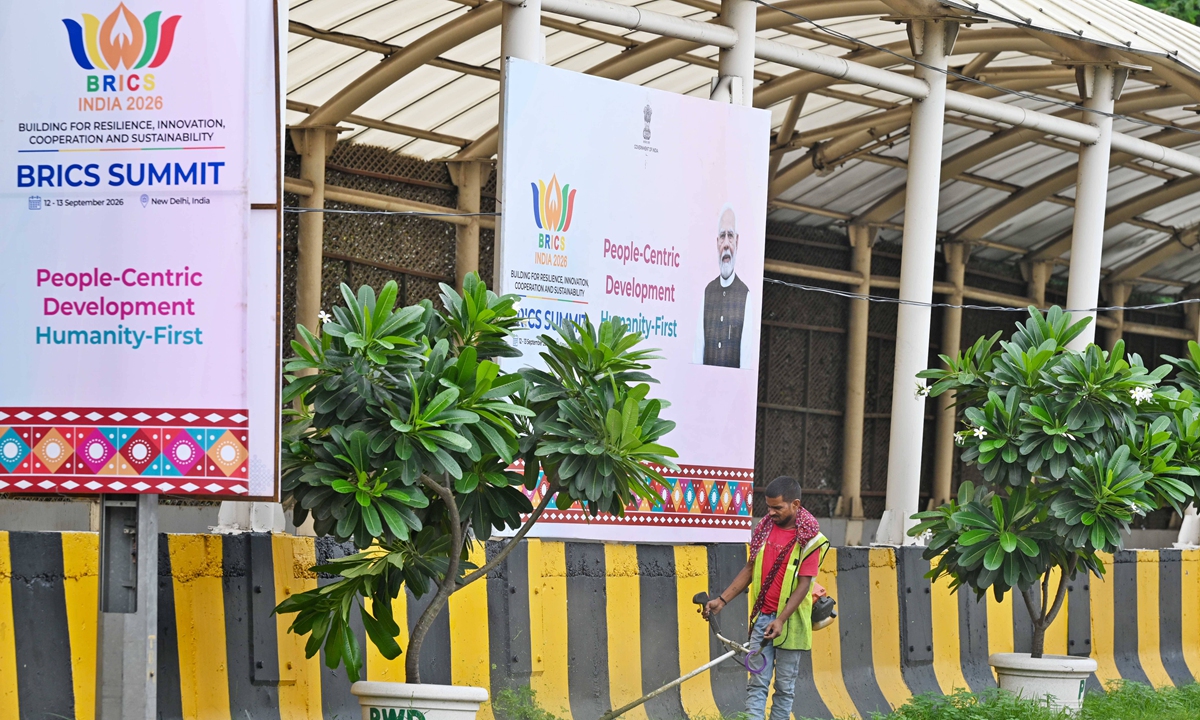
A worker carries out beautification work near Bharat Mandapam ahead of the upcoming BRICS Summit on September 6, 2026 in New Delhi. Photo: VCG
The 18th BRICS Summit is scheduled to be held in New Delhi, India, on September 12 and 13, bringing together BRICS member and partner countries, as well as the outreach invitees, according to Xinhua.
In the run‑up to the summit, New Delhi is undergoing an extensive beautification and improvement drive, with preparations including road upgrades, floral displays, improved landscaping and cultural activities across the capital, according to Indian media reports. All these efforts signal that New Delhi holds high expectations for this "home-court diplomacy."
As BRICS grows more diverse, the world is watching not only for the consensus the summit will produce, but also for how India will capitalize on its presidency to steer cooperation within the BRICS mechanism.
Since its inception in 2006, BRICS has grown to 11 members and 10 partner countries, spanning key regions across Asia, Africa, Latin America, the Middle East and Southeast Asia. The expanded group now accounts for about 40 percent of global GDP and 49.5 percent of the world's population.
Given its scale, every item on the agenda at the New Delhi summit will resonate across the Global South's development landscape.
Whether India can inject fresh momentum into BRICS cooperation and chart a viable path for emerging economies to strengthen resilience amid intensifying global uncertainty has become the central focus of international attention.
The theme of the forthcoming BRICS Summit will be "Building for Resilience, Innovation, Cooperation and Sustainability." It is no coincidence that "resilience" leads the theme. Against a backdrop of frequent supply‑chain disruptions, rising trade protectionism, and geopolitical tensions, strengthening economic resilience has emerged as the most pressing common challenge for BRICS nations.
It is noteworthy that "innovation," as one pillar of the theme, explicitly refers to the deployment of new and emerging technologies such as digital public infrastructure, fintech, artificial intelligence (AI), and knowledge sharing to enable effective service delivery and future-ready growth.
For a long time, BRICS cooperation has concentrated on trade, finance and energy. While these areas remain highly important, the booming development of the digital economy, green economy and AI is now redefining each country's position in global supply chains.
Recognizing this shift, BRICS members have already begun exploring cooperation in these domains.
India hosted the AI Impact Summit in February this year, while China convened the World Artificial Intelligence Conference in July and established the World AI Cooperation Organization. These early moves could lay a practical foundation for discussions on technology-related issues at the New Delhi summit.
Whether the focus is on AI governance, digital infrastructure, or green technologies, these issues are crucial for addressing the key bottlenecks restricting high-quality development.
If all parties can build consensus in these emerging fields, it will not only create more room for their respective technological development, but also open up entirely new possibilities for BRICS cooperation.
The challenges of translating grand cooperation visions into tangible outcomes persist. BRICS members differ greatly in national conditions, have diverse interests, and vary widely in development stages and technological foundations.
How to find common ground on key issues and reach pragmatic arrangements will test India's diplomatic finesse and coordinating ability.
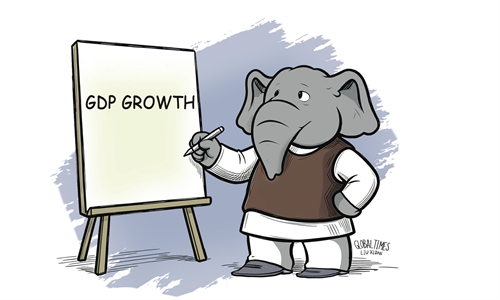
India's economic momentum in recent years has been obvious to all. Its remarkable GDP performance and rapid development in sectors including digital industry and biomedicine give it unique advantages when leading discussions on technology governance. If New Delhi can harness its own development momentum and channel it into BRICS cooperation, this summit will not only serve as a showcase for India's global ambitions, but also become a critical opportunity for it to enhance its tech industry.
In a volatile global environment, the world expects India to leverage its home-field advantage, maintain a development-first approach, and promote practical cooperation in emerging areas. As New Delhi enters "BRICS time," the world will watch keenly what will come out of the meeting.
RELATED ARTICLES