Brussels procurement overhaul seen as targeting China, could make Europe pay more for less competition: expert
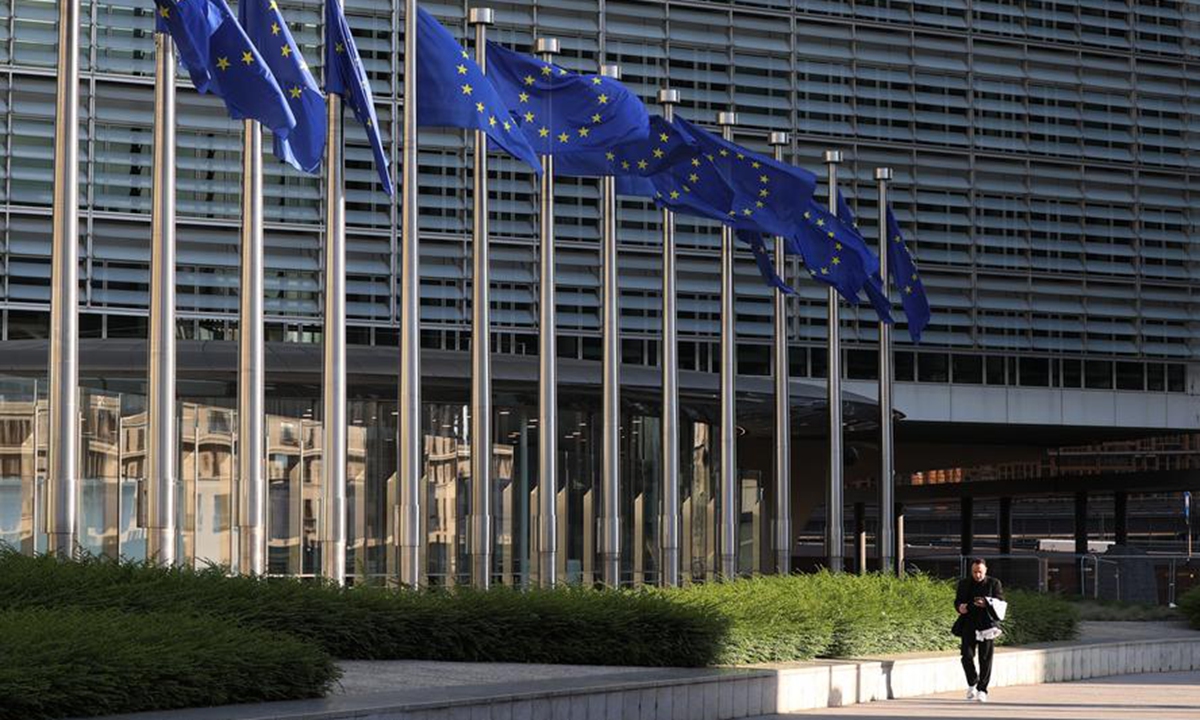
European Union flags fly outside the European Commission headquarters in Brussels, Belgium, on May 23, 2025. Photo: Xinhua
The European Commission is expected to propose a sweeping overhaul of EU public procurement rules this week, in what European media reports described as its latest effort to reduce economic reliance on China. Chinese analysts said on Tuesday that the proposed restrictions would extend protectionism into public purchasing without addressing Europe's underlying competitiveness problems.
Excluding cost-effective Chinese suppliers in the name of reducing strategic dependencies could leave European public bodies and consumers facing higher costs, while offering domestic companies only temporary relief from competition, they warned.
The draft Public Procurement Act, expected to be unveiled by EU industry chief Stéphane Séjourné on Wednesday, seeks to reduce an "excessive focus" on price in public tenders and curb "harmful strategic dependencies on third-country suppliers," European policy news outlet Euractiv reported on Monday. The draft could still change before publication.
The proposal would allow public buyers to weigh concerns including critical infrastructure, strategic supply chains and key technologies when awarding contracts, alongside risks such as espionage, cyber or hybrid attacks and interference by non-EU actors, according to the report.
Although the draft does not name China, Euractiv identified it as the clear target. The report also described a provision requiring bidders to explain prices that are significantly below those of competing offers as another "veiled reference" to China.
The Financial Times reported on the same day that the draft would allow public buyers to prefer European companies over bidders from countries like China when awarding contracts. This means Brussels is building a legal framework that could systematically disadvantage foreign suppliers, particularly Chinese bidders, even without imposing an outright ban, analysts said.
Jian Junbo, director of the Center for China-Europe Relations at Fudan University's Institute of International Studies, told the Global Times on Tuesday that the proposed reform is part of a broader protectionist agenda, with Brussels extending restrictions across different areas in the name of "de-risking" and reindustrialization.
The procurement proposal targets government agencies and other publicly funded institutions, while other industrial measures focus on businesses, he said. Despite their different scope, these measures share a common objective: shielding European producers from external competition, particularly from Chinese products.
"Brussels is effectively adding patches to its protectionist framework," Jian said, describing the discriminatory approach as contrary to the spirit of free trade and the basic principles of the multilateral trading system.
The potential reach could be significant. Bloomberg reported in July that the proposed European preference rules would cover sectors ranging from gas supply and energy extraction to water and electricity networks, railways, ports, airports and postal services. The draft would also allow public buyers to reject bids in which non-European content accounted for more than half the value of the goods and services offered.
Public procurement accounts for about 15 percent of EU GDP, or roughly 2.5 trillion euros ($2.86 trillion) based on 2025 output, according to a draft cited by Reuters in July.
Jian warned that while such protectionist measures may offer European companies short-term relief from external competition, they do little to address the bloc's underlying competitiveness problems. "Restricting access to more cost-effective and efficient suppliers could instead raise procurement and end-user costs, weaken competition and ultimately reduce incentives for European companies to improve efficiency and innovate," he said.
The EU has already restricted Chinese access to its public procurement market for medical devices. In June 2025, it imposed a five-year measure excluding Chinese companies from medical-device tenders worth more than 5 million euros under its International Procurement Instrument.
At the time, the China Chamber of Commerce to the EU expressed "profound disappointment and serious concern" over the move, saying that it contradicted the EU's proclaimed principles of openness, fairness, and non-discrimination in market access. It also noted that European medical device companies have enjoyed significant access to China's market for years.
The same protectionist tilt is also reflected in the bloc's proposed Industrial Accelerator Act. Unveiled in March and still under legislative review, the legislation prioritizes "Union-origin" products in public procurement and imposes new restrictions on certain major foreign investments.
Brussels is stepping up efforts to reduce so-called strategic dependence on China. EU Trade and Economic Security Commissioner Maroš Šefčovič told POLITICO in an August 31 interview that the bloc was continuing work on a diversification instrument aimed at encouraging companies to source from alternative suppliers where possible.
Jian cautioned that extending discriminatory restrictions across more areas could distort market-driven trade, weaken China-EU commercial ties and fuel further friction. Such measures risk eroding the openness of the global trading system and could prompt countermeasures from China, he said.
Addressing European trade concerns on July 21, Chinese Foreign Ministry spokesperson Lin Jian said that "protectionism leads nowhere. Win-win cooperation is the right way forward. The root cause of the EU's problems on trade and economy does not lie with China. Instead, China can be a partner for the EU in addressing the problems."
RELATED ARTICLES