China-Mongolia Media Forum held in Chinese city of Hohhot, highlights media role in strengthening people-to-people bonds
By in Hohhot Published: Sep 08, 2026 09:31 PM

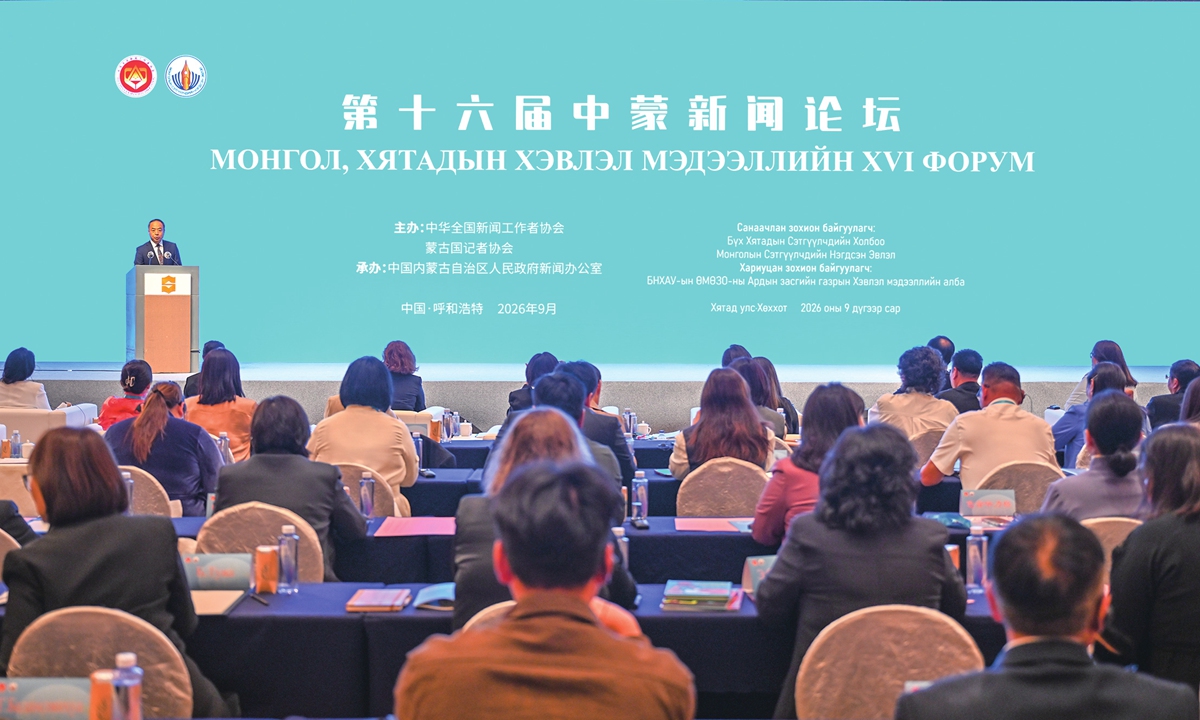
Cui Shixin, Secretary of the Leading Party Members' Group of ACJA, gives an address at the 16th China-Mongolia Media Forum on September 8, 2026 in Hohhot, North China's Inner Mongolia Autonomous Region. He highlighted the importance of the public foundation for China-Mongolia friendship amid today's complex and evolving international landscape. Photo: Courtesy of Information Office of the People's Government of China's Inner Mongolia Autonomous Region
The 16th China-Mongolia Media Forum was held on Tuesday in Hohhot, North China's Inner Mongolia Autonomous Region under the theme "Media Responsibility: Enhancing Mutual Understanding and Friendship between the Two Peoples," bringing together 120 guests and representatives from the news media sectors of both countries.
The forum was jointly hosted by the All-China Journalists Association (ACJA) and the Confederation of Mongolian Journalists, and organized by the Information Office of the People's Government of Inner Mongolia Autonomous Region.
Cui Shixin, Secretary of the Leading Party Members' Group of ACJA, said in his address that China and Mongolia are neighbors connected by mountains and rivers, stand side by side through thick and thin, forming time-honored friendship and exchanges between the two peoples. The China-Mongolia Media Forum has developed over more than a decade into an important regular platform for communication and dialogue between the news media communities of the two countries, Cui said.
China and Mongolia are both developing countries located in a key part of Northeast Asia. While facing development pressures brought by fluctuations in the external environments, the two countries are also presented with valuable opportunities for aligning development strategies and advancing regional cooperation, he said.
The complex and evolving international landscape not only tests the two countries' ability to withstand risks and pursue steady development, but also further highlights the contemporary value of good-neighborliness, friendship and mutually beneficial cooperation. Against this backdrop, it is all the more important to keep people-to-people exchanges flowing and consolidate the public foundation for China-Mongolia friendship, Cui noted.
As a major force in information communication and a messenger for mutual learning between civilizations, the news media shoulder important responsibilities to faithfully record the changes of the times, convey objective and truthful information, bridge gaps in understandings and build consensus for friendship, he said.
Zhang Dong, first-level inspector of the International Communication Bureau of China's State Council Information Office, said the theme of this year's forum - "Media Responsibility: Enhancing Mutual Understanding and Friendship between the Two Peoples" - is both far-reaching and highly relevant.
It not only represents a profound reflection on the core values of the news media, but also serves as a positive response to efforts by China and Mongolia to deepen their comprehensive strategic partnership in the new era, Zhang said.
Looking back, the forum has gone through more than a decade of development since its establishment. Journalists from the two countries have traveled together to each other's cities and villages, using vivid writing and authentic images to document the fruitful achievements of China-Mongolia economic and trade cooperation, touching stories of people-to-people exchanges and heartwarming moments of ordinary people helping one another, Zhang said.
These news reports, grounded in real life and filled with freshness and vitality, have crossed mountains and rivers and broken down information barriers, enabling people in both countries to see the other in a real, multidimensional and comprehensive way through screens and newspapers. They have played an irreplaceable and positive role in enhancing mutual understanding and deepening friendship between the two peoples, Zhang added.
Luvsandash Ninjjamts, president of the Confederation of Mongolian Journalists, said that Mongolia and China, as people often say, are permanent neighbors connected by mountains and rivers, sharing deep historical ties and a long history of exchanges.
The Mongolia-China comprehensive strategic partnership continues to deepen, while exchanges and cooperation continue to expand in politics, economy, trade, education, culture and many other fields, demonstrating sound momentum toward broader and deeper development, she said.
The forum held in-depth discussions on important topics including exchanges and cooperation in the news media sector and mutual understanding between the two peoples. Such discussions are of great significance for taking Mongolia-China media cooperation to a new level and further enhancing mutual understanding and exchanges among journalists from the two countries, Luvsandash Ninjjamts said.
Guests attending the forum said media organizations from the two countries should uphold the principles of objectivity, truthfulness and comprehensiveness, adhere to the spirit of sincerity, pragmatism and friendship, and deepen exchanges and cooperation between Chinese and Mongolian news media.
They called on the media to fulfill the responsibilities advocated by the forum, actively explain the concepts of peaceful coexistence, mutual assistance and win-win cooperation between the two sides, share each country's development achievements with the other, continuously enhance mutual understanding between the two peoples, safeguard the public foundation for China-Mongolia friendship, tell stories of China-Mongolia friendship well, and foster a positive public opinion environment for building a China-Mongolia community with a shared future.
Gandelger Sainjargal, a representative of the Confederation of Mongolian Journalists, told the Global Times that he was honored to participate in forum for the first time and was looking forward to the exchanges.
"I hope the news media communities of the two countries will continue to deepen exchanges and collaboration and produce, publish and disseminate more high-quality stories that can enhance understanding between the two peoples, strengthen bilateral friendship and showcase the achievements of cooperation," he said.
"Through truthful and vivid reporting, we can bridge gaps in understanding, bring the hearts of the two peoples closer and tell the stories of China-Mongolia friendship and cooperation well," he said.
Speaking about the aspects of China that attract the attention of Mongolian internet users and readers, the young Mongolian journalist said local audiences are currently highly interested in China's technological development and artificial intelligence.
News reports on such topics have received very positive responses from local readers, he said. People hope to gain a more direct understanding of the latest developments in China's cutting-edge technologies through media reports, including areas such as new-energy vehicles.
He also noted that new forms of media communication have opened up new channels for information exchanges between the two countries. Media organizations can explore more stories in these areas and use online content that appeals to the public to enhance mutual understanding between the two peoples.
In an interview with the Global Times, Ninjjamts said media exchanges between China and Mongolia have a long history and deep historical roots. As early as the 1920s, Mongolia's national news agency MONTSAME had begun relevant reporting. In 1958, MONTSAME and the Xinhua News Agency officially began cooperation, a cross-border media partnership that has now continued for nearly 70 years, she said.
For decades, journalists from the two countries have played an irreplaceable role in promoting friendly people-to-people exchanges between China and Mongolia. Media reporting and exchanges have not only brought the two peoples closer but also exerted a profound influence on the development of bilateral friendship and had a positive impact on exchanges and cooperation in areas including trade, culture and education, she said. Sustained communication between the news media communities is a key link in maintaining bilateral friendship and consolidating people-to-people bonds, Ninjjamts noted.
During the Tuesday forum, relevant localities and media organizations from the two countries signed cooperation agreements, while the 2026 "China-Mongolia Friendship News Works" exhibition and broadcast program was launched.
Following the conclusion of the forum, the Mongolian media delegation will visit Inner Mongolia Autonomous Region and Southwest China's Sichuan Province.
RELATED ARTICLES