ARTS / CULTURE & LEISURE
China’s top court sets rules for AI deepfakes to regulate booming short-drama industry
By Published: Sep 08, 2026 10:12 PM
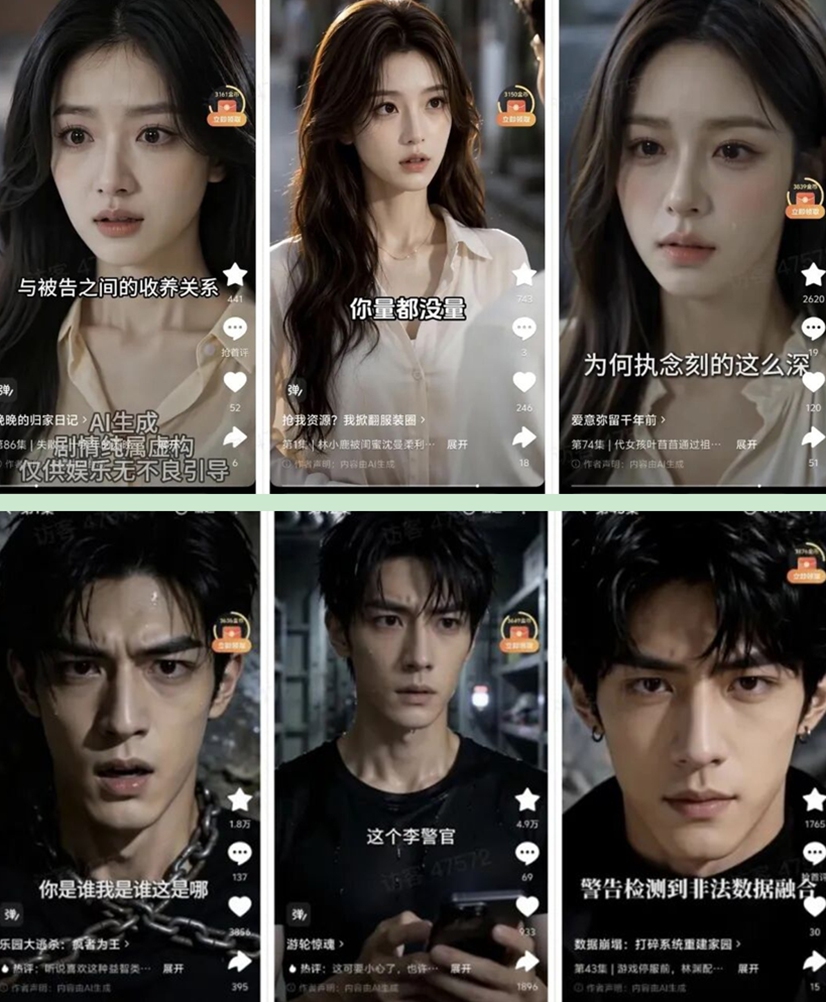
Screenshots of the short drama videos featuring AI characters sharing near-identical faces
China's Supreme People's Court on Monday issued guidelines for handling AI-related disputes, addressing issues of broad public concern including AI-generated face-swapping, voice cloning and other deep synthesis abuses, bringing long-awaited legal guardrails to the booming domestic short drama sector.Industry insiders and legal experts told the Global Times that the rules are widely seen as a much-needed crackdown on rampant copyright and personality rights abuses, and are sure to trigger a sweeping shake-up of the micro-drama industry, ending the era of crude, mass-produced AI content.
The Supreme People's Court's new judicial guidance marks the first time that China has explicitly established "identifiable equals infringement" as a core adjudication standard to AI-generated short dramas, Wu Xiaolin, a Beijing-based lawyer, told the Global Times on Tuesday, adding that the breakthrough is that the rules transform previously vague administrative requirements into directly enforceable judicial standards.
"It no longer relies on administrative documents, but directly applies civil code personality rights to define what AI deep synthesis can and cannot do in short dramas," he said.
China's short drama market has exploded in recent years, generating billions in revenue and becoming a major cultural export.
According to figures released by the National Radio and Television Administration, 33,000 micro-dramas were aired in China in 2025, reaching a domestic audience of nearly 700 million. The market surpassed 100 billion yuan ($14.9 billion) in 2025, doubling its size from 2024, the Beijing Youth Daily reported.
Yet rapid expansion has been accompanied by widespread irregularities. "Many low-cost, high-volume productions operate like commercial information flow advertisements, relying on unauthorized AI face swapping and voice cloning to slash production costs," Feng Anrong, a screenwriter and director who runs an AI production studio, told the Global Times.
The human cost of such practices has become increasingly visible. Media has reported that a number of high-profile celebrities, including Song Weilong, Yang Zi, Xiao Zhan, and Dilraba Dilmurat, have repeatedly issued statements defending their rights, as multiple AI micro-dramas have exploited their images through "face-blending" and "face-mimicking" techniques to piggyback on their star power.
According to Feng, these productions follow a separate business logic from mainstream short drama platforms: They are bulk purchased to drive traffic, and do not rely on conventional revenue sharing models, making them largely insulated from routine content reviews.
"The market has long suffered from a 'bad money drives out good' dynamic," Feng said. Low-quality AI generated short dramas can be produced for mere hundreds of yuan, squeezing legitimate creators who invest in original scripts, real location shooting and authorized performances.
He noted that genuine, law abiding production teams rarely resort to such infringing practices. "The new rules will mainly hit speculative, low-quality traffic driven content, rather than healthy, creative small and medium sized studios," said Feng.
Still, real-world implementation faces practical hurdles: blended AI faces and subtly altered voices make infringement identification ambiguous, and the sheer volume of circulating short drama content creates huge challenges for evidence collection and accountability.
Zhang Peng, an industry analyst, echoed this view. He noted that the new rules raise the cost of infringement from near zero to actionable and compensable, potentially forcing the profit-driven business model of mass produced infringing AI short dramas to collapse.
"Traffic and advertising budgets may gradually flow back to compliant original works, improving the bargaining power of genuine creators," he explained. Nevertheless, such a shift depends heavily on platform enforcement and illustrative court rulings.
Zhang stressed that the regulations do not ban legitimate AI applications. AI tools can still assist script writing, post production and voice over work. The real risk is over regulation that may inadvertently penalize lawful creators. "The rules represent short term pain for opportunistic players and long-term gains for the whole sector," he said.
He added that judicial punishment alone cannot completely erase the industry's reputation for crude, low brow content. To rebuild public trust, coordinated efforts from platforms, regulatory bodies and industry self regulation are required, alongside high quality, socially valuable flagship productions.
The stakes extend well beyond China's borders. Micro-dramas are not only expanding steadily at home; they are also breaking ground on the global stage as a fresh force for Chinese culture going global.
Data shows that in the first quarter of 2025, Chinese micro-dramas were downloaded more than 270 million times worldwide. By March 2025, the number of related apps in overseas markets had surged to 237, a nearly fourfold increase year on year. In regions such as North America, Southeast Asia, and the Middle East, downloads and active users of micro-drama apps have grown markedly, People.cn reported.
The operational model of micro-dramas has also caught the attention of overseas streaming platforms. Some have launched localized versions in international markets, adding multilingual subtitles and dubbing. Monetization models such as pay-to-unlock and membership subscriptions are also gradually gaining traction overseas.
China's approach, combining development with security and using judicial rulings to define boundaries, also positions it at the frontier of global AI content governance, according to Wu. "It offers a judicial expectation for the broader entertainment AI industry and provides a governance example for other countries," said Wu.
RELATED ARTICLES