Normal China-Canada defense dialogue needs no third-party approval: Global Times editorial
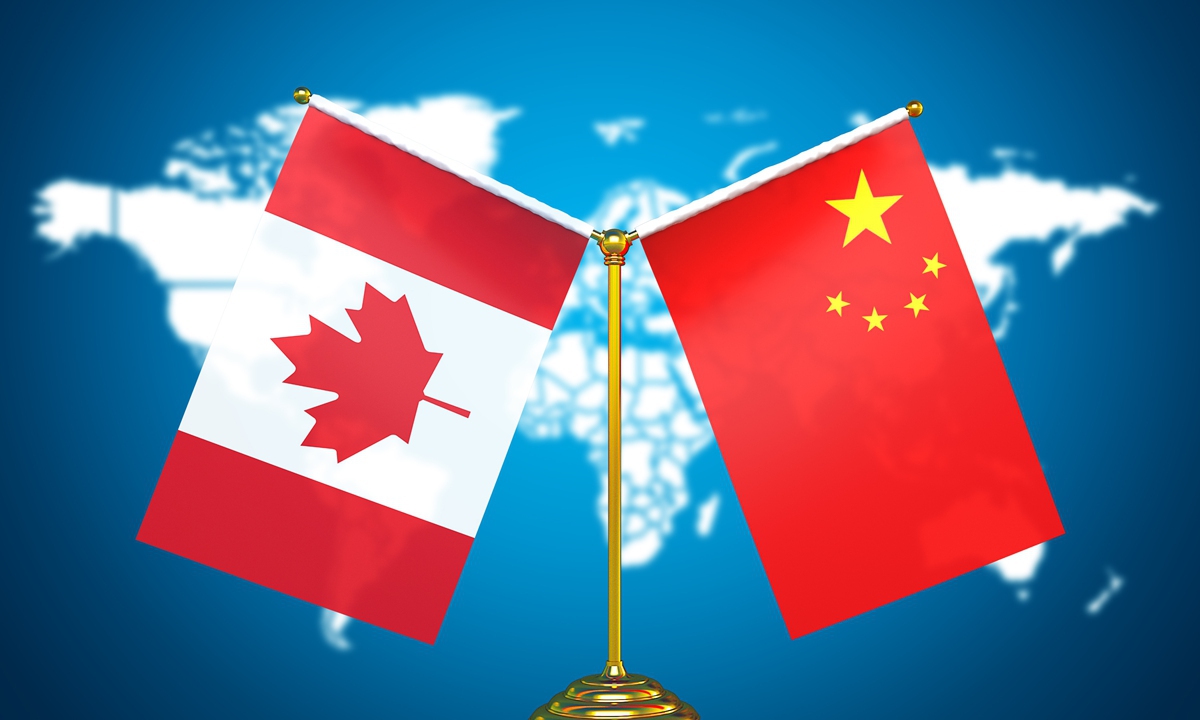
China and Canada Photo: VCG
Why has the resumption of China-Canada defense consultation and coordination mechanism after eight years triggered absurd speculation about "Canada and China forming a military alliance"? The answer may lie not at the negotiating table in Beijing or Ottawa, but in the profound rift in US-Canada relations. China has consistently maintained that it seeks to develop relations with Canada on the basis of mutual respect, equality and mutual benefit. This position will not change with fluctuations in US-Canada relations.
Recently, the 5th China-Canada Defense Coordination Dialogue was held in Canada, marking the first resumption of the defense coordination dialogue mechanism in eight years. What should have been a routine institutional working meeting has instead triggered absurd speculation in Western discourse, including claims that "Canada and China are joining forces against the US" or even "forming a military alliance." The noise generated by such narratives far exceeds the attention warranted by a routine working meeting and seriously distorts the facts.
In fact, the China-Canada defense consultation and coordination mechanism dates back to 2013, and this was its fifth meeting. Its nature is that of a communication channel through which the two militaries exchange views on international and regional issues of common concern - not any form of "military alliance negotiation." China has consistently adhered to a non-alliance policy, and spokespersons for its Ministry of National Defense have emphasized multiple times the stance of "engaging in dialogue rather than confrontation and building partnerships rather than alliances."
Military-to-military relations serve as a barometer of the trajectory of state-to-state relations. Following the improvement of China-Canada political relations and the positive momentum in bilateral ties, normal exchanges between the two militaries align with the basic logic of international relations. Over the past decades, defense contacts between the two sides have not been absent; rather, the eight-year suspension reflected an abnormal period in bilateral ties, while the resumption of dialogue marked a return to normality.
The restart of China-Canada defense dialogue also has a clear practical context. Since the beginning of this year, following Canadian Prime Minister Mark Carney's visit to China, cooperation in areas such as trade and aviation has resumed. The follow-up in the defense domain is a natural extension of the broader restoration of bilateral relations. As two important members of the Asia-Pacific region, China and Canada share many common interests in maintaining regional peace and stability. Keeping communication channels open between their militaries helps manage unexpected maritime encounters, reduce miscalculation, and prevent incidents from escalating. This itself is a positive contribution to regional security.
These are all matters that can be discussed openly and directly. Why, then, have they prompted speculation and even "conspiracy theories" in some Western media circles? The answer may lie not at the negotiating table in Beijing or Ottawa, but in the profound rift in US-Canada relations.
Around the time the China-Canada defense dialogue was held, the US-Canada trade dispute was escalating. Since August 22, the US has imposed 50 percent tariffs on Canadian goods worth approximately $20 billion, while Canada formally implemented equivalent retaliatory tariffs on September 8. The US repeatedly referred to Canadian Prime Minister Carney as a "governor" and on the eve of the Canadian tariffs taking effect, Washington threatened to ban Bombardier from selling aircraft in the US. Although the China-Canada dialogue is not directed against any third party, some Western media speculation, which is clearly abnormal, appears to have been influenced by turbulence in US-Canada relations.
When a country assumes that a neighboring country "naturally" falls within its sphere of influence, engagements between that neighbor and other countries are often interpreted as acts of "counterbalancing." The overly sensitive reaction to the China-Canada defense dialogue ultimately stems from Washington's hegemonic mind-set. At its core is a failure to treat other countries as sovereign entities with independent national interests and agency that deserve to be treated as equals. Under pressure from a hegemonic power, Canada has begun reassessing its own strategic circumstances and made more choices to safeguard its strategic autonomy and national interests. Its unwillingness to become a "vassal" that the US can manipulate is understandable. Yet such actions have triggered suspicion and unease among some politicians in Washington. Today, making an issue out of normal exchanges between China and Canada is one of the means of applying pressure - both overt and covert - to force Canada to choose sides once again.
Canada is an important economy in the Asia-Pacific region, with extensive complementary interests with China in areas including energy, agriculture and technological innovation. China has consistently maintained that it seeks to develop relations with Canada on the basis of mutual respect, equality and mutual benefit. This position will not change with fluctuations in US-Canada relations.
Why should anyone else's approval be required for normal China-Canada defense dialogue? The trend toward a multipolar world is irreversible. As sovereign and independent countries, China and Canada both have the right to independently determine the direction of their foreign relations and are capable of taking responsibility for the development of their bilateral ties. No third party is in a position to interfere or dictate terms.
RELATED ARTICLES