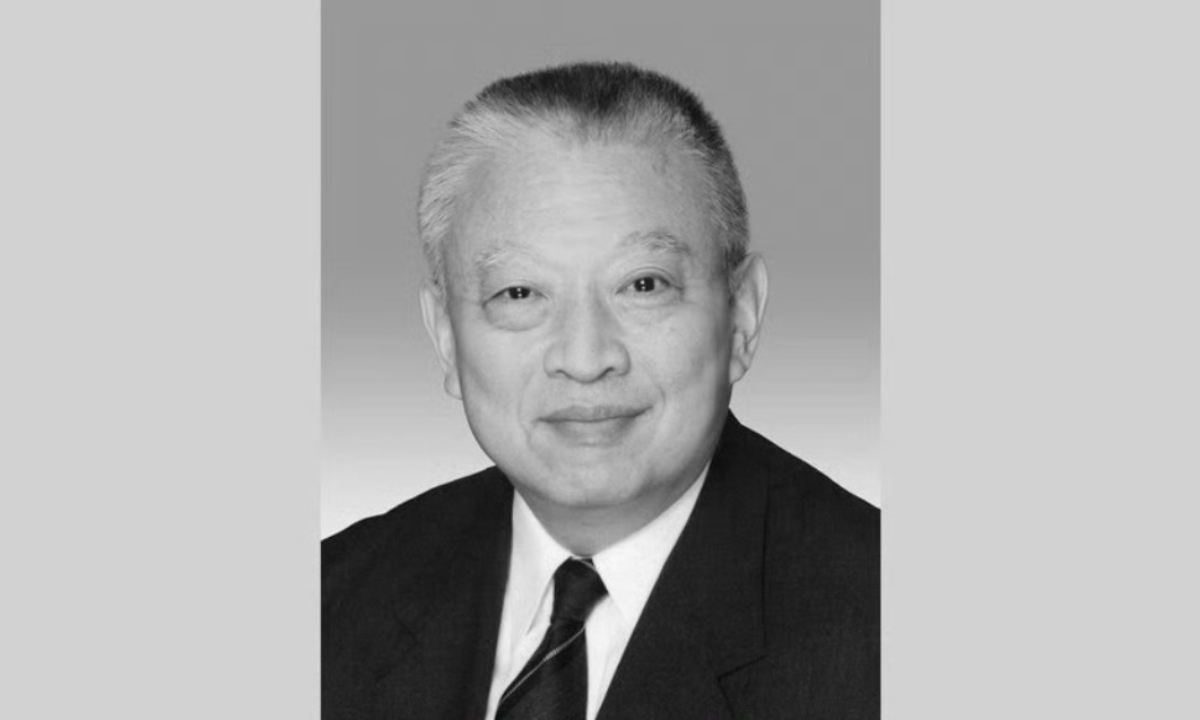
Tung Chee-hwa Photo: Screenshot from the website of The Paper
Tung Chee-hwa, former vice chairman of the National Committee of the Chinese People’s Political Consultative Conference and former chief executive of the Hong Kong Special Administrative Region (HKSAR), died of illness at the age of 89 in Hong Kong at 9:57 pm Tuesday, Xinhua News Agency reported on Wednesday.
Tung, who oversaw Hong Kong’s return to China in 1997, passed away peacefully in hospital, surrounded by his family, reported China News Service, citing a statement issued by Tung’s office in the early hours of Wednesday.
“Mr Tung dedicated his life with an unwavering commitment to the service of the Nation and the Hong Kong SAR. His contributions with integrity, compassion, and dignity will be well remembered,” the statement read.
A native of Zhoushan, East China’s Zhejiang Province, Tung was born in Shanghai in May 1937. He moved with his family to Hong Kong in 1947 and pursued higher education at the University of Liverpool in the UK. In 1969, he returned to Hong Kong to join his family’s shipping business.
Hong Kong Chief Executive John Lee Ka-chiu expressed profound sorrow over the passing of Tung on Wednesday, according to a press release issued by the HKSAR government.
Tung’s “distinguished leadership rendered exemplary contributions to the smooth process of Hong Kong’s return to the motherland, as well as the implementation of the ‘one country, two systems’ principle and the Basic Law,” Lee said.
“During his tenure of over seven years, Mr Tung successfully steered Hong Kong through the turmoil of the Asian financial crisis and led the people of Hong Kong in overcoming a wide range of challenges through concerted efforts, thereby facilitating a robust economic recovery and maintaining social prosperity and stability. With visionary foresight, he instituted mechanisms to promote economic and trade ties and co-ordinated development between Hong Kong and the mainland, laying a solid foundation for Hong Kong’s enduring competitiveness. His contributions to Hong Kong were exceptionally significant.” Lee said.
Upon the conclusion of his tenure as Chief Executive in 2005, Tung assumed the office of vice-chairman of the National Committee of the CPPCC, where he continued to offer his counsel at the national level and further contributed to the prosperity, stability and sustained development of Hong Kong. He was also instrumental in uniting the city to foster in depth exchanges between Hong Kong and the international community, elevating Hong Kong’s role and influence on the global stage, Lee said.
“Mr Tung dedicated his life to serving the country and Hong Kong. I am profoundly grieved by his passing, and his life-long and monumental contributions to Hong Kong will forever be etched on our memory. On behalf of the HKSAR, I extend my heartfelt condolences to his family,” said Lee.
On December 11, 1996, Tung won HKSAR’s first chief executive election by a wide margin and was formally appointed by the Central People’s Government.
Taking office on July 1, 1997, Tung steered Hong Kong through its historic transition under the “one country, two systems” framework. His tenure was marked by major challenges, including the 1997-98 Asian financial crisis, economic restructuring and the SARS outbreak.
In 2019, Tung was awarded a national honorary title for his outstanding contributions to the implementation of “one country, two systems” and Hong Kong’s smooth return to China. He was awarded the Grand Bauhinia Medal by the HKSAR government in 2006.
Global Times
RELATED ARTICLES