China acts as a buffer for global oil market, demonstrating strategic foresight as a major power
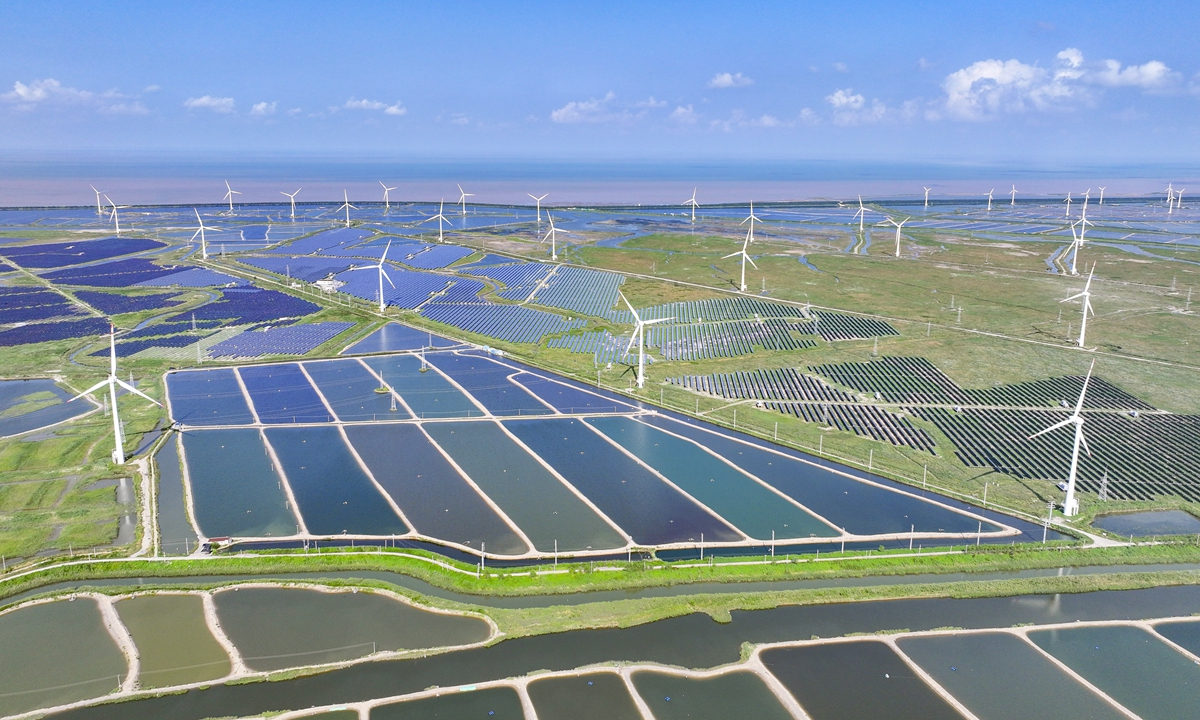
Wind turbines and photovoltaic panels in Yancheng, East China's Jiangsu Province deliver reliable green energy on August 15, 2024. According to data from the National Energy Administration, as of July, China's installed renewable energy power generation capacity reached 1.65 billion kilowatts, up 25 percent year-on-year. Photo: VCG
A recent international‑energy‑analysis video titled "China quietly saved the world," released by Max Fisher, a former columnist for The New York Times, has grabbed overseas public attention. The video spotlights a counter-intuitive phenomenon following the impact of the Iran war on global oil markets: Amid prevailing market fears of supply shortages and a global scramble among nations for alternative oil sources, China has substantially cut its crude oil imports and oil consumption, creating an unexpected buffer for the global oil market. According to Fisher, this shift stands as one major reason why global oil prices have not spiraled out of control as initially anticipated.
As a strategic chokepoint for global energy transportation, the Strait of Hormuz has recently seen persistently tense navigation conditions, driving up the risk premium on international crude oil. According to historical market logic, when geopolitical conflicts trigger supply concerns, major consumer nations typically rush to procure and stockpile oil, while the widening supply-demand gap further drives up oil prices, which in turn feed into global inflation through energy costs.
Following the recent escalation of tensions in the Middle East, market concerns have intensified that a rebound in energy prices could derail the global economic recovery, and expectations of an "oil scramble" briefly permeated the commodities trading markets.
However, the Chinese market has offered a different response. Domestic refining and petrochemical companies have adjusted their production schedules in line with market conditions, flexibly and orderly slowing down new purchases of high-priced crude oil, thereby moderating the growth rate of imports from the demand side. With remarkable restraint, China has acted as a buffer for tight global supply demand balances.
An article in The Wall Street Journal noted that China is propping up the world economy by importing a lot less oil; France's Le Figaro stated that China was helping "save" the world economy for a 2nd time since the 2008 financial crisis.
For a long time, the global response to oil crises has primarily focused on the supply side, with major consumer nations largely forced to passively endure price fluctuations. However, this recent experience demonstrates that a massive consumer market can also serve as a buffer through production adjustments and inventory management, becoming a vital force in maintaining market equilibrium.
Reuters noted that the dramatic reduction in China's seaborne crude oil imports since the start of the conflict means it is shouldering the bulk of the adjustment of lower volumes from the Middle East. The Financial Times also commented that the country's declining oil imports had emerged as a "critical variable reshaping global oil market dynamics."
Why has China been able to buck the trend and chart a different trajectory? The confidence comes from China's strategic foresight.
In previous years, when international oil prices stayed low, China steadily advanced the development of its commercial crude inventory system, gradually building up substantial reserves. During the current round of oil price increases, the country's domestic market has paused its routine pace of adding to commercial inventories, instead using previously built-up reserves to substitute for some high-priced imports.
This approach has not only ensured the basic operating needs of China's domestic refining and petrochemical industries but has also avoided scrambling for supplies at high prices in the international market, which would have further exacerbated supply-demand tensions. "Grain in hand, no panic in heart" - this robust stockpile is the direct underpinning of China's flexibility in adjusting its import pace.
After years of sustained efforts, China has established a smooth and efficient commercial inventory turnover system, while continuing to diversify its sources of crude oil imports to countries and regions such as Brazil and Africa, reducing its reliance on any single shipping route. More importantly, market-oriented refining and petrochemical operations have become increasingly mature, enabling companies to respond swiftly to price and risk signals and adjust their procurement and production plans accordingly. This diversified and flexible energy supply system gives China greater room to maneuver when faced with geopolitical disruptions.
From a longer-term perspective, what is truly reshaping the logic of energy markets is a green transition that is steadily gaining depth and momentum. According to the International Energy Agency, electric vehicles alone displaced 1.5 million barrels a day of China's oil demand in the second quarter of 2026, far exceeding the market's previous expectations. China's rapid development of new energy is not only reshaping its own energy landscape, but also quietly changing the underlying dynamics of the global energy market.
From once being a passive taker of fluctuations in international energy prices to becoming a proactive stabilizing force in the balance of the global market, the change reflects a consistent and steady logic underpinning China's energy development: keeping its own energy supply firmly in hand and using the certainty of its own development to navigate an uncertain external environment. In itself, this is one of the most tangible and enduring contributions China has made to global market stability.
The author is a reporter with the People's Daily. The article was originally published on People's Daily. opinion@globaltimes.com.cn
RELATED ARTICLES