GT on the spot: Foreign officials highlight China’s growing role in global public security cooperation, from police training to cutting-edge tech
By in Lianyungang Published: Sep 09, 2026 09:38 PM

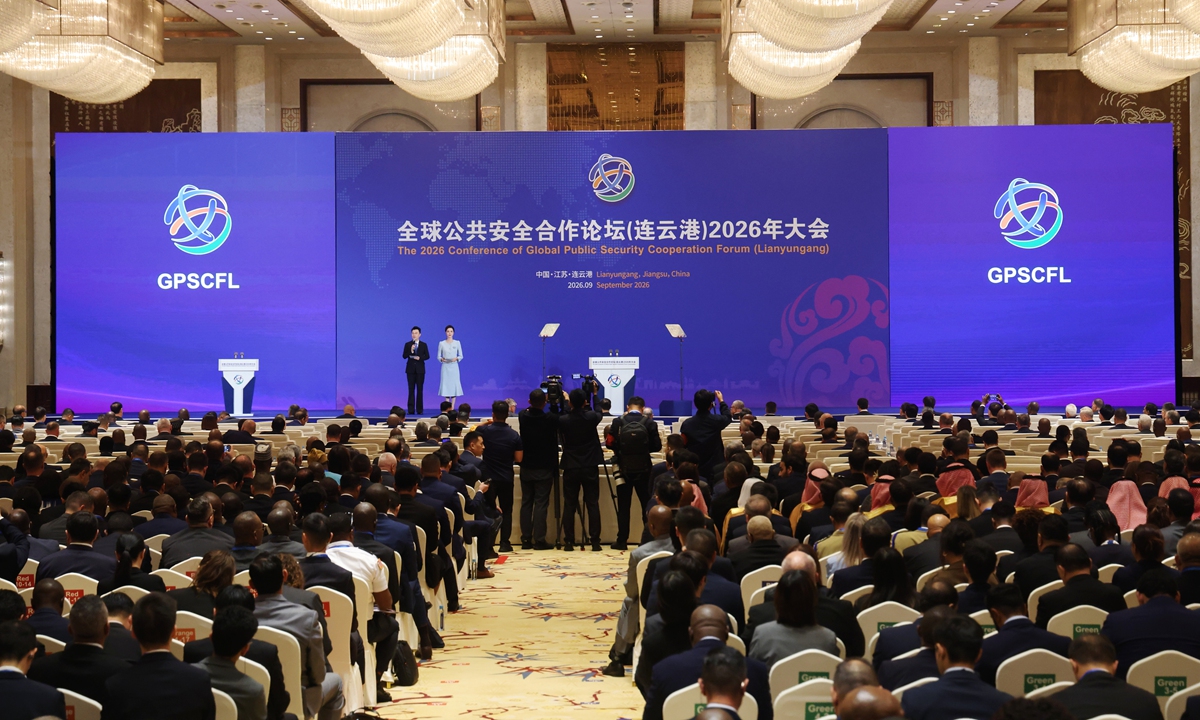
The opening ceremony of the 2026 Global Public Security Cooperation Forum in Lianyungang, China, on September 9, 2026. Photo: China's Ministry of Public Security
As emerging security threats, from cybercrime and telecom fraud to drug trafficking, increasingly cut across borders, no country can tackle the challenges alone, foreign officials attending the 2026 Conference of the Global Public Security Cooperation Forum in Lianyungang, East China's Jiangsu Province, told the Global Times on Wednesday, calling for stronger international cooperation while highlighting China's role in strengthening global public security cooperation, as well as providing advanced policing technology and resources to other countries to improve their policing practices.
The fifth edition of the forum revolves around the theme "Unite to advance public security governance, bring stability to a turbulent world." The event opened on Wednesday, followed by a main forum and a series of subforums focusing on cooperation in migration management, international counter-narcotics cooperation, international counterterrorism cooperation, cybersecurity, public security technology and equipment, international police education cooperation, tourism security, and international security services. Participants also visited the third Public Security Technology and Equipment Expo.
More than 2,100 participants from 139 countries, regions, and international organizations have been invited to attend the forum. The event is hosted by the China Association for Friendship.
A sub forum on anti-drug cooperation was held on Wednesday. More than 200 representatives from anti-drug, police and customs authorities, as well as experts and representatives from international organizations, attended the event, coming from 44 countries and regions.
The forum focused on emerging threats, trends and challenges related to synthetic drugs, as well as possible solutions. Participants noted that the growing spread of synthetic drugs has become a serious global public health and security challenge.
Participants called for stronger international cooperation to tackle synthetic drugs, stressing that no country can address the problem alone. They advocated comprehensive, balanced, science-based and evidence-based drug policies, with greater cooperation in prevention and education, law enforcement, drug control, rehabilitation and information sharing.
"Today, no single country can confront public security challenges alone," Mohamed Higazy, advisor to the minister of local development for international cooperation and former assistant foreign minister of Egypt, told the Global Times, pointing to cybersecurity, terrorism, and drug trafficking as threats that increasingly transcend national borders and require countries to work together.
He said the Lianyungang forum has established itself as "one of the most important forums" addressing public security challenges globally and has become an international platform advocating greater cooperation.
"As we face more transboundary security threats, international cooperation has become a necessity," he said, adding that the forum provides countries with a platform to jointly pursue peace, stability, and cooperation.
"The forum is increasingly important as a global platform, bringing together a growing number of countries and high-level representatives. It provides a unique opportunity to discuss emerging global security threats and explore possible solutions," Felipe Tavares Seixas, Director of International Cooperation of the Brazilian Federal Police, told the Global Times.
"This event on global security and cooperation allows us to exchange information, experiences, knowledge, and best practices, helping our countries strengthen public security and citizen security," Francisco Diaz, Co-director General of the Nicaraguan National Police, told the Global Times.
Apart from bringing countries together to discuss emerging global security challenges, participants also highlighted how cooperation with China has helped strengthen their law-enforcement capabilities through training, technology, and experience sharing.
After visiting the third Public Security Technology and Equipment Expo, where he saw advanced robots and AI technologies designed to support modern policing, Seixas said he was impressed by what was on display.
"The robots are really impressive, as are AI technologies, drones, and anti-scam technologies. There are a lot of interesting technologies that can be applied by law-enforcement agencies," Seixas said.
He also highlighted expanding law-enforcement training cooperation between Brazil and China. "We have signed agreements with China to exchange police training programs. Some Brazilian officers are currently receiving specialized training in China, and we are developing more training exchanges between the two countries."
"China has supported us, and continues to support us, in training officers of the Nicaraguan National Police in crime prevention, criminal investigation, and combating organized crime, particularly money laundering and international drug trafficking," said Diaz.
He spoke highly of Chinese police instructors working in Nicaragua, saying they are "highly professional" and have helped improve the country's police training and law-enforcement capabilities.
"Through China's Ministry of Public Security, we have received support not only in training, but also in logistics and improving police equipment," he said, adding that Nicaragua aims to build a police force with more advanced technology and resources to better combat both ordinary and organized crime.
Since the forum was first held in 2022, more than 30 subforums, seminars, and roundtable meetings have been organized, drawing nearly 8,000 participants, including government and international organization representatives as well as prominent experts and scholars.
RELATED ARTICLES