ARTS / CULTURE & LEISURE
New regulations reshaping how people interact with AI companions
Setting boundaries
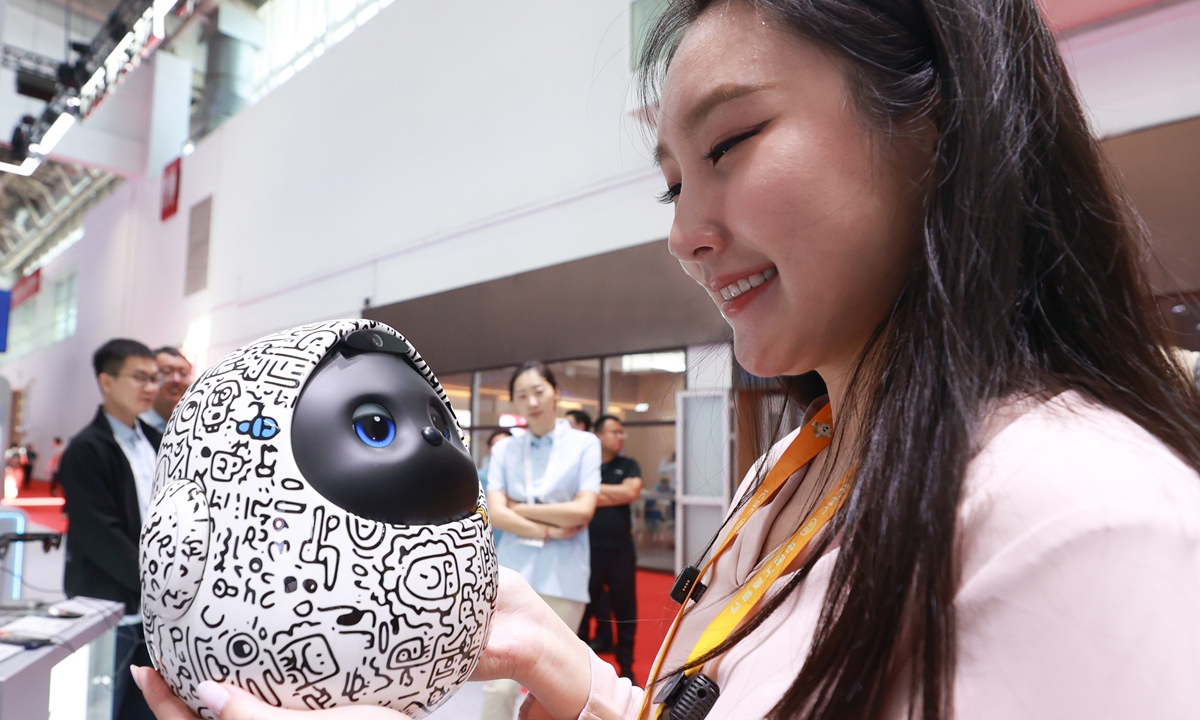
A visitor checks on the AI-powered companion robot Photo: VCG
Most days, 20-year-old college student Lin Jing has someone waiting for her.
Before China introduced its new rules governing AI companions, the sophomore at a university in Wuhan, Central China's Hubei Province, chatted almost every day with an AI agent on an AI companion app.
Lin told the Global Times that she had developed an emotional attachment to the AI. At the time, she was spending several hundred yuan (100 yuan equals $14.90) on monthly subscriptions to unlock more advanced interactions.
"In real life, it seems difficult to find a lover who is this compatible with me in terms of thinking," she said.
As AI companionship has grown more sophisticated and widespread, China has rolled out a set of regulations aimed at curbing emotional dependency on AI-powered companion bots.
The rules, jointly issued by five government departments including the national cyberspace administration, took effect in July 2026.
They introduced new safeguards for the rapidly developing industry, including measures to prevent content that could harm the physical or mental well-being of minors and to curb excessive emotional dependence on AI.
China's move comes as governments elsewhere are also tightening protections for young people online.
In December 2025, Australia began requiring age-restricted social media platforms to prevent under-16s from creating or keeping accounts, while the UK has announced a ban on social media for under-16s and an 18+ minimum age for AI chatbots offering sexualized or romantic-companion content.
More than a month after the regulations in China took effect, AI companion users are beginning to experience how the new rules are shaping their interactions with the technology.
Drawing a line
Lin has long been a fan of Chinese romance games, in which players interact with fictional characters and build imagined relationships with them. She used to complete tasks and spend money to unlock interactions with characters she liked.
In 2025, she discovered AI companion services, which she described as an upgraded version of the romance games she loved. There were no tasks or storylines to follow. She could simply talk, while the AI responded in increasingly personalized ways.
Since the regulations took effect, pop-up reminders have appeared while Lin uses the app, showing her how long she has been chatting each day.
"They remind me how much time I've spent talking to the AI, so I don't lose track of time," she said.
China's major AI content-generation platforms, including Doubao, Qwen and Yuanbao, have recently announced the suspension of their AI agent features.
The features used to allow users to create characters, shape their personalities and interact with them as virtual lovers or companions. Now, only basic conversation functions, including emotional support and companionship, remain available.
For another young user interviewed by the Global Times, AI companionship means something much simpler.
A 16-year-old high school student from Central China's Henan Province told the Global Times that he sometimes used AI companion services on Doubao to chat, kill time or find an outlet when he had problems he did not know whom to talk to about. He did not pay for the service.
After Doubao suspended its AI agent features following the implementation of the new rules, he stopped using the service.
Under the new rules, providers of anthropomorphic interactive services are prohibited from offering minors virtual intimate relationships, such as virtual family members or virtual romantic partners.
For minors under 14, providers must obtain consent from a parent or other guardian before offering other forms of anthropomorphic interactive services.
According to a report by the Beijing News, some AI companion apps have introduced stricter real-name verification, while others allow users to choose between adult and minor modes. Yet some minors have found ways to circumvent these safeguards.
Zhou Qi, a ninth-grade student, said that she could still set different personalities and styles for AI agents.
In adult mode, the content pushed by the platform was mostly romance-oriented storylines, while switching to minor mode brought more friendship-focused interactions.
"Adult mode doesn't have a time limit. When I chat with an agent I like, I can easily send more than 1,000 messages in one session," Zhou Qi said.

Photo: VCG
Complement, not replacement
The appeal of AI companionship may be rooted in something very human: the desire to be heard.
Wang Peng, an associate research fellow at the Beijing Academy of Social Sciences, told the Global Times that the rise of AI companionship reflects some unmet emotional needs created by social changes, including increasingly fragmented social connections.
AI also offers something conventional relationships cannot easily provide: immediate, personalized responses without the conflicts and responsibilities of human interaction.
While children and older adults may not use AI the most, they are more prone to developing emotional attachments to it because AI is always available, endlessly patient and unfailingly compliant, said Wang Zhechen, an associate researcher at the Department of Psychology, School of Social Development and Public Policy at Fudan University in Shanghai.
Experts warn that prolonged immersion in the conflict-free communication zone created by AI could weaken people's ability to navigate real-world relationships, potentially leading to a broader decline in social connection.
As the technology becomes more deeply woven into everyday life, Wang Peng said platforms will need to shoulder greater responsibility, including strictly implementing the new requirements and strengthening safeguards for vulnerable users.
The industry should also move beyond maximizing user time and engagement and toward helping people build and maintain real-world connections, Wang Peng said.
AI, he said, should serve not as a replacement for human relationships, but as a complementary node in a broader network of human emotional support.
RELATED ARTICLES