CIFIT serves as a platform for learning and connecting with China and the wider world for Serbian businesses: chamber head
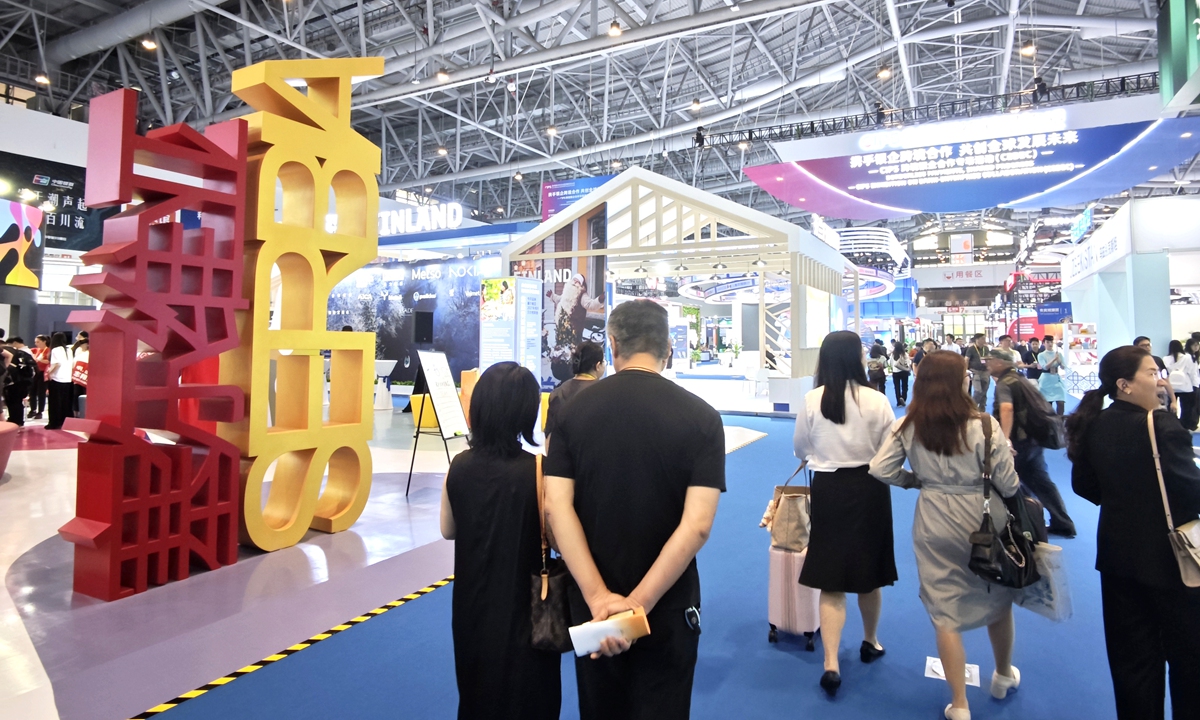
A glimpse of the Serbian pavilion at the 26th CIFIT in Xiamen, East China's Fujian Province, on September 9, 2026 Photo: Yin Yeping/GT
China International Fair for Investment and Trade (CIFIT) is more than an exhibition, which acts as a platform for learning and connecting with China and the wider world for Serbian businesses, Jelena Grubor Stefanovic, director of the representative office of the Serbian Chamber of Commerce and Industry in China, told the Global Times at the ongoing CIFIT, the annual investment fair for China, held in Xiamen, East China's Fujian Province.
The remarks were made as Serbian Deputy Prime Minister Adrijana Mesarovic was visiting Xiamen with a delegation to participate in the CIFIT, a platform where Serbian businesses have been participating for seven years since 2019, the Global Times learned.
Speaking with the Global Times, Stefanovic said that, over the years, for Serbian businesses, CIFIT has become one of the most important platforms in China for promoting investment, and keeping Serbia visible on the global investment map.
There are already concrete results from this year's CIFIT. During the event, the Serbian government and Xiamen Airlines signed a strategic cooperation memorandum aimed at expanding cooperation in aviation, agriculture and tourism, according to Jelena. Serbian food products are also being introduced into the local retail market via CIFIT.
At the same time, Serbia Investment Conference, which was also held at this year's CIFIT, brought together Chinese companies to discuss a new generation of potential investments.
In the first half of this year, China-Serbia bilateral trade reached $4.37 billion, up 45.5 percent year-on-year, according to data from the General Administration of Customs, with both imports and exports recording double-digit growth.
The China-Serbia Free Trade Agreement, which took effect in 2024, has become an important driver of economic ties.
"China is one of Serbia's most important investment partners, but we now see the relationship entering a new phase," said Jelena. She said the greatest potential lies in a wide range of sectors, including advanced manufacturing, green energy and clean technologies, the automotive and e-mobility sectors, digital infrastructure, artificial intelligence (AI) and robotics, biotechnology, food processing and logistics.
At a time of rising protectionism, trade restrictions and fragmentation of the global economy, platforms that keep investment, trade and business cooperation open are becoming critical. Jelena said that we need stability, as well as leadership guided by a vision of a future that creates opportunities for all.
"CIFIT sends a particularly relevant message because it focuses on two-way investment. It creates opportunities for international companies in China, for Chinese companies seeking to expand internationally, and for partnerships between markets around the world," Jelena said.
Jelena said that this matters greatly for Serbia as "we are a relatively small, open and export-oriented economy, and our development depends on remaining connected to international markets, capital, technology and global value chains."
In a recent conference, titled "Serbia and China - Leap into the Future," held in Belgrade, Chinese Ambassador to Serbia Li Ming said that China has become one of Serbia's main sources of direct investment, with projects spanning mining, manufacturing, energy and transport infrastructure under the Belt and Road Initiative. Chinese enterprises had created more than 40,000 jobs in Serbia and now contribute over 20 percent of the country's economic growth, according to Li.
Serbian and Chinese officials pledged at the conference to expand cooperation in AI, green technology and innovation.
Jelena said that both China and Serbia have an opportunity to take that relationship further - "from the infrastructure and manufacturing investments that characterised much of the earlier cooperation toward technology, innovation, green development and more sophisticated industrial partnerships."
RELATED ARTICLES