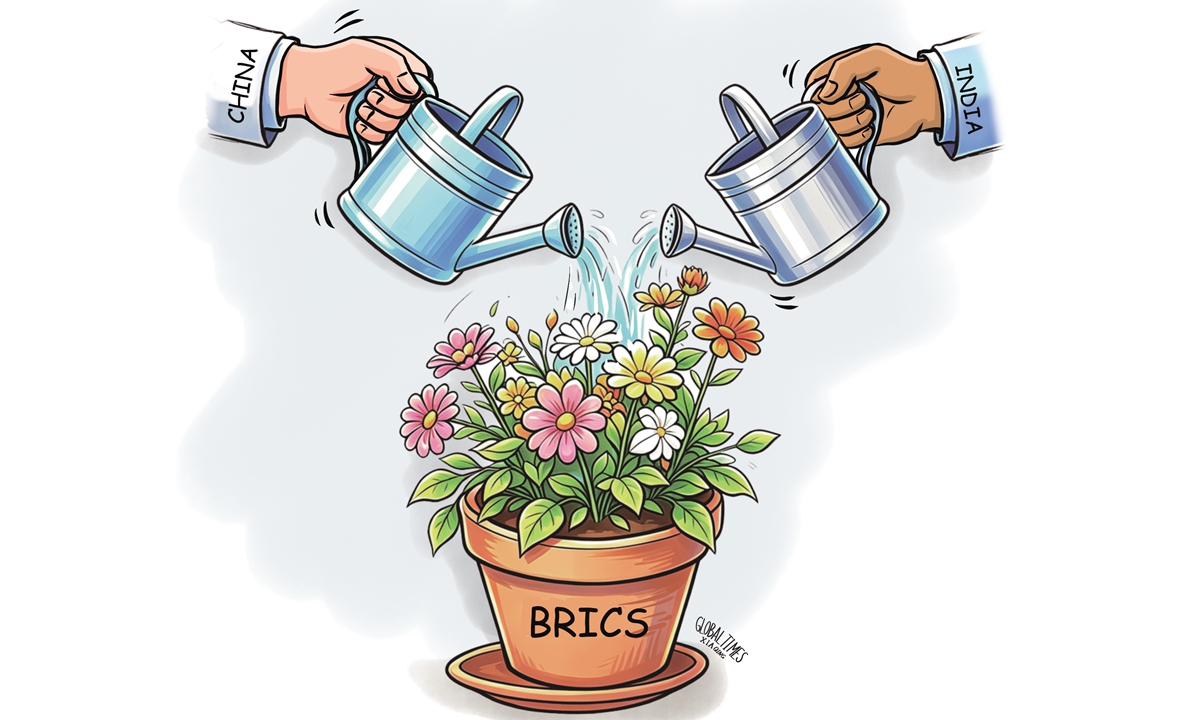
BRICS Illustration: Xia Qing/GT
Editor's Note:
At the invitation of Prime Minister of the Republic of India Narendra Modi, President Xi Jinping will attend the 18th BRICS Summit in New Delhi from September 12 to 13, Chinese Foreign Ministry spokesperson announced on Thursday. In this context, Global Times (GT) reporter Zhang Ao talked to B. R. Deepak (Deepak), professor at the Center of Chinese Studies, Jawaharlal Nehru University, to unpack the strategic weight of the BRICS framework for China-India cooperation and the wider Global South agenda. Professor Deepak calls on the two countries to treat their successive 2026-2027 BRICS presidencies as an integrated two-year strategic window and map out tangible public goods they can jointly deliver for the developing world.
GT: The theme of this year's BRICS Summit is "Building for Resilience, Innovation, Cooperation and Sustainability," covering development financing, food‑energy security and digital public infrastructure. What practical public goods can China and India advance via the BRICS platform to benefit developing countries at large?
Deepak: China and India can use BRICS to provide a set of practical public goods for the Global South. Its objective should be to diversify sources of global economic governance and make development finance, technology, digital infrastructure and economic connectivity more accessible to the Global South.
The first major public good could be a BRICS digital and payments infrastructure, combining India's experience with digital public infrastructure and China's strengths in digital payments, fintech and technological infrastructure. A BRICS framework could establish interoperable instant-payment systems, cheaper cross-border remittances and greater use of local currencies.
A second pillar should be development finance. The New Development Bank (NDB) already has $42.9 billion approved across 139 projects, covering transport, clean energy, water and sanitation, and social and digital infrastructure. It can be scaled into a BRICS development facility for infrastructure and industrialization across partner countries.
The third set of public goods should address food, energy and climate resilience. China and India could jointly promote a BRICS platform for agricultural technology, drought-resistant crops, affordable irrigation, digital agriculture and food-storage systems, while pooling expertise in solar power, batteries, grids, green hydrogen and energy efficiency. The NDB serves as a ready institutional vehicle.
Finally, BRICS should create a technology commons for the Global South, leveraging India's low-cost digital services and China's manufacturing scale and supply-chain capabilities. Partner countries should be brought into these programs as users, producers and participants in value chains.
GT: With the continuing expansion of the "BRICS+" network, how can China and India, two major pillars of the Global South, forge Global South consensus and amplify the collective voice of developing nations in global governance?
Deepak: China and India should be bridge-builders and partnership-builders. Their credibility depends on translating their economic and political weight into common positions that smaller developing countries can own. The two countries have already agreed to support each other's BRICS presidencies and to strengthen coordination on Global South issues.
The first task should be to forge consensus through consultation within "BRICS+." They should identify overlapping interests, such as a greater voice for developing countries within the IMF, World Bank and UN system; reform of the WTO and preservation of special and differential treatment; development finance and infrastructure; affordable digital and AI technologies; food and energy security.
India's strengths lie in digital public infrastructure, pharmaceuticals, services and development partnerships; China brings large-scale manufacturing, infrastructure expertise, development finance and robust supply-chain capacities.
Ultimately, they should make "BRICS+" a consensus-building mechanism rather than a geopolitical bloc, advancing a positive vision for a more representative, multipolar, development-focused governance.
GT: From a BRICS perspective, what constitutes the core essence of Global South cooperation?
Deepak: BRICS is a platform that brings together countries with diverse political systems, strategic interests and relationships with the West. Its institutional discourse emphasizes sovereign equality, mutual respect, openness, inclusiveness, consensus and cooperation, while calling for reform of the UN, IMF, World Bank and WTO.
This is not geopolitical opposition; its practical meaning is mutual development.
GT: You have noted that the 2026 BRICS Summit gives China and India a wider diplomatic theater in which to translate the current thaw into broader strategic cooperation. What real‑world underpinnings inform this assessment?
Deepak: The unique value of BRICS for China-India relations is that it provides a multilateral buffer and practical cooperation platform at a time when bilateral ties are improving but remain constrained by strategic mistrust. China and India should therefore treat their successive BRICS presidencies in 2026 and 2027 as a single two-year strategic window, prioritizing a common agenda of practical cooperation.
BRICS can provide a relatively insulated environment in which the two countries maintain high-level strategic communication and prevent bilateral disagreements from paralyzing cooperation across wider multilateral institutions.
China and India should jointly promote flagship initiatives - especially a BRICS interoperable payments and settlement platform, a development and industrialization program through the NDB, a technology partnership in areas such as AI, semiconductors, health and agricultural technology, and an institutionalized people-to-people mechanism covering academia, culture, media and the publishing industry. Greater air connectivity and visa facilitation should form part of this effort.
GT: What is your outlook for China-India bilateral relations?
Deepak: My outlook is cautiously optimistic. The realistic trajectory is a managed stabilization followed by selective normalization. Both governments have strong incentives to maintain political stability and restore economic and people-to-people exchanges. The latest Special Representatives' talks in August produced eight points of consensus, including additional military communication channels, renewed border-trade cooperation and an agreement to continue dialogue on trans-border rivers.
The next phase hinges on whether stabilization becomes institutionalized. Direct flights and the Kailash Manasarovar Yatra have resumed; diplomatic and economic mechanisms are being rebuilt.
I anticipate a three-track relationship: competition where interests diverge, cooperation where interests converge and dialogue to prevent competition from becoming confrontation. India needs access to Chinese manufacturing capacity, components and technology even as it seeks to diversify supply chains; China, meanwhile, has an interest in a stable Indian market and in preventing China-India relations from becoming part of a broader bloc confrontation. Their leaders have already articulated the principle that the two countries are "cooperation partners, not rivals." If they can consolidate border peace, expand trade and investment, ease visas and travel, the relationship could enter sustained pragmatic normalization.
RELATED ARTICLES