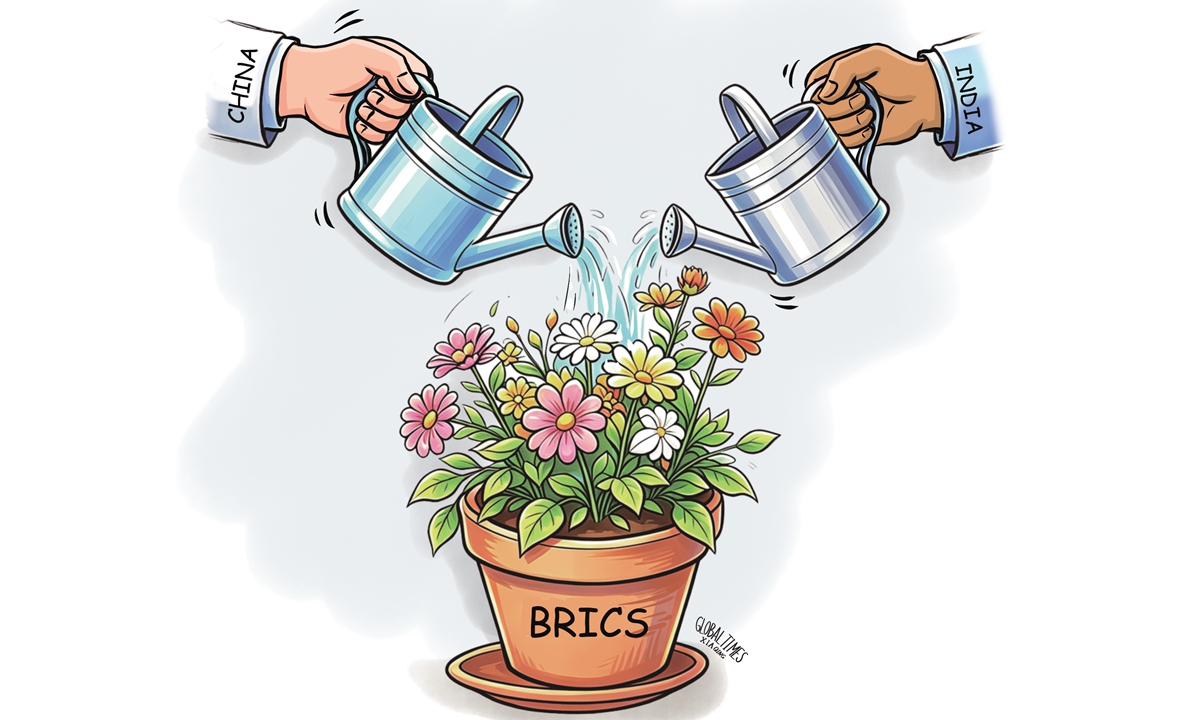
BRICS Illustration: Xia Qing/GT
India's merchandise exports rose by about 15 percent in April-August this fiscal year despite global uncertainties, the country's Commerce and Industry Minister Piyush Goyal said on Wednesday, noting that huge potential exists between India and other BRICS nations to increase trade in goods and services, according to the Press Trust of India.
With the 18th BRICS Summit set to open on Saturday, the timing of these remarks reflects India's expectations of tangible economic and trade outcomes from the event.
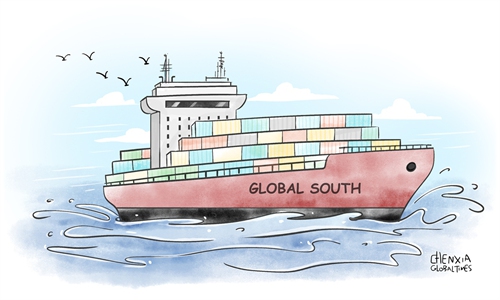
According to an UNCTAD report, intra-BRICS merchandise trade has expanded more than 13-fold since 2003, reaching $1.17 trillion in 2024. At this scale, whether BRICS trade can take another step forward at the New Delhi summit is not only a question for member states, but also one of whether countries of the Global South can forge a new path of win-win cooperation in an increasingly fragmented international economic order.
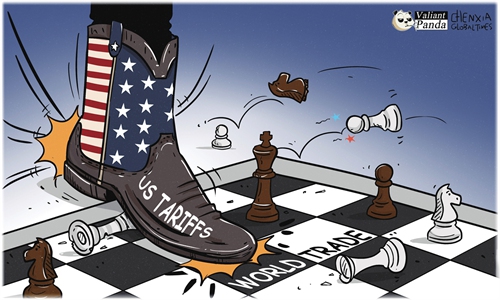
The rise of Western trade protectionism lends urgent impetus to deepening BRICS trade. For developing countries, narrowing access to traditional export markets is making it increasingly difficult to accumulate the funds needed for technological upgrading and industrial transformation. BRICS has grown increasingly important precisely because the world is fragmenting, opening space for cooperation mechanisms outside the traditional Western framework. Against this backdrop, expanding intra-BRICS trade is not merely a matter of deepening economic cooperation, but a strategic choice by the Global South to hedge against external risks.
Given the economic size, population, and development needs of BRICS countries, the potential of intra-BRICS trade remains far from fully realized. BRICS countries differ markedly in resource endowments, industrial structures, and stages of development. While their complementarities are strong, mutual trade still accounts for a relatively low share of their respective foreign trade. The growth of traditional goods trade alone cannot lift the ceiling; the breakthrough for trade to "take another step forward" must be sought in new tracks such as services trade, the digital economy, and green industries.
These sectors also point to the direction of global trade. Take services trade as an example: Global trade in digitally delivered services has exceeded $4.5 trillion, accounting for 54.2 percent of total services trade. As BRICS countries develop, their digital markets have continued to expand and their strengths in the digital economy have become increasingly prominent. China has a strong manufacturing base and well-developed digital infrastructure, while Brazil's cross-border e-commerce is growing rapidly, and India is known for its world-leading information technology and digital services export sector. Together, these complementary strengths can open up broader space for digital economic and trade cooperation among BRICS members.
Moreover, green industry trade among BRICS members also expands fast, and countries have formed distinctive growth points based on differentiated endowments. China's new-energy technologies and production capacity, South Africa's renewable energy demand, and India's vast green infrastructure market and solar sector can fully form efficient supply-demand linkages, making it a new growth pole that supports the low-carbon transition in each country and injects momentum from emerging markets into the global green economy.
Thus, the New Delhi summit may present a crucial opportunity to convert these scattered sources of potential into concrete results. Much of the consensus reached in past BRICS cooperation has been translated from ideas into actions at successive summits. The New Delhi summit can continue along this proven path by further deepening industrial and supply chain collaboration among members and building a more resilient, self-reliant, and secure industrial system.
Meanwhile, deepening BRICS trade cooperation is not a smooth journey. Member states differ greatly in development stages, industrial competitiveness and market openness. However, such diversities precisely highlight the core value of the BRICS mechanism. Rather than eliminating all differences among participants, the BRICS has provided an inclusive platform for developing countries to communicate, coordinate positions and seek common ground while reserving differences.
From the $1-trillion-trade threshold to the New Delhi summit, the next phase of BRICS trade development is not merely about statistical growth. It is also about further upgrading the bloc into a core platform for the Global South to hedge against external risks and share development dividends, enabling more emerging market countries to find a stable anchor in a turbulent global economy.
RELATED ARTICLES