Why is the phone call between Chinese and British leaders significant?: Hai Feng
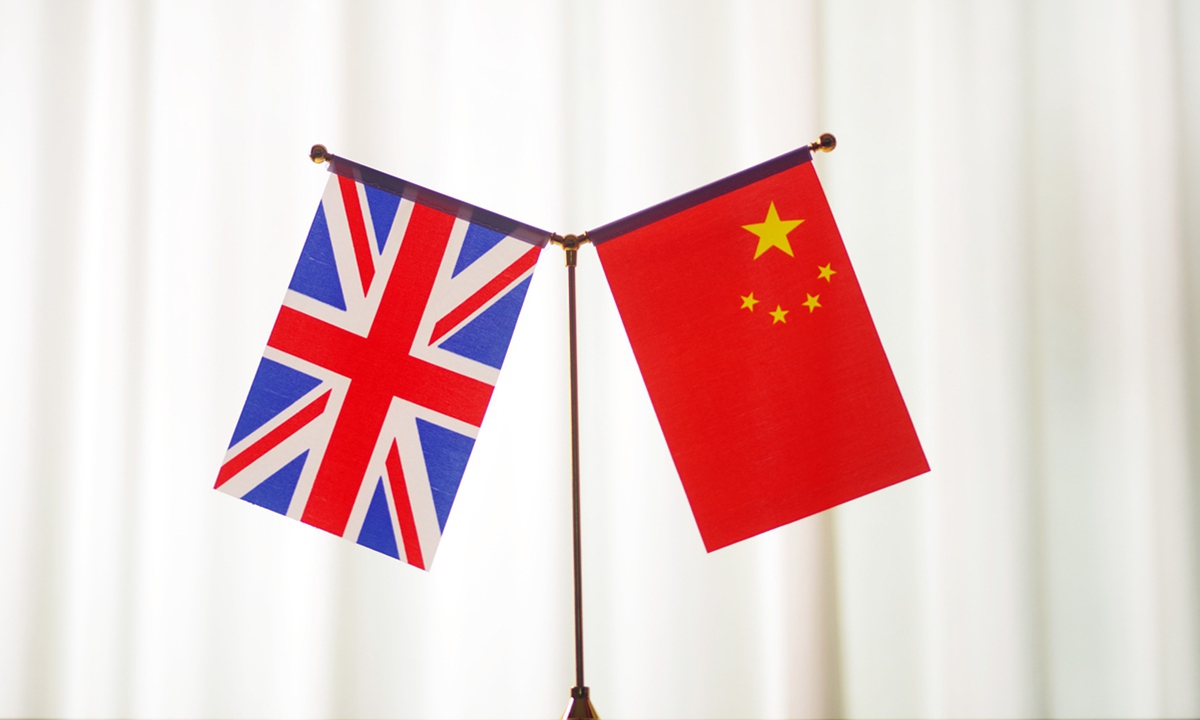
China UK Photo: VCG
Chinese President Xi Jinping on Tuesday held phone talks with British Prime Minister Andy Burnham. Against the backdrop of sluggish global economic recovery, rising trade protectionism and continued spillover effects of geopolitical conflicts, the phone talks between the Chinese and British leaders has drawn extraordinary global attention. Its core message is this: although China and the UK differ in some ways, their common interests far outweigh their differences; faced with a turbulent world, the two countries should opt for dialogue and cooperation instead of being led astray by bloc confrontation and short-term sentiments.
President Xi stressed that China and Britain are comprehensive strategic partners. Despite differences in their social systems and national conditions, the two countries share more common interests than differences. He urged the two sides to respect and trust each other, overcome differences, seek common ground and expand mutually beneficial cooperation. Burnham said Britain is willing to maintain continuity in its policy toward China and remain firmly committed to developing a long-term, stable strategic partnership between Britain and China, and restore bilateral relations to their historic high. This exchange recalibrates the direction for China‑UK relations.
The first major significance of this phone call lies in conveying a positive willingness to advance China-UK relations by seeking common ground while shelving differences.
It is not surprising to see divergences given China and Britain's different social systems, development stages and national conditions. What truly matters is how the two sides handle such differences: Will they magnify disagreements infinitely and allow ideology and geopolitics to hijack bilateral ties? Or uphold mutual respect, seek cooperation amid differences and build mutual trust through cooperation?
The answer is straightforward. China and Britain are both major world economies and permanent members of the UN Security Council. Stable bilateral relations first benefit enterprises and peoples of both nations, and also serve stability in Europe and the wider world. If China‑UK relations are misled by "decoupling and severing industrial and supply chains," over securitization and zero-sum games, it will only erode the development space of both sides.
The second major significance of this phone call lies in defining the practical foundation for current China‑UK cooperation.
President Xi noted that during the 15th Five-Year Plan period (2026-30), China will further expand opening up in such areas as education, healthcare and finance, all of which offer great potential for bilateral cooperation. Precisely these are areas where the UK boasts traditional strengths and where the two countries enjoy strong complementarity. The UK needs economic growth, investment confidence and broader market access. Especially amid accelerated restructuring of global industrial and supply chains, the UK cannot overlook China's market, manufacturing capacity and innovation vitality if it wants to strengthen its economic resilience. For China, deepening pragmatic cooperation with Britain also helps expand avenues for opening-up and cooperation, attract high-quality resources and deliver win-win outcomes.
That explains why President Xi expressed the hope that the British side will fully protect the legitimate rights and interests of Chinese investors. This has clear practical relevance. Investment demands stable expectations, and enterprises require a level playing field. Any move to politicize or securitize economic and trade issues may appear to erect safeguards on the surface, yet it undermines the country's market credibility and development capacity in reality.
The third major significance of this phone call is the signal of continuity in Britain's China policy.
In recent years, Britain's China policy has fluctuated under the influence of domestic politics, external pressure and public opinion. Yet facts show that building China policy on short-term political calculations can neither resolve Britain's own economic woes nor boost its international clout.
Burnham recalled his friendly exchanges with China during his tenure as mayor of Manchester. He also mentioned the positive impact of President Xi's visit to Manchester during his state visit to Britain in 2015. These details illustrate that the vitality of China‑UK relations is rooted in subnational collaboration, economic and trade exchanges, educational ties and people-to-people contacts.
For the UK, what truly serves its national interest is not blind alignment with other countries' strategies, nor using China as a talking point in electoral politics. Instead, it should uphold strategic autonomy and develop its China ties in a pragmatic and rational manner.
The fourth major significance of this phone call is the two sides reaffirmed their shared responsibility to uphold multilateralism.
The world today is confronted not only with bilateral frictions, but also a host of common challenges including regional conflicts, climate change, development imbalance and deficits in global governance. As permanent members of the UN Security Council, China and Britain should strengthen coordination within frameworks such as the UN, the G20 and the WTO, promote settlement of hotspot issues through dialogue, and jointly safeguard open trade and international cooperation.
Of particular note, Burnham said that Britain's position on the Taiwan question remains unchanged. The Taiwan question bears on China's core interests and constitutes an important part of the political foundation of China‑UK relations. Respect for the one-China principle is by no means a bargaining chip. It is the prerequisite for the steady growth of China‑UK relations.
Win-win cooperation has always been a key norm guiding China's foreign engagements. Differences between China and the UK are natural, but both sides can fully achieve a two-way effort to keep those differences in check and to expand and solidify cooperation. This phone conversation should serve as a fresh starting point for the two sides to resume communication, enhance mutual trust and expand cooperation.
The world today does not need more bloc collisions. The more turbulent the world becomes, the greater the need for major powers to engage in rational communication and pragmatic cooperation, injecting greater certainty into global stability. It is to be hoped that China and Britain can blaze a viable path of peaceful coexistence and pragmatic collaboration between major powers, offering important inspiration for the world.
RELATED ARTICLES