Behind the Philippine defense minister’s denial of ‘theatrics’: an ongoing political performance
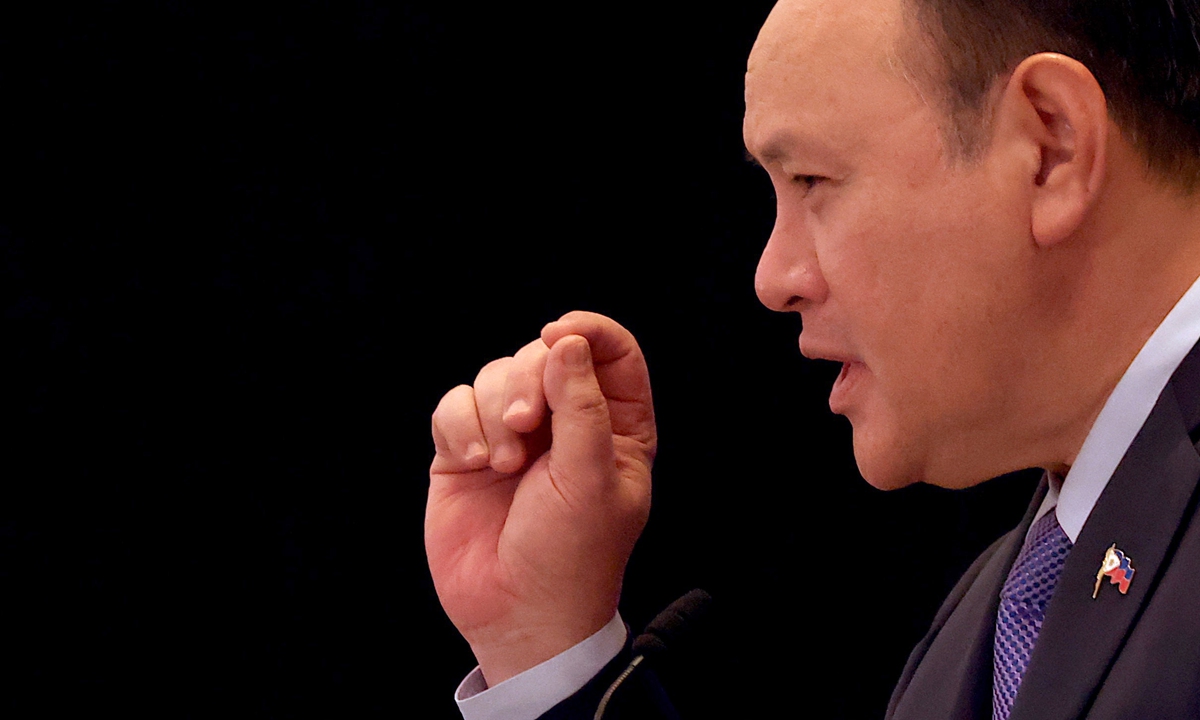
Secretary of Defense of the Philippines, Gilberto Teodoro Jr., speaks during the 37th International Military Law and Operations Conference in Kuala Lumpur, Malaysia, on August 3, 2026. Photo: VCG
"I'm not an actor, so I don't know theatrics" Philippine Defense Secretary Gilberto Teodoro Jr. said, in what may already be one of the most theatrical lines ever delivered by a man insisting he does not perform. The irony is almost complete: the harder one tries to look un-staged, the more one appears to be holding an invisible script. In Teodoro's case, the stage never seems to close.
The latest scene played out on Friday, when Teodoro told ABS-CBN that the Philippines must "push back" against China and further strengthen its defense capabilities and security partnerships.
This was not an isolated remark. Only days earlier, at the Seoul Defense Dialogue, after reportedly receiving a note outlining China's position on the South China Sea, Teodoro reacted explosively on the spot. He interpreted an ordinary written communication as "coercion, bullying, and aggression" from China and launched into personal attacks against the unknown messenger. China has already responded, urging "the certain individual of the Philippine side to cut the provocations and theatrics, and stop undermining China-Philippines relations and stability in the South China Sea."
A written note — whose author remains unknown for the moment — is nonetheless a long-established form of communication, widely used in international conferences for over a century as part of standard procedural practice. At international conferences, where shouting and disruption are not permitted, written notes are routinely passed by staff to convey messages. Teodoro, however, seems to follow a different "style": public outbursts, personal insults.
Teodoro criticizes China's "diplomatic approach," but what kind of diplomatic style does his behavior actually represent for Manila? Teodoro's rhetoric has become indistinguishable from online trolling — repeated, unrestrained attacks on China. This naturally raises a question for the Philippines: is this really the diplomatic style by which it wants to define itself?
"Teodoro has built his political visibility largely on anti-China rhetoric, using attacks and disinformation against China as a way to gain exposure and political traction," Ding Duo, director of the Research Center for International and Regional Issues at the National Institute for South China Sea Studies, told the Global Times on Wednesday. Ding also noted that the Philippine military and security establishment bears a strong American imprint.
Teodoro's increasingly attention-seeking remarks have gone beyond the normal scope of a Philippine defense minister's responsibilities and mandate; they are largely driven by political calculations, Ding added.
What Teodoro asserts most "forcefully" — that "it is China who exercises the bad behavior" — is in fact the exact opposite of what the facts on the ground show.
Since 1999, Manila has deliberately grounded a rusting warship at Ren'ai Jiao, repeatedly pledging to remove it but never fulfilling that commitment, effectively turning it into a floating outpost to support a claim that lacks a solid legal foundation. In recent years, Philippine vessels have repeatedly engaged in provocative actions toward China Coast Guard vessels. The facts are clear. Against this backdrop, the unilateral distortion of facts and the practice of "blaming the other side" have become familiar narrative tools used by the Philippine side. Teodoro's remarks of this kind essentially serve to justify and provide political cover for Manila's actions at sea.
China's response - calling for the Philippine side to "cut the provocations and theatrics" - is a phrase that Manila would do well to read more than once.
However, what, then, is Manila's recurring prescription? More defense cooperation. Not only the defense secretary himself, but also the Marcos administration has made "showing off security partnerships" a characteristic feature - hoping that a major power will backstop Manila's risky actions. However, how many external powers are actually willing to be drawn into a potential conflict for the Philippines? The likely outcome of this repeated display of partnerships is not greater security, but heightened tensions. This is not defense. This is the sacrifice of national and regional security.
In the end, the question is not who needs the "basic decency" that the Philippine defense chief speaks of. It is whether the Philippines itself does. If Manila continues to treat diplomacy as theater, provocation as leverage, and external powers as its "backstage," the first casualty will be the Philippines' own interests.
