New Delhi Summit provides clear guidance for higher-quality greater BRICS co-op; Xi-Modi meeting lifts ties to new phase of confidence-building: experts
By Xie Wenting, Zhang Yiyi and Xian Yifan in New Delhi, and and Li Yu in Beijing Published: Sep 13, 2026 01:06 AM

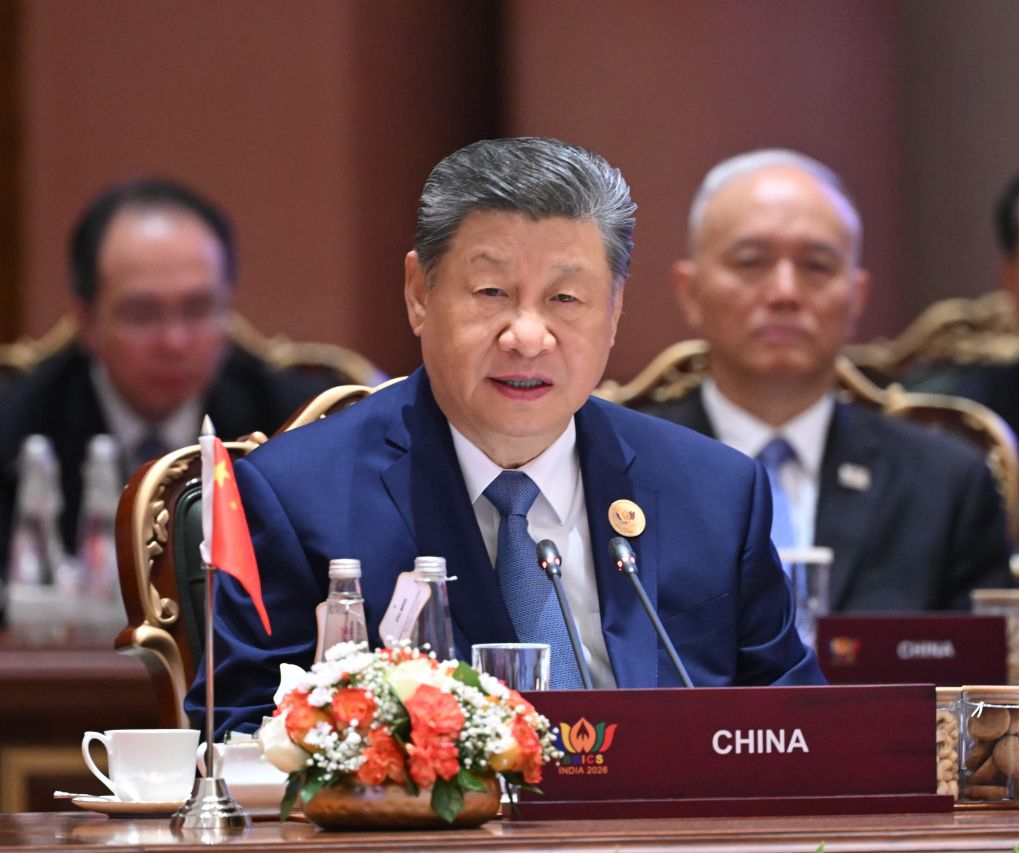
Photo: Xinhua
Chinese President Xi Jinping said on Saturday that the BRICS cooperation mechanism has become the world's most influential platform for cooperation among emerging markets and developing countries, the Xinhua New Agency reported.
When addressing the Session I of the 18th BRICS Summit in New Delhi, Xi noted that this year marks the 20th anniversary of BRICS cooperation, saying that over the past two decades, the BRICS cooperation mechanism has continued to grow and expand, and has demonstrated remarkable vitality and dynamism, according to Xinhua.
Xi also hailed the past 20 years of BRICS cooperation as fruitful, saying that BRICS countries have undergone a historic expansion, established a comprehensive, multi-tiered framework for cooperation, and ushered in a new stage of high-quality development for greater BRICS cooperation.
Xi stressed that the world is undergoing accelerated transformation unseen in a century, the Global South is rapidly growing in strength, and the trend toward a multipolar world is unstoppable.
Meanwhile, countercurrents of unilateralism and power politics are surging, multilateralism and the international order are coming under strain, and deficits in peace, development, security and governance continue to widen, he added.
Analysts said that President Xi’s remarks review two decades of BRICS cooperation, underscoring the unstoppable trend of multipolarity and the rising strength of the Global South, and sending a clear message that BRICS stands for the shared interests of the Global South amid turbulent global order.
Higher-quality co-op
President Xi arrived on Saturday in New Delhi, India, to attend the 18th BRICS Summit at the invitation of Prime Minister of the Republic of India Narendra Modi. Xi was warmly welcomed upon his arrival, according to the Xinhua News Agency.
Held on Saturday and Sunday, the summit coincides with the 20th anniversary of BRICS cooperation, marking a pivotal moment to review past gains and map out high-quality cooperation for the expanded grouping. It is also expected to help elevate BRICS cooperation to a new level in both quality and effectiveness, Qian Feng, director of the Research Department at Tsinghua University's National Strategy Institute, told the Global Times.
At the 18th BRICS Summit, President Xi said that China will assume the BRICS presidency next year and will host the 19th BRICS Summit. In his speech, Xi called on BRICS members to remain sincere and candid with one another, seek common ground while respecting differences, and respect each other's core concerns.
He also urged the group to deepen mutual understanding through communication and dialogue, properly handle differences, and ensure that BRICS cooperation continues to move forward steadily.
The Chinese side stands ready to work with all parties to build consensus, create a better future, and embark on BRICS' third "golden decade," jointly opening up a bright future of prosperity and progress, he added, according to Xinhua.
The summit is expected to provide clear guidance for deeper, higher-quality development and greater BRICS cooperation and the 2027 summit will help BRICS embark on its third “golden decade,” Lan Jianxue, director of the Department of Asia-Pacific Studies at the China Institute of International Studies, told the Global Times on Saturday.
Lan noted that BRICS members should make full use of the opportunity created by India and China hosting consecutive summits to carry forward the consensus, consolidate the gains of greater BRICS cooperation, and improve the mechanisms of the expanded grouping.
China can play a leading role in innovation, global governance, people-to-people exchanges and South-South cooperation by advancing cooperation on AI and new industrialization, strengthening supply-chain resilience, safeguarding the common interests of the Global South, and promoting more practical cooperation projects, said Lan.
When addressing the Session I of the summit, Xi said that BRICS countries should firmly stand on the right side of history, strive to be a pioneer of the times, steer the international order toward greater justice and equity, and work together to build a community with a shared future for humanity.
Xi called on BRICS to pioneer in advancing innovation-driven development. BRICS countries, he said, should firmly seize the initiative, strengthen cooperation in artificial intelligence, encourage open-source development, openness, cooperation and sharing, and push practical cooperation into new areas and to new heights.
Xi also called on BRICS to be a pioneer in upholding peace and stability, to be a pioneer in facilitating mutual learning between civilizations, to be a pioneer in reforming and improving global governance.
Amid rising unilateralism and growing global deficits, BRICS are working to uphold genuine multilateralism, defend the UN-centered international system, safeguard developing countries’ interests, and help build a fairer global order while bringing greater stability to a turbulent world, said Lan.
The BRICS countries on Saturday unanimously adopted the New Delhi Declaration 2026 at the summit in New Delhi. The 45-page declaration, comprising 140 points, was discussed under the theme “Strengthening Cooperation to Promote Fair Competition, including in Renewable Energy Markets,” with the aim of supporting sustainable energy transitions, according to the Times of India.
The declaration focused on condemning terrorism, conflict prevention and peaceful resolution of disputes, stronger multilateralism and concerns over unilateral trade measures, according to the Times of India.
Chinese analysts said that the expanded BRICS promotes partnership over alliance and rejects bloc confrontation and Cold War thinking. As a leading force of the Global South, it can deepen South-South cooperation, advance multipolarity, and bring greater stability and positive momentum to an increasingly turbulent world.
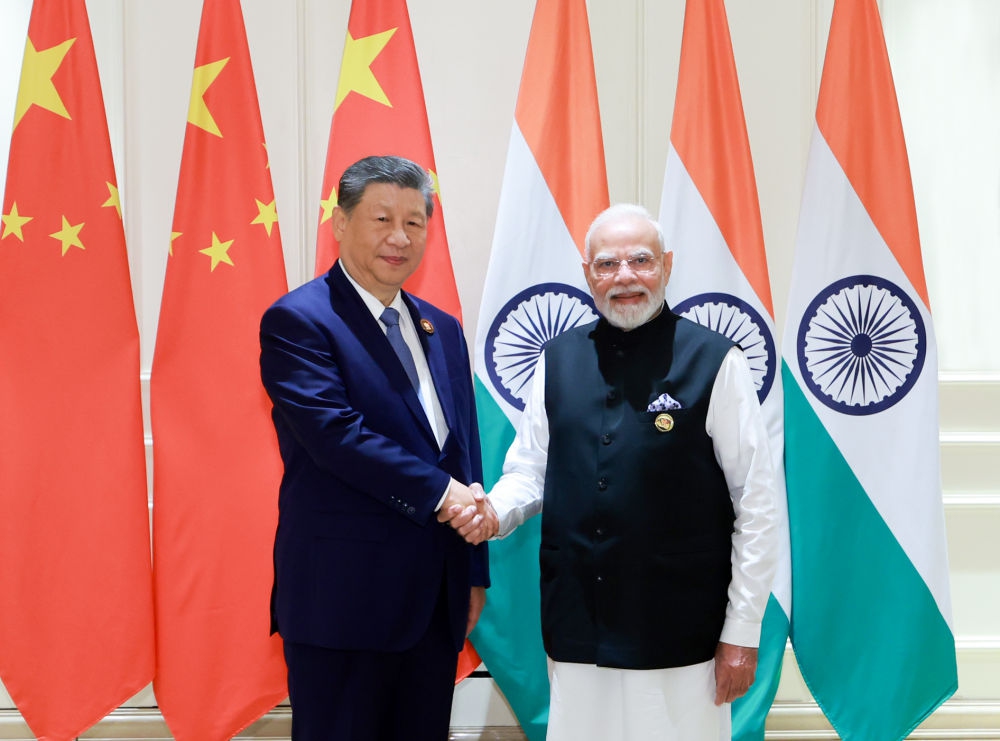
Photo: Xinhua
Stabilizing bilateral relationsPresident Xi met with Indian Prime Minister Narendra Modi on Saturday on the sidelines of the BRICS summit.
This is the third consecutive year that the Chinese and Indian leaders have met, following Kazan meeting in 2024 and Tianjin meeting in 2025, underscoring the steady stabilization of bilateral ties. If Kazan marked a turning point and Tianjin helped put relations back on a stable track, the New Delhi meeting can be seen as a new phase of confidence-building, focused on turning strategic consensus into concrete mechanisms and results, Wang Xu, executive deputy director of the Center for South Asian Studies at Peking University, told the Global Times on Saturday.
Recent progress — including agreements on border management, the resumption of border trade, restored direct flights and growing people-to-people exchanges — provides tangible evidence of that momentum. The key value of leader-level engagement is to keep the broader relationship on course, manage differences and reduce the risk of miscalculation, said Wang.
Zakka Jacob, a journalist with Times Network, told the Global Times that the two countries are now seeing a degree of normalization, including the easing of visa restrictions and lifting of some investment restrictions on Chinese firms, as well as the resumption of direct flights.
The meeting and interactions between the Chinese and Indian leaders have drawn wide attention in India. The Hindustan Times reported on Saturday that Modi and Xi’s “half-minute-long handshake” at the BRICS Summit attracted attention. It noted the handshaking and interactions happened after the conclusion of the closed-door session for BRICS member countries at the 18th BRICS Summit in New Delhi.
Political trust between two major countries is built through concrete actions, said Wang, noting that more efforts could be put on a few areas to restore ties, including strengthening institutional mechanisms for managing the border issue, expanding people-to-people and practical exchanges, avoiding the securitization of trade and investment, and deepening coordination in multilateral and regional affairs.
China and India also have broad room to coordinate through BRICS, the SCO and G20 on global governance reform, climate change and development financing, said Wang.
The broader the cooperation, the less weight differences will carry, helping make bilateral ties more stable and resilient, and also contributing to global stability, said the expert.
Mohammed Saqib, CEO of the Indian think tank Bureau of Research on Industry & Economic Fundamentals and the India China Economic & Cultural Council, told the Global Times that China now is one of India’s largest trading partners, and there are many areas for cooperation. He noted that China has strong hardware capabilities, while India has strong software capabilities and a large pool of young talent, creating significant complementarities in both economic and social development.
