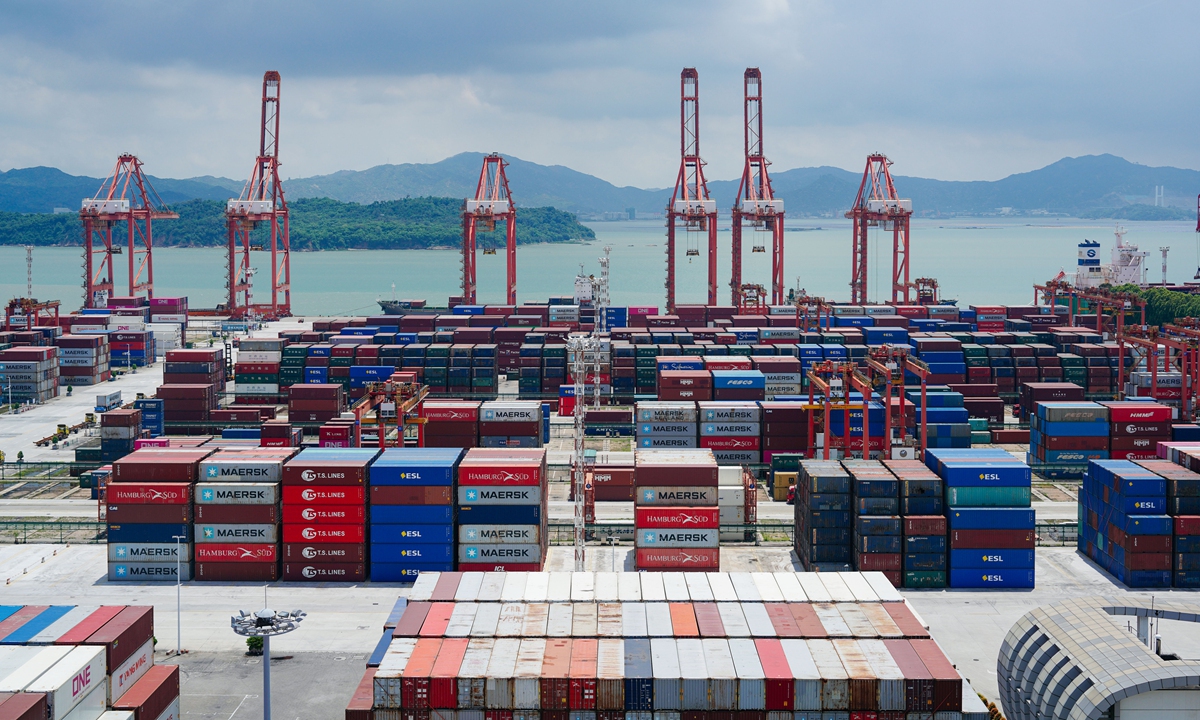
Xiamen port in Xiamen, East China's Fujian Province Photo: VCG
Inflation in the euro area will stay elevated for some time, European Central Bank (ECB) President Christine Lagarde said, Bloomberg reported on Saturday.
Her comments came after the ECB raised interest rates by 25 basis points. Inflation in the euro area is currently above 3 percent, and further monetary policy tightening is broadly expected to return price growth to the ECB's 2 percent target.
The intention behind the ECB's rate hike is clear. The core driver of the euro area's current inflation jump is the dramatic volatility in energy prices triggered by geopolitical conflicts. Persistent uncertainty over energy supplies has continuously pushed up the cost of oil, gas and other energy products, and since energy underpins the entire industrial system, rising energy prices ripple through every segment of production and consumption.
Higher interest rates can restrain demand by making loans to companies and consumers more expensive, but elevated rates cannot repair the supply shock at the root of rising prices.
This is the risk that will likely linger on. The approach amounts to trading economic vitality for cooler prices. Higher financing costs discourage capacity expansion and dampen consumer spending, while rising prices carry the risk of an economic slowdown.
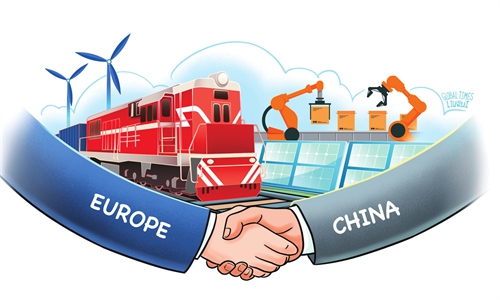
Lagarde also noted that "the current shock is longer-lasting." If that is acknowledged as a long-term reality, then it calls for reliable partners rather than new frictions. China is an important trading partner for Europe, with deeply intertwined supply chains. To both economies, the certainty that cooperation brings far outweighs the perils of confrontation.
Yet, the policy debate in Europe has not fully absorbed this logic. It is striking that some in Europe are still hyping the so-called "China shock," framing the competitiveness of Chinese technology and Chinese goods as a threat to European industry. Such a narrative often reduces Chinese manufacturing to low-cost competition while overlooking that the real value of China's supply chain extends far beyond inexpensive goods. China's stable, efficient supply chain is a critical pillar helping Europe ease cost pressures and keep industries running.
After decades of development, China has built the world's largest and most complete industrial system, with closely integrated upstream and downstream clusters spanning basic materials, component processing and finished manufacturing, capable of rapid response to orders and stable, continuous delivery.
For many European companies, sourcing intermediate goods and high-tech components from China means lower overall costs, shorter delivery cycle and more controllable supply chain risk. At a time when Europe faces high energy costs and a risk of lower growth, this efficiency dividend is not a threat but a scarce resource.
European manufacturers are being squeezed from both sides. Persistently high energy bills inflate operating expenses, while interest rate hikes make corporate funding more expensive.
As European companies grapple with soaring energy costs, intermediate inputs, components and manufactured goods from China actually help downstream European industries absorb energy price pressures and prevent unchecked cost pass-through to European consumers.
A recent report from consultancy EY-Parthenon, citing an ECB analysis, showed that in Europe, severing reliance on trade with China could leave prices 1 percent to 2.5 percent higher in critical sectors, and the ECB and Bank of England will likely permanently keep their rates above their 2-percent inflation target.
Acknowledging the dividend brought by China's supply chain does not mean in any way denying the transformation pressures facing European industries. Industrial competition among economies is a normal part of globalization, and market competition can inspire European industrial structural reform and upgrading.
But industrial competition should not be politicized. Protectionism should not replace industrial innovation. Europe's remedy is not to erect trade walls but instead to ease energy supply risks, better optimize its internal industrial structure, and leverage global supply chains to further reduce its inflationary pressure.
With inflation high and growth weak, Europe's use of rate hikes to bring down inflation is already a costly gamble. Europe has no need to put itself in another set of shackles. What it should do is value the efficiency dividend brought by Chinese supply chains and look for a way out through openness and cooperation, rather than drifting further along the old road of protectionism.
Global Times
RELATED ARTICLES