GT Voice: Deeper co-op with China a pragmatic choice for EU industrial revitalization
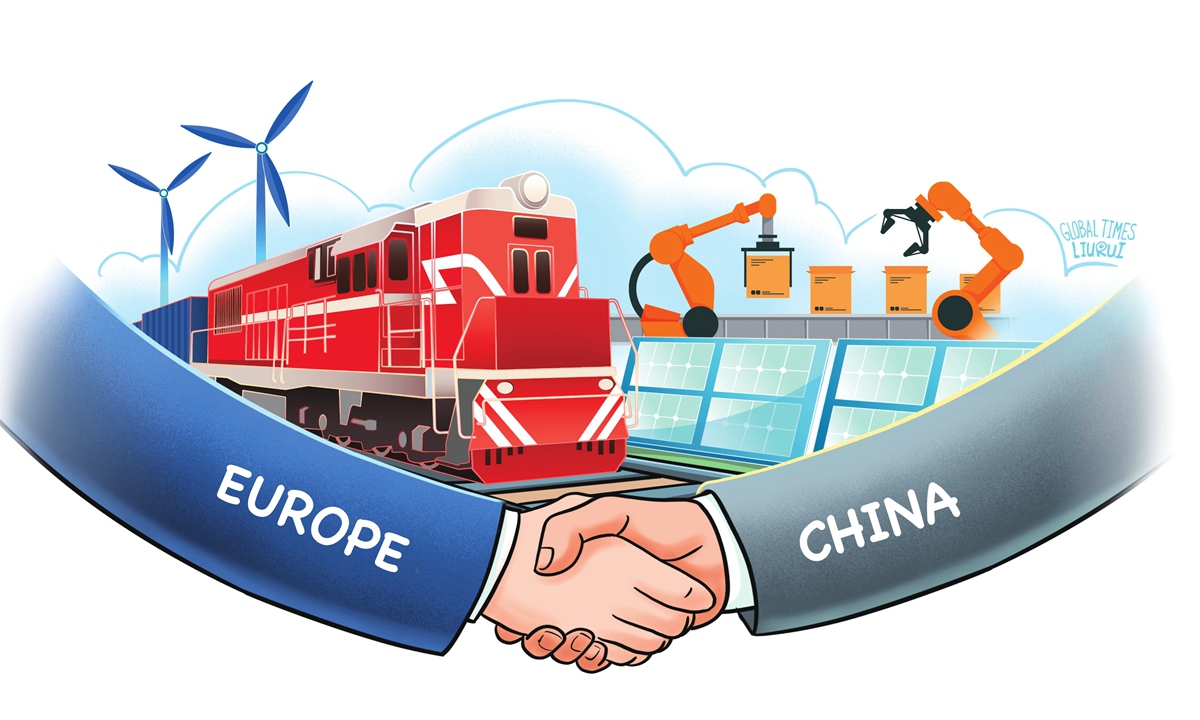
Illustration: Liu Rui/GT
With deindustrialization fears mounting and industrial headwinds persisting, the revival of Europe's manufacturing sector has become a topic of debate across the EU.In an interview with the Financial Times published on Wednesday, Swedish Prime Minister Ulf Kristersson warned that protectionism cannot be a recipe for European success.
While acknowledging that EU companies faced tough competition from China and that the bloc had been slow to respond to companies' concerns, Kristersson said: "We need to be able to compete because of quality and because of innovation, not because we try to protect the European markets … We do not want to protect European businesses that are basically not competitive."
His remarks followed French President Emmanuel Macron's call for a Buy European policy that would require certain key goods to be made within the bloc despite higher costs, and laid bare the differences and doubts within the EU over the protectionist turn.
The European economy is facing multiple pressures: geopolitical volatility, persistently high energy prices, shrinking industrial output, and the relocation of production capacity. Amid these challenges, how to revitalize local industries has become the EU's core concern.
Some political forces have chosen to attribute the problem to external competition and attempted to create a protective market environment by building trade barriers to avoid competitive pressures. But this short-sighted approach fundamentally misunderstands the very foundations of Europe's industrial strength.
European competitiveness has never been built on closure. It is the product of decades of open competition, which has forged technological sophistication, rigorous quality control, and sustained innovation capacity. Every major advance in European manufacturing has been inseparable from deep integration into the global economy. So attempts to secure industry through protectionism would undermine the very foundations that made it strong.
Indeed, protectionism is never a panacea for solving the problem of competitiveness, but may instead become a constraint. In the short term, trade barriers may offer a temporary haven for certain firms. But over the long haul, they erode the incentive to innovate, dull competitive edges, and ultimately relegate Europe to a passive position in global industrial competition.
Data from Eurostat showed that in December, industrial producer prices decreased by 2.1 percent year-on-year in the euro area and by 1.9 percent in the EU. If Europe remains wedded to a protectionist mindset, its remaining advantages will continue to erode, and the path to a manufacturing revival will only become more difficult.
The real solution lies in embracing open cooperation, and in that context, it is necessary to reassess the strategic value of China-EU economic and trade relations. China and Europe are not engaged in a zero-sum rivalry. Their manufacturing sectors are deeply complementary. With a complete industrial system, a vast domestic market, and diverse technology application scenarios, China offers unparalleled scale and innovation.
Europe, for its part, continues to lead in high-end manufacturing, precision instruments, and industrial software. China is not just a destination market for European goods - it is a vital anchor sustaining the global competitiveness of European firms. The fact that European manufacturers are reportedly increasing their investment in Chinese factories is evidence of it.
There is also scope for collaboration on other fronts, such as the green energy transition. China's production advantages in solar and wind power equipment, together with Europe's deep expertise in clean energy technology and systems integration, can accelerate the profound transformation of the global energy structure. In the biomedical field, China's abundant clinical resources and rapidly expanding market align effectively with Europe's research and development capabilities.
In this sense, deepening engagement with China is not a slogan. If Europe is serious about revitalizing its manufacturing sector, it is a pragmatic and urgent strategic choice. It calls for a long-term view of global competition and a willingness to move beyond protectionism. Only by converting complementarity into concrete growth momentum can Europe restore its industrial vitality.
Protectionism cannot power a manufacturing resurgence. What Europe needs now is the resolve to forge new comparative advantages in an open world, and the first step of that journey begins with the courage to deepen cooperation with China.
RELATED ARTICLES