IN-DEPTH / IN-DEPTH
Witnessing in Belgium how media brings people together amid revelry of World Cup live broadcast and beer cheers
Shared moments
Editor's Note:
In an era of profound global shifts and increasingly complex regional dynamics, a proper understanding of the world must be rooted in "grounded experience" and localized insights. Global Times English edition, in collaboration with the Academy of International and Regional Communication Studies, Communication University of China, is proud to launch "Local Insights," an English-language column dedicated to original, field-based observations.
We invite Chinese scholars and professionals who are studying, conducting exchanges, or working outside China, as well as international students and friends living and studying in China who are familiar with the social contexts of their home countries or third countries, to begin from first-hand field experience and engage with social, cultural, and contemporary issues beyond China. In the sixth article of this column, in a Brussels beer bar during the 2026 World Cup, the author finds that football, beer and live TV turn strangers into a temporary community - and that this shared ritual creates an emotional and economic value no algorithm can replace.
Known as the "crossroads of Europe," Brussels has long been a meeting place for different languages, cultures and ways of life. Yet once the whistle blows, many of those differences seem to fade beneath a more basic and spontaneous passion. The distance between French-speaking and Flemish-speaking communities, and between locals and newcomers, temporarily disappears in the light of a television screen.
On the evening of July 10, Belgium played Spain in the quarterfinals of the 2026 FIFA World Cup. Two friends and I squeezed into a small neighborhood bar on Avenue Georges Henri in Brussels. The air carried the fresh smell of hops. Dark wooden walls glowed under warm yellow lights. The space was tight, with only a row and a half of seats apart from the bar. We ordered three draft beers and waited for the match between two of Europe's strongest teams.
Spain scored first in the 30th minute. The bar suddenly fell silent. The collective tension felt almost physical. Then, in the 41st minute, Belgium launched a quick counterattack and Charles de Ketelaere headed in the equalizer. The room exploded. Cheers and screams seemed loud enough to lift the low ceiling.
The experience felt both familiar and exciting. It also made me wonder: In an age when algorithms narrow what we see and digital life makes social relations increasingly fragmented, what makes so many individuals leave their homes, and cram into a small bar, and hold their breath or cheer together for the same moment on the same screen?
Football: An emotional medium beyond language
Belgium is a country deeply attached to football. Football arrived in the Low Countries through British merchants, workers and students in the second half of the 19th century. Since then, it has taken root for more than a century and become part of the shared experience of generations of Belgians.
Belgium is also divided by language. Dutch is mainly spoken in the north and French in the south, and political and cultural tensions between the two communities have lasted for nearly two centuries. Football, however, often crosses that boundary. During the World Cup, an everyday passion for the sport can quickly turn into a nationwide emotional experience.
In Belgium, during the World Cup, the rhythm of society visibly changes whenever the Belgian National Football team, also known as the Red Devils, are playing. Offices let employees leave early. Streets suddenly grow quiet before kickoff, only to fill up again after the final whistle. This shared rhythm across society makes every individual aware that, at the same moment, millions of people are all feeling the same tension and hoping for the same result.
Between 2018 and 2022, the Belgian National Football team remains at the top of the FIFA world rankings for quite a long time. This sustained success has further strengthened the World Cup's role as a nationwide outlet for shared emotion. Football cannot heal Belgium's deeper structural divisions, of course. But for the 90 minutes of a match, a country divided along linguistic lines can experience a rare sense of emotional unity.
Beer: A liquid bond from daily social life to celebration
If football provides the structure of Belgium's World Cup celebrations, beer is what flows through them.
What makes Belgian beer distinctive is that, long before the World Cup arrives, it is already deeply rooted in the country's everyday life and cultural identity.
In 2016, UNESCO added Belgian beer culture to its Representative List of the Intangible Cultural Heritage of Humanity. It noted that Belgian beer culture brings together knowledge of nature, social customs and craftsmanship, and forms an important part of both everyday and festive life. It also plays a role in maintaining social ties and strengthening a sense of community.
Belgium has nearly 1,500 varieties of beer. They range from Trappist beers, whose traditions can be traced back to medieval monasteries, to lambic beers that ferment naturally through exposure to wild yeasts in the open air. Their flavors vary widely, and different beers are associated with different social occasions.
In everyday Belgian life, beer is woven into the fabric of social interaction. In public spaces, it is one of the safest ways for strangers to start a conversation.
On a World Cup night, however, beer changes from a gentle social lubricant into fuel for collective excitement. At the moment a goal is scored, the movement of the beer seems to mirror the emotions of the crowd: Beer flies into the air as emotions erupt around the room.
On an ordinary day, spilling beer on a stranger would call for an apology. At the moment of a goal, however, the flying beer is no longer seen as an offense. It becomes part of a collective celebration. Beer turns into a liquid carrier of emotion. Holding a glass becomes a sign of participation, and raising it becomes a physical way of saying, "I am part of this too."
Live broadcast: Shared presence and emotional resonance
When the World Cup and the beer are in place, one more element is needed to turn them into a complete collective experience: the live television broadcast inside the bar.
French philosopher Henri Lefebvre argued that space is not simply a fixed physical container. It is constantly produced and reshaped through social practice.
On an ordinary day, the beer bars scattered through the streets of Brussels each serve their familiar social purposes. But the moment a World Cup match appears on the television screen, the usual rules begin to change. A live broadcast transforms a bar from "a physical space where individuals consume separately" into a "social space where people experience something together."
In a digital age dominated by on-demand streaming, algorithmic recommendations and short-form video, the ability of live television to make large numbers of people experience the same moment has become both underestimated and increasingly rare.
This is what makes a live World Cup broadcast so valuable. Technically, it resists personalization. Everyone has to watch the same event unfold at the same pace, holding their breath together before an unpredictable next second arrives.
So why do people leave their homes and cram into bars instead of simply watching the match alone?
In Communication as Culture, American communication theorist James Carey led us to think about communication in a ritual sense. From this perspective, communication is not simply about transmitting information. It is also a way of maintaining society over time, and its central idea is sharing.
Seen in this light, people do not watch the same live broadcast only because they want information about what is happening on the pitch. They are also taking part in a shared ritual. By focusing their attention on the same event and going through the same emotional highs and lows, they confirm that they belong to a larger social community.
At home, you can still watch the match, drink beer and shout at the screen. But you cannot high-five a room full of strangers or share their reactions in the same physical space.
That is the irreplaceable value created when live television meets the social space of a bar. A screen becomes a device that gathers people together. Watching a football match becomes participation in an offline collective ritual.
Making 'being together' a sustainable source of value
The combination of football, beer and live television during the World Cup is not only a social and cultural phenomenon, but also an economic one.
During the tournament, a bottle of beer that costs less than two euros in a convenience store may sell for more than three times that price in a bar. Yet people still arrive early, sometimes an hour or two before the match has started, just to secure a seat.
Why are consumers willing to pay the premium? Clearly, the beer comes with something that a convenience store cannot provide: the feeling of witnessing something together, the warmth of high-fiving a stranger, the roar of an entire bar after a goal and the subtle sense at the end of the night that "we have just been through something together."
This is one of the questions raised by the idea of humanistic economics: While pursuing economic growth, can economic activity also strengthen social connections, create cultural meaning and enrich people's emotional lives? It looks at the possibility of economic activity becoming more human-centered, while human and cultural needs themselves become part of economic value creation.
A World Cup night in a Belgian beer bar offers a vivid example on a small scale.
Here, consumption and the production of emotional value are two sides of the same coin. People pay more for a glass of beer not only because of its taste or alcoholic effect, but because they are buying access to a shared experience that cannot be recreated on the sofa at home. And that experience is precisely what digital consumption cannot fully replace.
This form of human-centered economic activity is built around shared interests, physical presence and emotional participation. It is not unique to European football culture.
If we turn our attention back to China, striking similarities appear.
In Rongjiang county, Southwest China's Guizhou Province, the locally organized "Village Super League," or Cun Chao, grew rapidly from a grassroots football competition into a nationwide cultural phenomenon. Provincial football competitions in places such as Jiangsu Province, often referred to as Su Chao, have also drawn enormous public attention. Office workers, teachers and delivery drivers form teams to compete, while stadium seats are difficult to find on weekends.
From Guizhou to Jiangsu, from village leagues to provincial competitions, a grassroots football boom is emerging in different parts of China.
The people who travel from across the country to watch these matches are not necessarily looking for the highest level of technical football. What they are seeking is the experience of being there on a summer evening - shouting together, watching ordinary people run and sweat on the pitch, and becoming part of a shared moment.
A beer bar in Brussels and a Cun Chao, or a provincial-league stadium, in China may be thousands of kilometers apart, but they operate according to a similar logic.
In an age of highly developed digital media, people's desire to experience things together has not disappeared. If anything, it has become stronger.
This is an important direction for humanistic economics to explore.
Back to the bar in Brussels. That evening, Belgium lost 2-1 to Spain and was eliminated in the World Cup quarterfinals.
The screens in the bar replayed the highlights. Some people quietly put on their coats and slowly finished the last sip of their beer. Others patted the person next to them on the shoulder and exchanged a helpless smile. No one seemed in a hurry to leave. It was as if everyone had silently agreed to stay a little longer and process the disappointment together.
At a time when algorithms increasingly divide our attention and digital interfaces keep more of our interactions at a distance, "being together" is gradually changing from something that once came naturally into something precious that must be actively created and supported by both media technology and social spaces.
The World Cup provides the story. Beer acts as an emotional and social catalyst. Live television provides the essential window through which everyone experiences the same moment together.
That night, in a small bar in Brussels, I watched a group of people leave their homes, sit beside one another, and share the joy and disappointment of the same match.
It did not solve any of the world's difficult problems. But for one moment, it allowed a group of strangers to genuinely feel that they were not isolated from one another.
When media can help rebuild our ability to be together, the warmth and vitality of everyday public life can return to streets and neighborhoods. And when that sense of shared life becomes part of the everyday character of a city or a society, what it brings is more than emotional comfort.
It can also give lasting energy to economic development and to the richness of people's inner lives - an energy rooted in emotion, trust and human connection.
The author is Deputy Head and Associate Professor at the Department of Audiovisual Communication, Television School, Communication University of China
In an era of profound global shifts and increasingly complex regional dynamics, a proper understanding of the world must be rooted in "grounded experience" and localized insights. Global Times English edition, in collaboration with the Academy of International and Regional Communication Studies, Communication University of China, is proud to launch "Local Insights," an English-language column dedicated to original, field-based observations.
We invite Chinese scholars and professionals who are studying, conducting exchanges, or working outside China, as well as international students and friends living and studying in China who are familiar with the social contexts of their home countries or third countries, to begin from first-hand field experience and engage with social, cultural, and contemporary issues beyond China. In the sixth article of this column, in a Brussels beer bar during the 2026 World Cup, the author finds that football, beer and live TV turn strangers into a temporary community - and that this shared ritual creates an emotional and economic value no algorithm can replace.
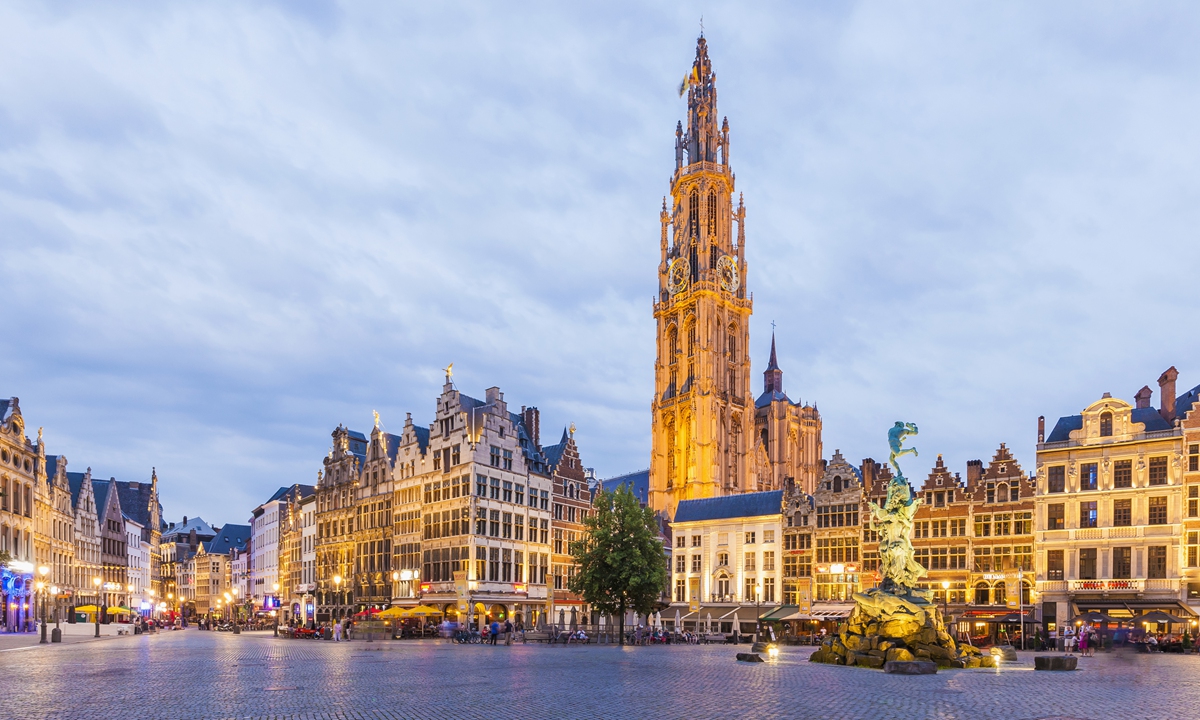
The Cathedral of Our Lady of Antwerp is one of the symbols of the Belgian city. Photo: VCG
During the 2026 FIFA World Cup, if you ask where the best place to watch a match in Brussels is, the answer will almost certainly be one of the many beer bars scattered across the city.Known as the "crossroads of Europe," Brussels has long been a meeting place for different languages, cultures and ways of life. Yet once the whistle blows, many of those differences seem to fade beneath a more basic and spontaneous passion. The distance between French-speaking and Flemish-speaking communities, and between locals and newcomers, temporarily disappears in the light of a television screen.
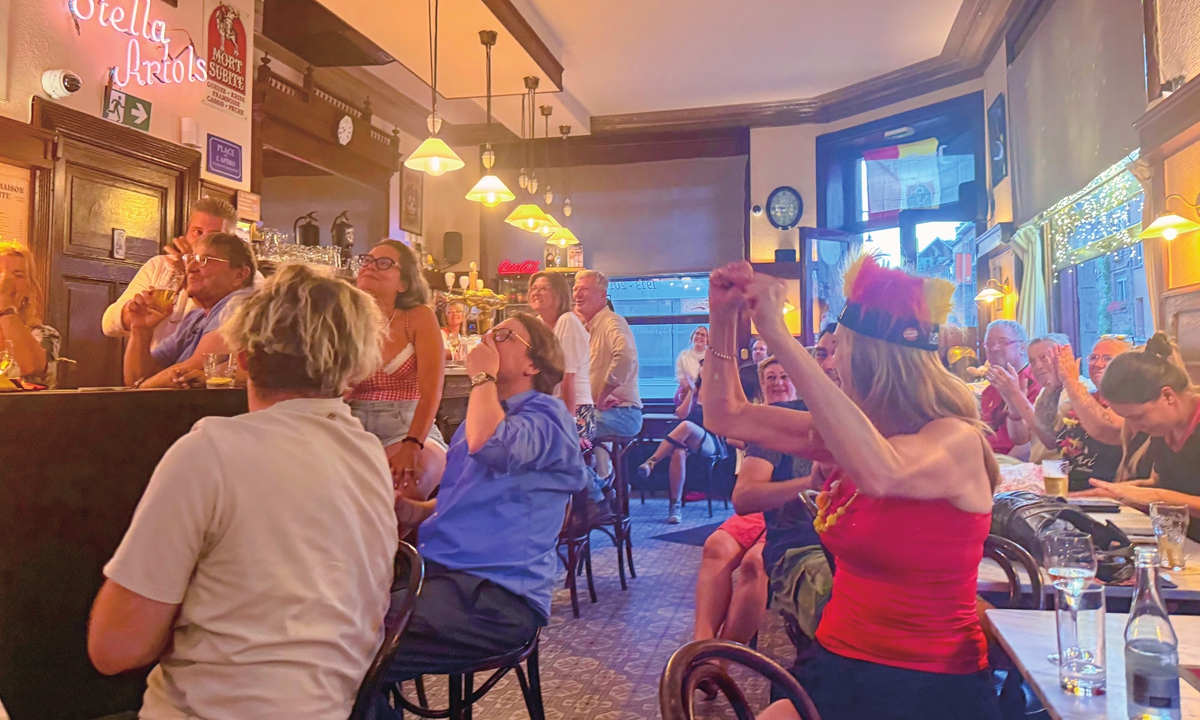
On the evening of July 10, Belgium played Spain in the quarterfinals of the 2026 FIFA World Cup. Two friends and I squeezed into a small neighborhood bar on Avenue Georges Henri in Brussels. The air carried the fresh smell of hops. Dark wooden walls glowed under warm yellow lights. The space was tight, with only a row and a half of seats apart from the bar. We ordered three draft beers and waited for the match between two of Europe's strongest teams.
Spain scored first in the 30th minute. The bar suddenly fell silent. The collective tension felt almost physical. Then, in the 41st minute, Belgium launched a quick counterattack and Charles de Ketelaere headed in the equalizer. The room exploded. Cheers and screams seemed loud enough to lift the low ceiling.
The experience felt both familiar and exciting. It also made me wonder: In an age when algorithms narrow what we see and digital life makes social relations increasingly fragmented, what makes so many individuals leave their homes, and cram into a small bar, and hold their breath or cheer together for the same moment on the same screen?
Football: An emotional medium beyond language
Belgium is a country deeply attached to football. Football arrived in the Low Countries through British merchants, workers and students in the second half of the 19th century. Since then, it has taken root for more than a century and become part of the shared experience of generations of Belgians.
Belgium is also divided by language. Dutch is mainly spoken in the north and French in the south, and political and cultural tensions between the two communities have lasted for nearly two centuries. Football, however, often crosses that boundary. During the World Cup, an everyday passion for the sport can quickly turn into a nationwide emotional experience.
In Belgium, during the World Cup, the rhythm of society visibly changes whenever the Belgian National Football team, also known as the Red Devils, are playing. Offices let employees leave early. Streets suddenly grow quiet before kickoff, only to fill up again after the final whistle. This shared rhythm across society makes every individual aware that, at the same moment, millions of people are all feeling the same tension and hoping for the same result.
Between 2018 and 2022, the Belgian National Football team remains at the top of the FIFA world rankings for quite a long time. This sustained success has further strengthened the World Cup's role as a nationwide outlet for shared emotion. Football cannot heal Belgium's deeper structural divisions, of course. But for the 90 minutes of a match, a country divided along linguistic lines can experience a rare sense of emotional unity.
In a bar on Avenue Georges Henri in Brussels, fans cheer for the Belgian national team during the quarterfinals of the 2026 FIFA World Cup on July 10, 2026. Photo: Courtesy of Han Fei
Beer: A liquid bond from daily social life to celebration
If football provides the structure of Belgium's World Cup celebrations, beer is what flows through them.
What makes Belgian beer distinctive is that, long before the World Cup arrives, it is already deeply rooted in the country's everyday life and cultural identity.
In 2016, UNESCO added Belgian beer culture to its Representative List of the Intangible Cultural Heritage of Humanity. It noted that Belgian beer culture brings together knowledge of nature, social customs and craftsmanship, and forms an important part of both everyday and festive life. It also plays a role in maintaining social ties and strengthening a sense of community.
Belgium has nearly 1,500 varieties of beer. They range from Trappist beers, whose traditions can be traced back to medieval monasteries, to lambic beers that ferment naturally through exposure to wild yeasts in the open air. Their flavors vary widely, and different beers are associated with different social occasions.
In everyday Belgian life, beer is woven into the fabric of social interaction. In public spaces, it is one of the safest ways for strangers to start a conversation.
On a World Cup night, however, beer changes from a gentle social lubricant into fuel for collective excitement. At the moment a goal is scored, the movement of the beer seems to mirror the emotions of the crowd: Beer flies into the air as emotions erupt around the room.
On an ordinary day, spilling beer on a stranger would call for an apology. At the moment of a goal, however, the flying beer is no longer seen as an offense. It becomes part of a collective celebration. Beer turns into a liquid carrier of emotion. Holding a glass becomes a sign of participation, and raising it becomes a physical way of saying, "I am part of this too."
Live broadcast: Shared presence and emotional resonance
When the World Cup and the beer are in place, one more element is needed to turn them into a complete collective experience: the live television broadcast inside the bar.
French philosopher Henri Lefebvre argued that space is not simply a fixed physical container. It is constantly produced and reshaped through social practice.
On an ordinary day, the beer bars scattered through the streets of Brussels each serve their familiar social purposes. But the moment a World Cup match appears on the television screen, the usual rules begin to change. A live broadcast transforms a bar from "a physical space where individuals consume separately" into a "social space where people experience something together."
In a digital age dominated by on-demand streaming, algorithmic recommendations and short-form video, the ability of live television to make large numbers of people experience the same moment has become both underestimated and increasingly rare.
This is what makes a live World Cup broadcast so valuable. Technically, it resists personalization. Everyone has to watch the same event unfold at the same pace, holding their breath together before an unpredictable next second arrives.
So why do people leave their homes and cram into bars instead of simply watching the match alone?
In Communication as Culture, American communication theorist James Carey led us to think about communication in a ritual sense. From this perspective, communication is not simply about transmitting information. It is also a way of maintaining society over time, and its central idea is sharing.
Seen in this light, people do not watch the same live broadcast only because they want information about what is happening on the pitch. They are also taking part in a shared ritual. By focusing their attention on the same event and going through the same emotional highs and lows, they confirm that they belong to a larger social community.
At home, you can still watch the match, drink beer and shout at the screen. But you cannot high-five a room full of strangers or share their reactions in the same physical space.
That is the irreplaceable value created when live television meets the social space of a bar. A screen becomes a device that gathers people together. Watching a football match becomes participation in an offline collective ritual.
Making 'being together' a sustainable source of value
The combination of football, beer and live television during the World Cup is not only a social and cultural phenomenon, but also an economic one.
During the tournament, a bottle of beer that costs less than two euros in a convenience store may sell for more than three times that price in a bar. Yet people still arrive early, sometimes an hour or two before the match has started, just to secure a seat.
Why are consumers willing to pay the premium? Clearly, the beer comes with something that a convenience store cannot provide: the feeling of witnessing something together, the warmth of high-fiving a stranger, the roar of an entire bar after a goal and the subtle sense at the end of the night that "we have just been through something together."
This is one of the questions raised by the idea of humanistic economics: While pursuing economic growth, can economic activity also strengthen social connections, create cultural meaning and enrich people's emotional lives? It looks at the possibility of economic activity becoming more human-centered, while human and cultural needs themselves become part of economic value creation.
A World Cup night in a Belgian beer bar offers a vivid example on a small scale.
Here, consumption and the production of emotional value are two sides of the same coin. People pay more for a glass of beer not only because of its taste or alcoholic effect, but because they are buying access to a shared experience that cannot be recreated on the sofa at home. And that experience is precisely what digital consumption cannot fully replace.
This form of human-centered economic activity is built around shared interests, physical presence and emotional participation. It is not unique to European football culture.
If we turn our attention back to China, striking similarities appear.
In Rongjiang county, Southwest China's Guizhou Province, the locally organized "Village Super League," or Cun Chao, grew rapidly from a grassroots football competition into a nationwide cultural phenomenon. Provincial football competitions in places such as Jiangsu Province, often referred to as Su Chao, have also drawn enormous public attention. Office workers, teachers and delivery drivers form teams to compete, while stadium seats are difficult to find on weekends.
From Guizhou to Jiangsu, from village leagues to provincial competitions, a grassroots football boom is emerging in different parts of China.
The people who travel from across the country to watch these matches are not necessarily looking for the highest level of technical football. What they are seeking is the experience of being there on a summer evening - shouting together, watching ordinary people run and sweat on the pitch, and becoming part of a shared moment.
A beer bar in Brussels and a Cun Chao, or a provincial-league stadium, in China may be thousands of kilometers apart, but they operate according to a similar logic.
In an age of highly developed digital media, people's desire to experience things together has not disappeared. If anything, it has become stronger.
This is an important direction for humanistic economics to explore.
Back to the bar in Brussels. That evening, Belgium lost 2-1 to Spain and was eliminated in the World Cup quarterfinals.
The screens in the bar replayed the highlights. Some people quietly put on their coats and slowly finished the last sip of their beer. Others patted the person next to them on the shoulder and exchanged a helpless smile. No one seemed in a hurry to leave. It was as if everyone had silently agreed to stay a little longer and process the disappointment together.
At a time when algorithms increasingly divide our attention and digital interfaces keep more of our interactions at a distance, "being together" is gradually changing from something that once came naturally into something precious that must be actively created and supported by both media technology and social spaces.
The World Cup provides the story. Beer acts as an emotional and social catalyst. Live television provides the essential window through which everyone experiences the same moment together.
That night, in a small bar in Brussels, I watched a group of people leave their homes, sit beside one another, and share the joy and disappointment of the same match.
It did not solve any of the world's difficult problems. But for one moment, it allowed a group of strangers to genuinely feel that they were not isolated from one another.
When media can help rebuild our ability to be together, the warmth and vitality of everyday public life can return to streets and neighborhoods. And when that sense of shared life becomes part of the everyday character of a city or a society, what it brings is more than emotional comfort.
It can also give lasting energy to economic development and to the richness of people's inner lives - an energy rooted in emotion, trust and human connection.
The author is Deputy Head and Associate Professor at the Department of Audiovisual Communication, Television School, Communication University of China
RELATED ARTICLES