BRICS Illustration: Liu Rui/ GT
Chinese President Xi Jinping's call for BRICS countries to strive to be "four pioneers" has injected a valuable force of certainty into a world of turbulence and transformation. Participants praised it highly, and it has struck a wide chord internationally.
The 18th BRICS Summit concluded successfully in New Delhi and adopted the New Delhi Declaration. Chinese President Xi Jinping, in his speech, reviewed 20 years of BRICS cooperation systematically and called on BRICS countries to be "four pioneers": a pioneer in advancing innovation-driven development, a pioneer in upholding peace and stability, a pioneer in facilitating mutual learning between civilizations, and a pioneer in reforming and improving global governance. From the four dimensions of development, security, civilization and governance, the "four pioneers" sketch a clear picture of BRICS cooperation for the next decade. They are both earnest expectations and a guiding direction.
The pioneering nature of BRICS first lies in exploring a path of development cooperation that is neither dependent nor closed. In this process, China has always used concrete action to strengthen the foundations of BRICS cooperation and raise the quality of "greater BRICS." From first proposing the "BRICS Plus" cooperation approach, to driving the historic enlargement of BRICS, to putting forward the idea of high-quality "greater BRICS cooperation," every leap of the grouping has carried a clear Chinese imprint. This year marks the 20th anniversary of BRICS cooperation. Together, BRICS countries have spent two decades standing on their own feet, weathering storms and delivering solid results. Now, undercurrents of unilateralism and power politics are rising, and the four deficits in peace, development, security and governance keep growing. Human society stands at a historical crossroads. At this moment, President Xi's call to strive to be "four pioneers" has injected precious certainty into a world in flux. Participants praised it highly, and it has struck a wide chord internationally.
Development is the master key to all problems. Among the "four pioneers," advancing innovation-driven development is placed first, in line with the trend of the times. Scientific and technological innovation is now a key variable reshaping the global development landscape. Yet many BRICS countries still face weak spots in key technologies and insufficient momentum for industrial innovation. China, which has a solid foundation and distinctive strengths in artificial intelligence, upholds open sharing and mutual benefit, and works to help countries of the Global South achieve sustainable development, demonstrating China's broad-mindedness in transforming the dividends of its own development into shared opportunities for BRICS members.
For "greater BRICS" to accomplish more and achieve greater development, the foundations of practical cooperation must be made solid. To that end, President Xi put forward five initiatives: on the open source and inclusive AI, trade and investment facilitation, digital industry cooperation, intelligent manufacturing cooperation, and science and technology talent development.
China will be a pioneer in establishing a BRICS AI open-source community, and promote a BRICS digital ecosystem cloud platform. China's 15th Five-Year Plan will become not only a blueprint for China, but a list of cooperation offered to the world. This is both China's responsibility as a major country and a collective advantage for inclusive growth among BRICS countries.
Delicious soup is made by combining different ingredients. On the first day of the summit, BRICS countries issued the New Delhi Declaration, stressing peaceful resolution of international disputes through dialogue, consultation and diplomacy, and opposing the imposition of unilateral coercive measures that are contrary to international law.
BRICS members do not agree on everything. That is precisely why this consensus carries more weight. Living multilateralism does not crush different voices into one. It enables countries with differences to have both the will and the capacity to coordinate on major issues and find the greatest common ground.
Over 20 years, BRICS cooperation has grown into a three-wheel structure of political and security cooperation, economic and financial cooperation, and people-to-people exchanges. The New Development Bank has approved more than 140 projects totaling about $44 billion. The New Delhi Declaration calls for continued exploration of fast, low-cost, more accessible, efficient, transparent, and safe cross-border payment mechanisms, and for stronger cooperation on special economic zones, value chains and standards. "Greater BRICS" is not a talking shop. It is a platform from which emerging markets and developing countries genuinely benefit.
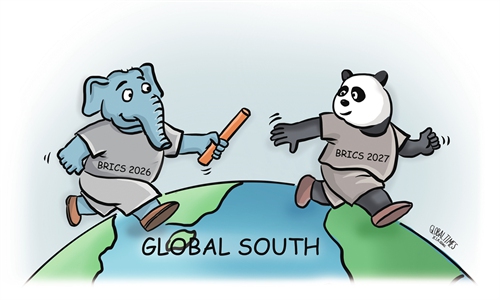
Twenty years is an important milestone, and also a new starting point. China will assume the BRICS presidency in 2027 and will host the 19th BRICS Summit - its fourth time as chair. From first inviting South Africa in 2011, to creating the "BRICS Plus" model in 2017, to launching a new journey of high-quality development of greater BRICS in 2022, the fourth "China year" of BRICS is highly anticipated internationally. It will also give the third "golden decade" of BRICS cooperation more real weight, push "greater BRICS cooperation" to a new level, and inject more certainty, stability and positive energy into a world of intertwined change and disorder.
RELATED ARTICLES