Beijing, New Delhi can boost ‘Greater BRICS’ as a powerful voice for the Global South
China-India cooperation Illustration: Xia Qing/GT
The 18th BRICS Summit successfully concluded in New Delhi on Sunday. The gathering came as BRICS marks two decades since its members first sat down as a political grouping. It also came at a moment when China-India relations have regained positive momentum. The summit has shown that the two largest developing countries can turn high-level consensus into practical cooperation that serves the Global South.In 2001, the acronym BRIC was coined by Goldman Sachs economist Jim O'Neill as an economic term for major emerging markets. In 2006, the foreign ministers of Brazil, Russia, India and China met on the sidelines of the UN General Assembly.
The first leaders' summit took place in Yekaterinburg, Russia in 2009, against the backdrop of the global financial crisis, which exposed structural flaws in Western-dominated global financial governance. South Africa was formally admitted to the grouping in 2010 and officially joined the cooperation mechanism in 2011, turning BRIC into BRICS.
The grouping's purpose was never to replace the existing international system, but to make it fairer. At the 2014 Fortaleza Summit, members agreed to establish the New Development Bank (NDB), headquartered in Shanghai, and the Contingent Reserve Arrangement. The NDB has since become a working alternative for infrastructure and sustainable-development lending in local currencies as well as dollars.
At the 2023 Johannesburg Summit, Egypt, Ethiopia, Iran, the United Arab Emirates and other countries were invited to join. Indonesia in 2025 joined as a full member, and a partner-country track was also set up. Today, "Greater BRICS" represents a large share of the world's population and a rising share of global output.
China and India have not always agreed on every issue, yet they have continued to work together within BRICS even when bilateral ties were strained.
First, they have helped build institutions rather than merely attend meetings. Both are major shareholders of the NDB. Indian and Chinese officials have served in its leadership. The bank's project pipeline in energy, transport, water and urban infrastructure has given member states options beyond traditional lenders. Local-currency financing, which both countries support in principle, reduces exchange-rate risk for borrowers in the Global South.
Second, they have treated BRICS as a venue for economic and financial coordination, not only communiqués. Work on cross-border payments, linking national systems such as China's CIPS and India's UPI, and exploring interoperability of fast-payment rails and central-bank digital currencies, reflects a shared interest in cheaper, faster settlement among developing economies.
Third, BRICS has given the two countries a structured way to talk about global governance, climate, public health, counter-terrorism, and food and energy security. Ministerial tracks, working groups and the BRICS Business Council have kept officials and businesses in contact.
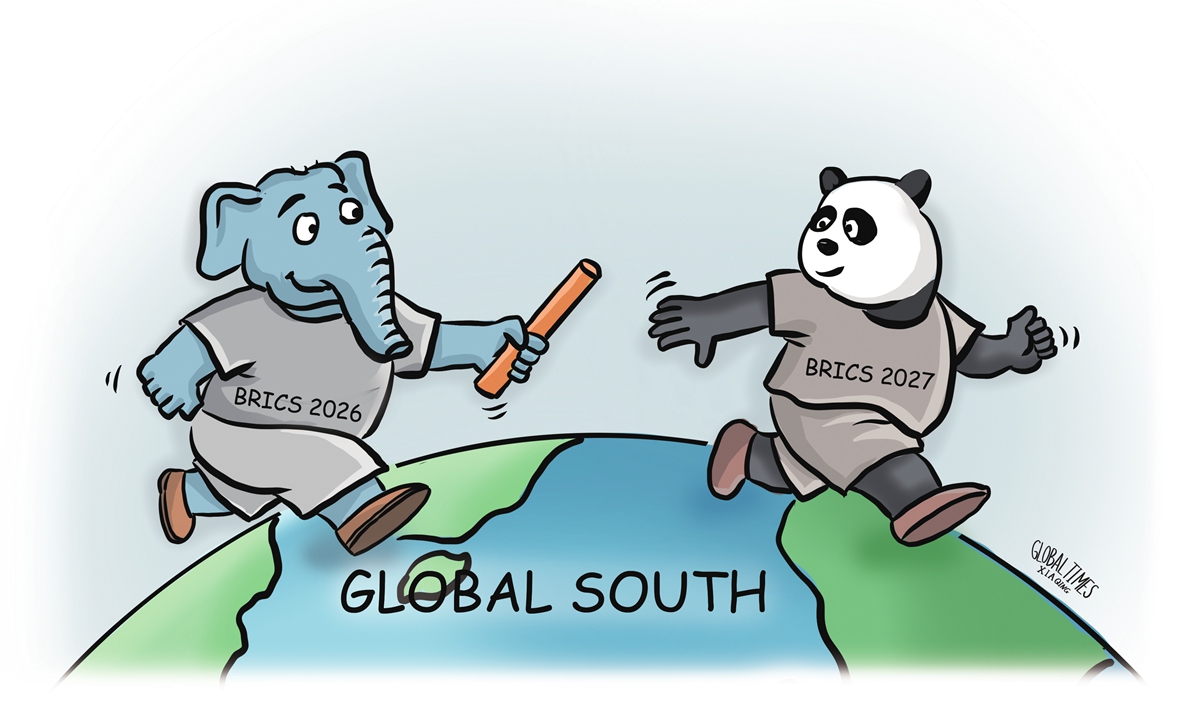
Fourth, political signaling has mattered. China publicly supported India as 2026 chair. India has also indicated support for China taking the chair in 2027. That rotation is how BRICS is supposed to work. Continuity between India's 2026 priorities and China's 2027 agenda would send a powerful message, in which the two countries can hand the baton. As the two largest developing nations and two ancient civilizations, China and India have a responsibility that goes beyond their own border. When the two greatest civilizations tango and work together as partners, Asia is more stable and the Global South has a stronger voice.
The author is director of the South Asian Communication Studies Centre at the Academy of International and Regional Communication Studies, Communication University of China. The article was originally published in the Times of India. opinion@globaltimes.com.cn
RELATED ARTICLES