Doubao consumer launch puts system-level AI agents in focus in China’s smartphone race
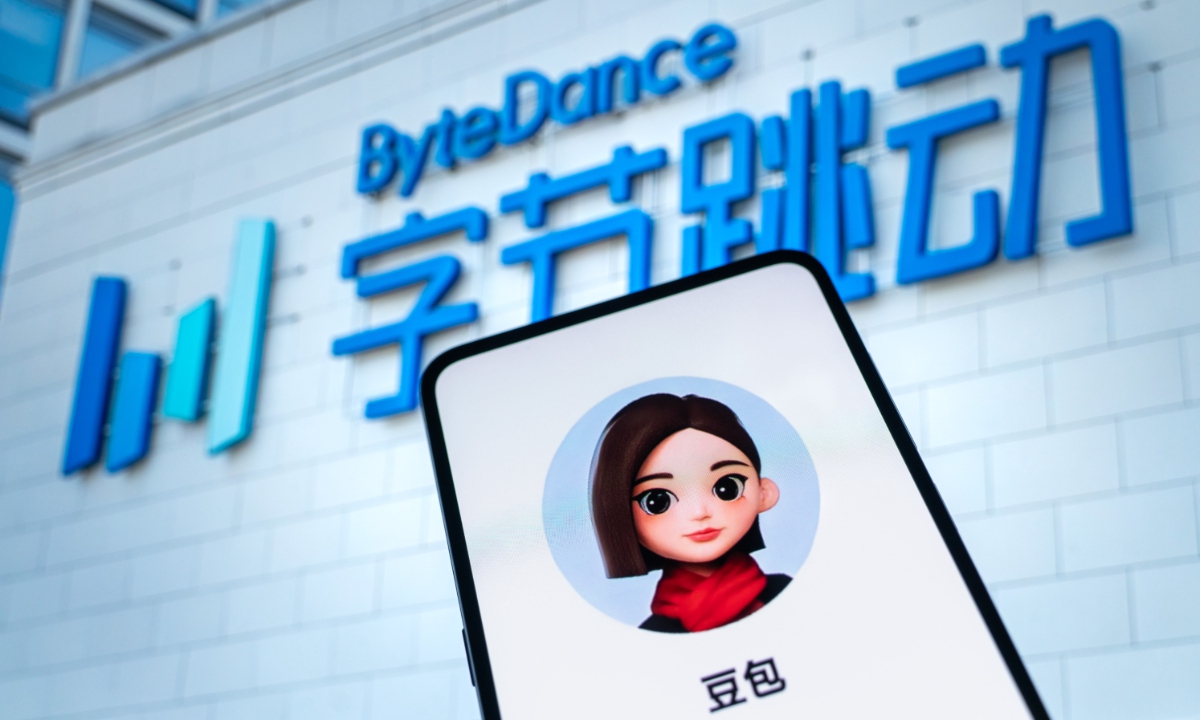
Chinese technology company ByteDance's artificial intelligence chatbot Doubao Photo: VCG
ByteDance's Doubao on Monday launched a consumer version of its smartphone assistant, adding upgraded functions in interaction, memory and task execution, as Chinese handset makers increasingly shift from standalone artificial intelligence (AI) features toward deeper integration of AI with operating systems and apps.
Deeper AI integration is emerging as a key direction for smartphones, though current AI assistants have yet to prove they can fundamentally reshape how users interact with their devices, industry analysts said.
Built on the Doubao app, the new Doubao smartphone assistant focuses on interaction, task execution, local memory and information retrieval. Compared with the technology preview released last December, the consumer version places greater emphasis on stability and user experience, according to a statement published on Doubao's WeChat account.
The company said that it has also upgraded functions involving interaction, personal context and memory, as well as agent-based task execution.
The consumer version highlights interaction and task execution. According to the company, the assistant supports multiple ways of activation, including voice commands and an AI key, to suit different usage scenarios. In one ride-hailing example, a user can say, "Book me a car to the office," and the assistant can then confirm a commonly used address, select a vehicle type and initiate the order.
A phone-operation function that drew attention in last year's preview version is now being offered in beta. The feature is designed to execute multi-step or cross-app tasks through simulated taps and supported tools, according to the company.
Liu Dingding, a veteran industry analyst, told the Global Times on Monday that the value of competing over specifications, configurations and benchmark scores is diminishing as smartphones mature, while AI is emerging as a more important differentiator by expanding what handsets can actually do for users.
Smartphone producers have long sought to make devices more intelligent and autonomous, but as large-language models have advanced, many have increasingly turned to partnerships with leading AI companies rather than relying solely on in-house development, Ma Jihua, a telecom industry observer, told the Global Times.
Ma said that different manufacturers are taking different routes, but the longer-term goal is to make smartphones better understand users' habits and intentions, shifting interaction from "people adapting to machines" toward "machines adapting to people."
Major Chinese smartphone brands including Huawei, Xiaomi, OPPO, vivo and Honor are expected to roll out new flagship models later this month, with analysts saying that AI is likely to be a major focus of the latest product cycle.
ZTE's Nubia said that its NaviX Ultra, which integrates the Doubao smartphone assistant, will be launched on Wednesday. The company has billed the device as the world's first "AI agent smartphone," saying it is designed to move beyond manual operation and carry out tasks for users through natural-language instructions.
Liu said that the key test of an AI assistant's competitiveness is whether it can actually "get things done" - accurately understanding user intent and delivering useful results, whether a document, image or video. "Ultimately, it is about solving real problems rather than showing off features or competing over parameters," he said.
According to Ma, the current generation of AI assistants remains transitional. "Judging from the applications shown so far, the Doubao smartphone assistant is not enough to reshape the industry. At this stage, it is more of an enhancement to the existing smartphone experience," he said.
The real turning point will come when AI phones enable new forms of interaction and applications that would be difficult or impossible without AI, Ma noted, adding that how far products such as Doubao can go will depend on deeper app integration and the user experience they deliver.
RELATED ARTICLES