The continued resumption of China-US security dialogue sends multiple signals: Global Times editorial
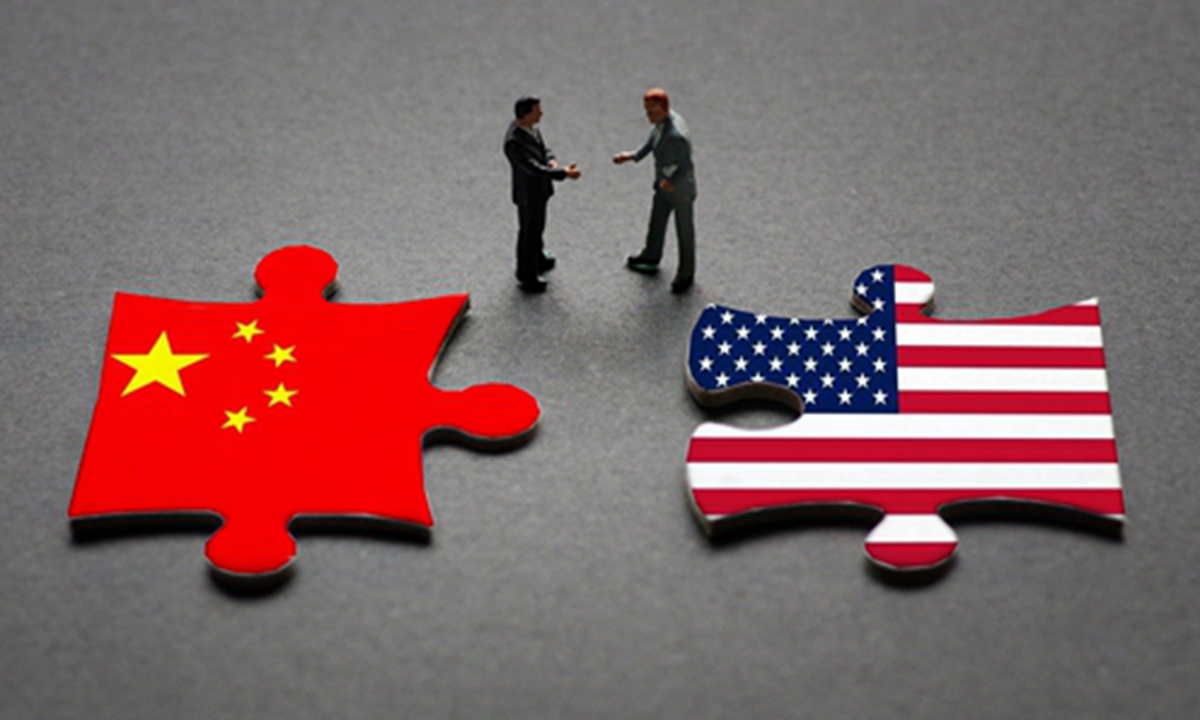
China US. Photo: IC
The 13th Beijing Xiangshan Forum will be held on September 15 at the Beijing International Convention Center. Reuters reported that hundreds of military officers, diplomats and scholars from dozens of countries, regions and international organizations are expected to attend "amid roiling regional tensions." Meanwhile, changes in the level of the US delegation have attracted considerable attention. Some observers said the US' participation is "at a higher level than last year" and that "China-US military relations appear to have improved."
Guided by the consensus reached by the Chinese and US heads of state, military-to-military dialogue between the two countries at various levels has continued to resume.
In late May, the Chinese and US militaries held a working group meeting of the Military Maritime Consultative Agreement in Hawaii. In late August and early September, the commander of the Eastern Theater Command of the People's Liberation Army held the first bilateral meeting with the chief of US military's Pacific Command. It is reported that the US delegation attending this year's Beijing Xiangshan Forum is led by the Pentagon's principal director for China. Although this level of representation does not break with established practice, it creates conditions for the two sides to engage in pragmatic policy-level discussions.
The continued resumption of China-US security dialogue sends multiple signals. The logic is straightforward: China and the US need security dialogue and strategic stability. What is complicated is that some Americans have insisted on handling relations with China according to a mindset when the US enjoyed overwhelming advantages.
Under this mindset, "dialogue" has sometimes been interpreted as demanding that China accept rules set by the US, while "crisis management" has at times been distorted into Washington's repeated testing of China's red lines while simultaneously demanding that Beijing exercise restraint. This situation is changing.
Building strategic stability requires both sides to accurately assess the other's resolve and capabilities in safeguarding its core interests, and to fully recognize the enormous costs that direct military conflict could entail. As the balance of power between China and the US undergoes significant changes, using military deterrence to force China to make concessions on its core interests is not practically feasible. China's growing national strength is itself an important anchor for China-US strategic stability.
This is the underlying reality behind Washington's constant communication with China on security.
Of course, the participation of relatively senior US officials in the Xiangshan Forum does not mean that Washington's military strategy toward China has fundamentally changed. There remains a strong competitive impulse toward China in the US, and some political forces continue to push for a stronger military presence in the Asia-Pacific while attempting to create new frictions over issues related to Taiwan, the South China Sea, technology restrictions, and military alliances.
At the same time, the various "small moves" the US has taken against China are becoming increasingly ineffective. Whether it is adding a few more military bases around China, deploying some weapons systems, recruiting more countries into small multilateral mechanisms targeting China, or continuing to hype the so-called "China threat," none of these measures can alter the basic realities that China possesses a complete industrial system, a vast market, sustained capacity for technological innovation, and a firm determination to safeguard its core interests.
Those who still fantasize about achieving their own interests by provoking or exploiting China-US tensions, or by attempting to manufacture a "China threat" to enhance their own strategic "value," should understand this shift. Various "small moves" targeting China may continue to emerge, and attempts to test China's limits will not stop. But such actions cannot alter China's fundamental trajectory of continued development, nor can they reverse the historical direction of profound adjustments in the global balance of power.
Some Americans need to recognize and adapt to a reality: China has no need to demonstrate its strength by creating military tensions. China today has the capacity and confidence to safeguard peace through rationality and strength, demonstrate confidence through restraint and rationality, draw clear red lines through necessary countermeasures, and at the same time promote a more stable and balanced relationship between major powers through sustained dialogue.
China will also continue to strengthen its capabilities through its own development and defense modernization, providing firmer guarantees for safeguarding its national interests, regional peace and global stability.
The theme of this year's Beijing Xiangshan Forum is "Build Consensus on Stability, Advance Security Governance Together." For China-US relations today, the word "stability" carries particular weight. If the world's two major powers can establish a more mature, stable and predictable way of managing their relationship, the beneficiaries will extend far beyond China and the US.
This is the important signal conveyed by the strengthening of China-US security dialogue: China has the confidence and capability to safeguard its core interests, while remaining willing to manage differences through constructive dialogue. Continuing in this direction serves the interests of China and the US, the Asia-Pacific and the wider world.
RELATED ARTICLES