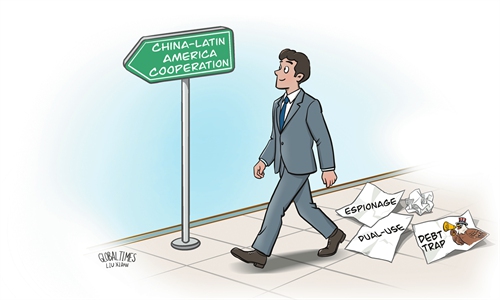
The US push for de-Sinicization in Latin America Illustration: Xia Qing/GT
Recently, some US officials have publicly urged Latin American countries to abandon cooperation with Chinese partners in order to mitigate "risks." For instance, a recent New York Times report pointed out that senior US administration officials have warned, while "offering no evidence," that Chinese-financed projects threaten Peru's sovereignty.The US push for de-Sinicization in Latin America is an increasingly institutionalized practice of overstretching the concept of security, rooted in the hegemonic mindset of the Monroe Doctrine.
The US has been exerting pressure, urging Latin American countries to take a cautious approach toward projects invested by Chinese enterprises. Yet the criteria for "approved" suppliers by the US have been shaped by Washington's own geopolitical considerations. The merits of economic and trade partners are judged less by companies' performance in fulfilling contracts, technological capabilities and the actual cost-effectiveness of projects, and more by whether potential partners align with US bloc interests.
This logic is intended to bind Latin American countries to Washington's framework of strategic competition while turning a blind eye to their development needs and cooperation opportunities. Normal investment, trade and engineering cooperation can easily be labeled as posing various security risks once they run up against US competitive concerns.
There is no need to look further than Peru to see why Washington's attempt to distance Latin American countries from China is unlikely to succeed.
China and Peru have highly complementary economies, and their cooperation has produced substantial results in trade, infrastructure, digital technology and other fields. China has remained Peru's largest trading partner for more than a decade. The stable demand from the Chinese market enables Peru to efficiently convert its resource advantages into fiscal revenue, which can then support domestic livelihoods and industrial investment. In the first year after the Chancay Port began operations, its total import and export value reached $3.65 billion, generating more than 1.64 billion soles in tax revenue.
At the same time, Chinese companies have participated in the construction of local broadband and telecommunications networks. By providing cost-effective solutions adapted to local conditions, they have helped Peru narrow the regional digital divide and improve internet access in some remote towns. These cooperation projects respect Peru's domestic affairs and impose no political conditions. Looking around the world, it would be difficult to find another external partner capable of providing Peru with infrastructure, market access and technological support on such a scale and so closely matched to its needs.
Peru's choice reflects the broader realities shaping the decisions of developing countries in Latin America. Closing infrastructure gaps, expanding channels for resource exports and advancing the digital economy are common development priorities across the region, and cooperation with China offers practical opportunities to address these challenges.
It is important to recognize that amid intensifying competition among major powers, securitizing development issues has become a familiar tool of US policy. Yet this approach does not create additional common interests. Instead, it breeds mistrust, erects barriers and narrows the space for cooperation.
External pressure has already had a tangible impact. In the future, China-Peru cooperation, as well as China-Latin America cooperation more broadly, will face greater external attempts to sow discord. Even so, the foundation of cooperation between China and Peru, and between China and Latin America more broadly, lies in the high degree of economic complementarity and its alignment with countries' own development aspirations. External forces will find it difficult to fundamentally reverse this trend.
For Latin American countries, the more pragmatic choice is to remain alert to the "confrontation trap" set by the US, ground their decisions in their own realities and maximize the shared benefits of practical cooperation. This is the viable path toward stable development.
The author is an assistant research fellow at the Institute of Latin American Studies, Chinese Academy of Social Sciences. opinion@globaltimes.com.cn
RELATED ARTICLES