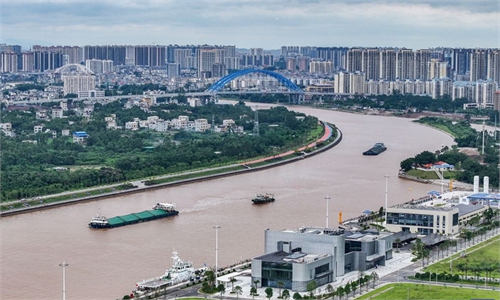
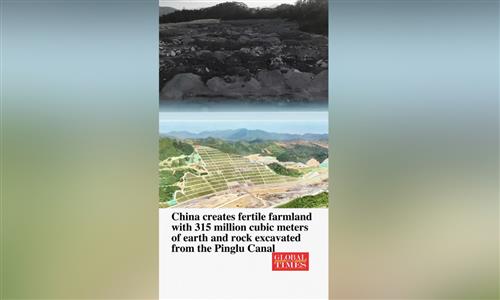
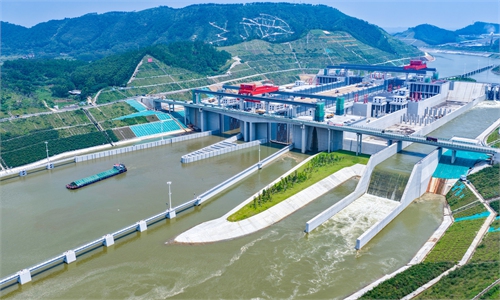
A China committed to high-standard opening-up is surging forward along the Pinglu Canal: Global Times editorial
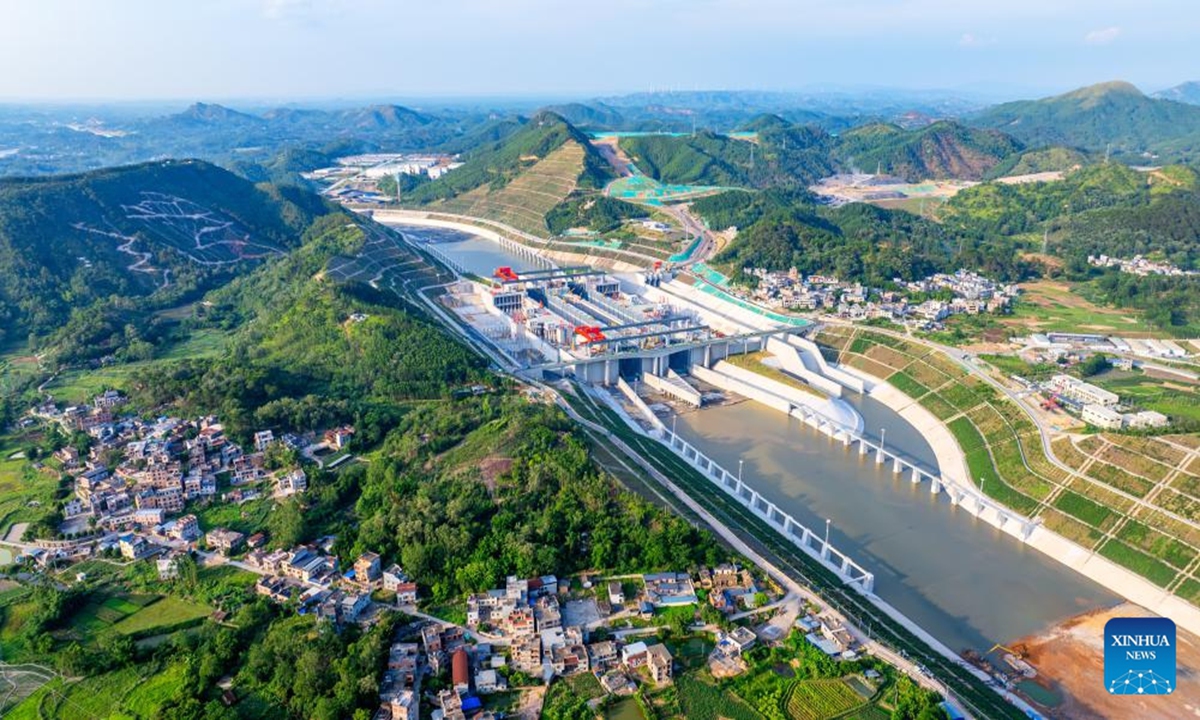
An aerial drone photo taken on June 3, 2026 shows water being pumped into the Madao hub on the Pinglu Canal in South China's Guangxi Zhuang Autonomous Region. Photo: Xinhua
The value of the Pinglu Canal extends far beyond interconnectivity and economic and trade cooperation. It embodies the profound sincerity with which China and ASEAN nations are jointly building a community with a shared future. Along this golden waterway where history and the future converge, a confident and poised China is surging forward - a nation committed to high-standard opening-up and sharing development opportunities with the world.
The Pinglu Canal - a major project long awaited by Southwest China and the surrounding regions, and the first canal connecting inland rivers to the sea planned and constructed at the national level since the founding of the People's Republic of China - is set to officially open to navigation on September 16. Vietnamese media have described this "super canal" as a potential new "logistics lifeline" linking Southwest China with Southeast Asia, while an expert from a Singaporean think tank said it "could strengthen ASEAN's position in global supply chains by supporting the region's role as a cost-efficient manufacturing hub." The completion and operation of this monumental project represent not only a significant milestone in the history of China's transport infrastructure development but also a strategic move to advance high-standard opening-up, foster a new development pattern, and jointly promote the high-quality Belt and Road cooperation in the new era.
The opening of the Pinglu Canal has, most directly, "brought the sea" to Nanning, capital of Guangxi Zhuang Autonomous Region, offering a new model of high-standard opening-up for Southwest China and the vast hinterland.
Traditionally, the eastern coastal regions developed first through opening-up, followed successively by the central and western regions. The completion of the Pinglu Canal demonstrates a new pathway - spearheaded by major national infrastructure - to overcome geographical constraints and achieve leapfrog progress in opening up southwestern areas. It will not only further facilitate the smooth flow of the domestic economic cycle but also enhance the efficiency and quality of the "dual circulation" of domestic and international markets.
The opening of the canal to navigation serves as a vivid example of the deep integration of industrial and supply chains between China and ASEAN. The canal's opening and the China-ASEAN Expo complement each other. The former establishes "hard connectivity" at the physical level, while the latter creates "soft connectivity" regarding rules and mechanisms. By reducing institutional transaction costs through infrastructure interconnectivity and facilitating the free flow of production factors via economic and trade platforms, the Pinglu Canal will become a robust link between China and ASEAN. Moving forward, automotive components, construction machinery parts, and aluminum products from Southwest China will gain easier access to ASEAN markets, while rubber, palm oil, and fruits from ASEAN will enter China at lower costs. Cooperative initiatives such as the China-Malaysia Qinzhou Industrial Park, the China-Singapore (Chongqing) Demonstration Initiative on Strategic Connectivity, and direct shipping routes between Beibu Gulf Port of Guangxi and Brunei's Muara Port are all poised for new growth driven by the "Canal Economic Belt."
With the establishment of the channel, the dividends of institutional opening-up will find a tangible outlet for realization. Ultimately, the value of a canal will be reflected in the orders received by regional factories, the containers handled at its terminals, and the livelihoods of ordinary people. By establishing an efficient and convenient river-sea intermodal transport network, the ties between China and ASEAN in areas such as economic and trade investment, industrial capacity cooperation, and people-to-people exchanges will be further strengthened, thereby solidifying the material foundation for the development of the China-ASEAN Free Trade Area 3.0. The Pinglu Canal connects with the China-Laos Railway, the China-Europe Railway Express, and the New International Land-Sea Trade Corridor, creating a multimodal transport network that integrates rail, inland waterway, and maritime shipping. Water transport is ideal for high-volume, low-cost cargo, while rail suits orders with tight delivery schedules. This allows enterprises to make flexible choices based on their needs, thereby enhancing supply chain resilience. Rules and transport channels complement each other, helping China and ASEAN establish more stable division of labor and strong regional production networks.
The value of the Pinglu Canal extends far beyond interconnectivity and economic and trade cooperation; it embodies the profound sincerity with which China and ASEAN nations are jointly building a community with a shared future. The construction of the canal and its associated corridors, along with the enhancement of multimodal transport capabilities, addresses regional development needs for the coming decade and beyond.
This stands in stark contrast to the bloc-based confrontation and exclusionary "small circles" pursued by certain nations. Amidst a rapidly evolving global geopolitical landscape, a rising tide of anti-globalization sentiment, and an increasingly complex and challenging external environment, China is using this monumental project to not only build a bridge for development that meets shared regional needs but also to put the vision of a community with a shared future into concrete action.
As the first cargo ships sound their whistles and set sail, the convergence of river and sea signifies more than just the meeting of waters and shipping lanes; it represents the powerful pulse of shared opportunity connecting China, ASEAN, and the global market.
The Pinglu Canal carries not only water but also shared aspirations, embodying the hope for the common development of countries across the region.
Along this golden waterway where history and the future converge, a confident and poised China is surging forward - a nation committed to high-standard opening-up and sharing development opportunities with the world. It is joining hands with ASEAN nations to forge ahead toward a vast blue ocean of shared regional prosperity.
RELATED ARTICLES