Why rivals Altman, Musk and Amodei made a rare joint call on AI
Chip curbs, distillation crackdowns, safety rules serve commercial interest, tech hegemony: Chinese expert
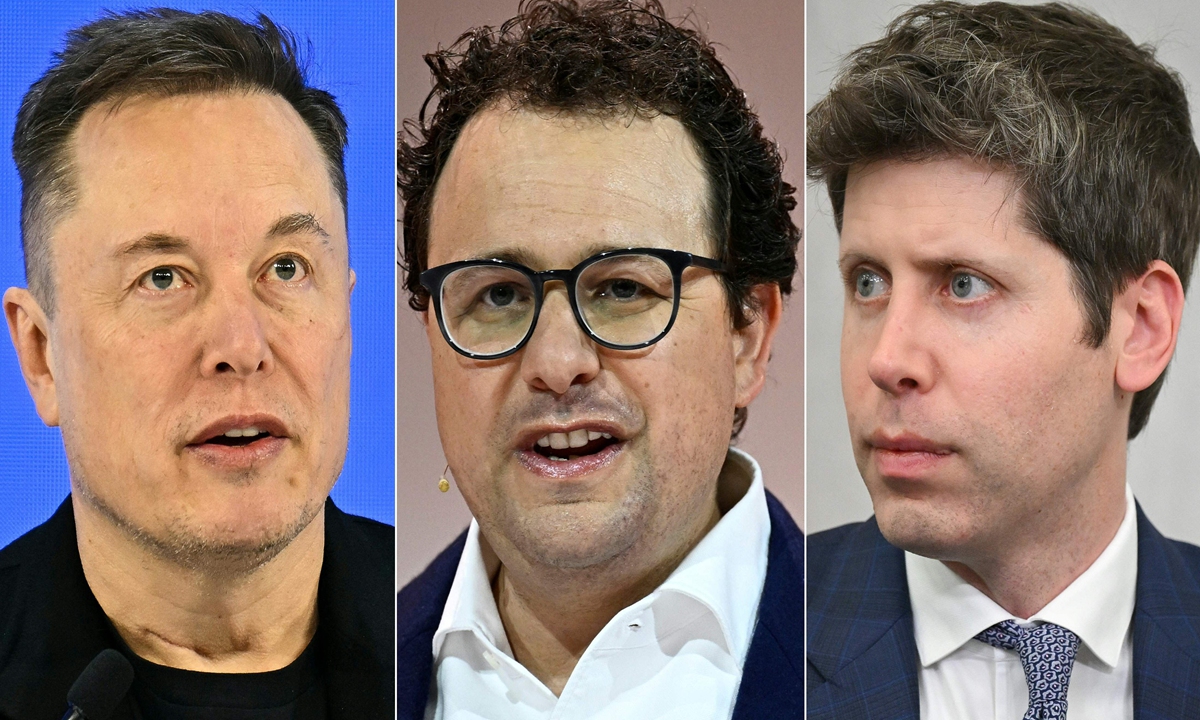
This combination of pictures created on September 12, 2026 shows (from left to right) Elon Musk in Davos on January 22, 2026, Dario Amodei, co-founder and CEO of Anthropic, in Paris, on May 22, 2024, and OpenAI CEO Sam Altman in Washington, DC, on July 22, 2025. Photo: VCG
Longtime rivals in the US' AI race have suddenly found some common ground. OpenAI CEO Sam Altman, CEO of Tesla, SpaceX, and xAI Elon Musk, and Anthropic CEO Dario Amodei have made a rare call to "pace the frontier," urging a slower development of increasingly powerful AI models to give society more time to manage their risks.
But just days later, US President Donald Trump struck a sharply different tone at Monday's All-In Summit in Los Angeles, defending rapid AI development and dismissing safety concerns as a "hoax" during a phone call with Nvidia CEO Jensen Huang. Trump also praised data centers as "great" and said they make people and states "wealthy," NBC News reported.
Chinese experts said that while political and business circles in the US may appear divided over AI development, their views reflect a broader US effort to build technological barriers and contain China's AI development in pursuit of technological hegemony. This "silent AI Cold War" is hypocritical and short-sighted.
According to NBC News, the US president called Huang on Monday during an industry summit, delivering another full-throated defense of AI after Huang put the call on speakerphone.
Trump characterized concerns over AI safety as a "hoax," saying, "The robots will not be taking over. The AI will not be taking over the rest of the world. The whole thing is a hoax." He suggested that critics' concerns were politically motivated, per the report.
Trump also lauded politically unpopular data centers, calling them "great" and saying they make people and states "wealthy."
In stark contrast, Amodei recently called for slowing the pace of frontier AI development, saying, "We must slow the pace at which we improve the capabilities of AI models." Altman and Musk quickly voiced support for his proposal, with Altman saying, "I agree with Dario that we need to pace the frontier," while Musk simply posted, "Dario is right."
Chinese observers noted that while the discussion appears to be a "responsible" debate over AI safety, it is, in essence, a carefully packaged "silent AI Cold War," aimed not simply at safeguarding humanity's future but at containing China's AI development through technological barriers and rule-setting, preserving Washington's dominance in frontier technologies, and excluding China from global AI governance. Such exclusion would only raise the costs and risks of global AI development.
A closer look at the backgrounds and interests of these tech figures reveals that they are far from being mere "guardians of AI safety"; rather, they are spokespersons for interests deeply embedded in the US political-capital complex.
Anthropic, led by Amodei, who has also been openly critical of Trump, urged his network to support then-presidential candidate Kamala Harris. Forbes reported that Amodei appears to be a registered Democrat.
At the same time, Anthropic has cultivated extensive ties with the US national-security establishment. The US Department of Defense awarded the company a two-year agreement with a ceiling of $200 million in 2025, while Anthropic has said its models have been deployed on classified government networks and in national-security missions, according to the company's official website.
The company has also donated $40 million to Public First Action, which advocates AI safeguards, federal AI governance, and tighter controls on advanced AI chips. Anthropic has separately called for stronger chip export controls and measures to curb illicit model access and AI model-distillation attacks, explicitly linking such policies to maintaining US AI leadership and preventing advanced technologies from benefiting authoritarian states, its website shows.
Xiang Ligang, a veteran telecom and tech policy observer, told the Global Times that "this fence-sitting approach, in essence, seeks to consolidate the commercial advantage of closed-source models under the guise of security while raising the barriers for China to catch up in the name of so-called national security."
Altman has also closely aligned OpenAI with US national strategy through projects such as Stargate, which OpenAI says will help "secure American leadership in AI," according to an OpenAI announcement.
Backed by Microsoft's massive investment and cloud infrastructure, OpenAI has strong commercial incentives to maintain its technological lead while shaping a regulatory environment favorable to its expansion, including curbing unauthorized model distillation and opposing overly burdensome regulation, Chinese experts noted.
Altman's support for "embedded evaluators" and industry coordination is aimed at allowing a handful of leading US companies to dominate rulemaking and turn "safety" into an exclusionary barrier to entry, Xiang said.
Similarly, Musk's "Dario is right" remark does not represent a sudden turn against growth. Rather, Xiang noted, by embracing AI safety, Musk is seeking to reshape the rules of the game as competition intensifies, in ways that could serve the broader interests of his AI, aerospace, and robotics ventures.
The common interests behind these figures are clearly visible: to protect the US monopoly in advanced chips, closed-source models, and computing infrastructure; to slow China's AI catch-up through export controls on China; and to secure a dominant role in setting the rules of global AI governance while excluding China from core decision-making, Chinese experts noted.
Chip restrictions, crackdowns on model distillation, and demands for third-party evaluations may appear to serve security interests on the surface, but in reality, they serve a dual agenda of market and geopolitical hegemony, they said.
With the US 2026 midterm elections approaching, these tech behemoths' calls to "slow down" AI development may also carry clear political implications, Xiang said.
The calls aim to help them shape rules favorable to their business models - curbing Chinese competition without inviting excessive domestic regulation, the expert said. "It is less a debate over tech ethics than a calculated effort to turn safety concerns into political and commercial capital."
Can this "silent AI Cold War playbook" work? Xiang noted that AI development is becoming increasingly multipolar, with China advancing in open-source models, applications, and engineering. Excluding China would raise global costs and create blind spots in AI safety, while technological barriers would deepen fragmentation and confrontation.
"A truly responsible approach is inclusive dialogue, common standards, and practical cooperation," Xiang noted.
RELATED ARTICLES