Third China-Latin American and Caribbean States Roundtable on Human Rights held in Peru
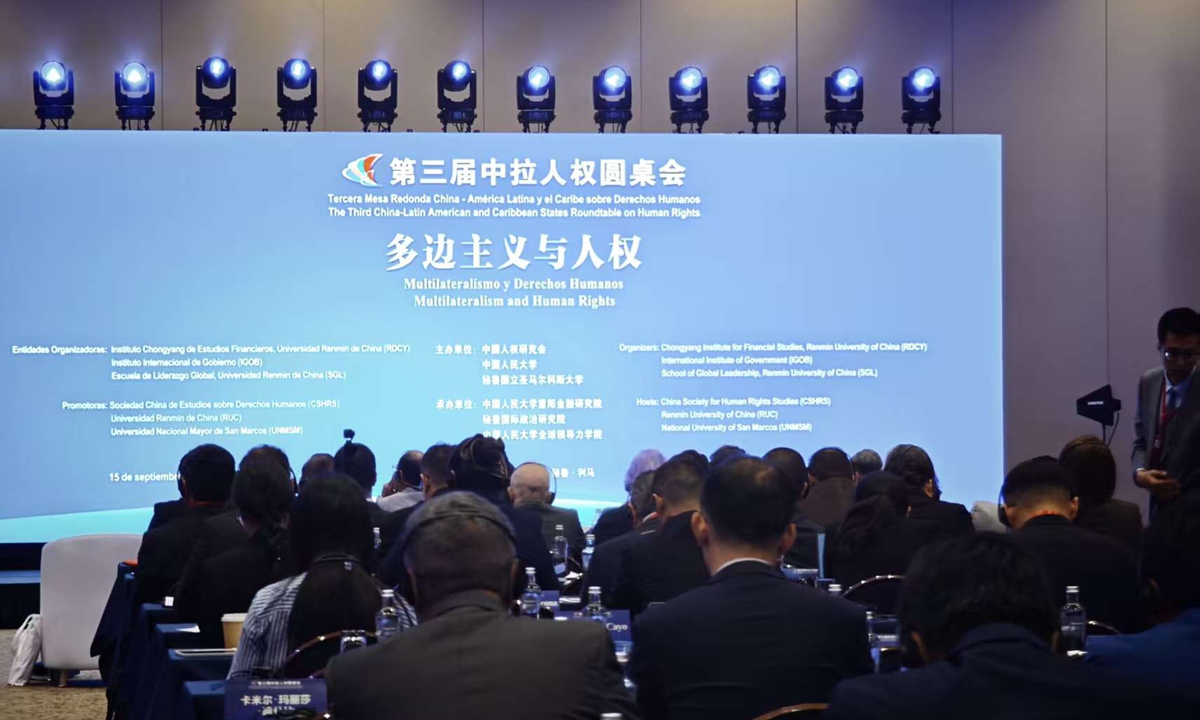
The Third China-Latin American and Caribbean States Roundtable on Human Rights was held in Lima, Peru, on Tuesday local time under the theme “Multilateralism and Human Rights.”
Nearly 200 participants, including senior officials, experts, scholars, and representatives of social organizations, media outlets and think tanks from China and Latin American and Caribbean countries, attended the event to discuss the future of global human rights governance.
Ma Huaide, president of Renmin University of China and one of the event’s organizers, said at the opening ceremony that global human rights governance is facing serious deficits and challenges, with some countries resorting to armed intervention and unilateral sanctions in an attempt to maintain power politics and hegemony.
Practicing genuine multilateralism and reforming and improving global human rights governance have become a shared aspiration among developing countries, Ma said.
He noted that the China-Latin America and Caribbean Roundtable on Human Rights has become an important platform for exchanges in the field of human rights. This year’s meeting, themed “Multilateralism and Human Rights,” aims to help address geopolitical challenges and promote a fairer and more equitable system of global human rights governance.
Gustavo Pacheco, founding president of the Institute for International Political Studies of Peru, highlighted China’s achievement in lifting hundreds of millions of people out of poverty and eliminating extreme poverty, saying it deserves greater recognition from the international community.
Pacheco stressed that the right to life is the foremost human right, and that war and armed conflict directly deprive people of that right. He called for rejecting war, pursuing peace and building a shared future.
He also said that in modern society, human rights should include access to science and technology and the benefits brought by technological progress.
Noting China’s growing contribution to global artificial intelligence (AI) development and technology training, Pacheco said China’s Global AI Governance Initiative is helping promote broader access to technology and create more opportunities for a shared future.
Chinese Ambassador to Peru Song Yang said that although China and Latin America are separated by vast oceans, they share the aspiration to improve people’s well-being and pursue development and progress.
Both sides, based on their respective national conditions, have explored their own paths of human rights development and accumulated extensive experience in safeguarding the rights to subsistence and development, Song said.
Drawing on his years of experience working in Latin America, Song highlighted three points.
First, security is one of the most fundamental aspects of people’s well-being and one of the most universally shared human rights. China, he said, has strengthened the foundation for protecting people’s rights through poverty alleviation and the use of science and technology in public security, and is willing to work with Latin American countries to turn technological progress into stronger support for public safety.
Second, development should remain a priority. Song said cooperation between China and Latin America and the Caribbean has continued to deliver tangible benefits. He cited the Chancay Port project, which has created a large number of local jobs, as an example of how development can provide solid support for human rights protection.
Third, human rights protection depends on concrete action. In response to disaster risks linked to El Niño, China has supported the construction of Peru’s National Emergency Operations Center and will help upgrade the facility to strengthen disaster prevention and mitigation capacity.
Song also noted China’s efforts to advance the establishment of a World AI Cooperation Organization and the application of the Mazu disaster early-warning AI model, with the aim of helping countries in the Global South bridge the technological divide.
During the meeting, the China-Latin America and Caribbean Human Rights Academic Research Action Plan 2026-2030 was launched. An expert committee under the China-Latin America and Caribbean Human Rights Research Cooperation Network was also established, and certificates were presented to newly appointed committee members.
The network also released its joint research projects for 2026-2027.
Three parallel forums were held in the afternoon under the themes of “Peaceful Development and Human Rights Governance,” “China-Latin America and Caribbean Practical Cooperation and Human Rights Development,” and “Exchanges and Mutual Learning among Human Rights Civilizations.”
Participants from China and Latin American and Caribbean countries held in-depth discussions on these topics.
From the inaugural roundtable in Rio de Janeiro to the second meeting in Sao Paulo and this year’s gathering in Lima, the China-Latin America and Caribbean Roundtable on Human Rights has now been held successfully for three consecutive years.
The number of participating countries has increased from 17 to 23, while attendance has grown from more than 130 representatives to nearly 200. The scope of discussion has also expanded from specific human rights issues to broader topics including multilateralism and global human rights governance.
