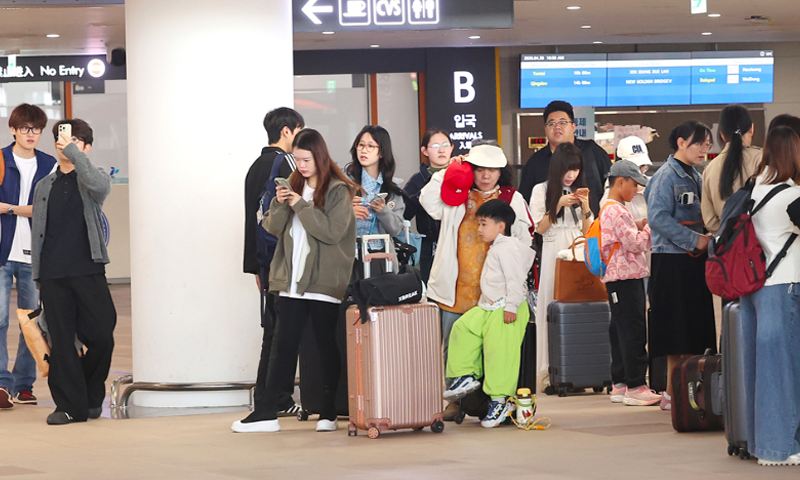
Chinese tourists arrive at Incheon Port International Passenger Terminal in Incheon, South Korea, preparing to spend the May Day holidays from May 1 to 5, on April 30, 2026. Photo: VCG
The South Korean transport ministry on Wednesday allocated rights for 25 international routes to 10 airlines, significantly expanding flight capacity between South Korea and China and giving more opportunities to low-cost carriers, South Korean media reported.
Chinese analysts said that the increase in flights is in line with South Korea's efforts to attract more Chinese tourists, together with visa-free trial programs and increasing tourist products.
The new plan revealed that Incheon, South Korea's main international gateway, will gain more connections to major Chinese cities including Beijing, Shanghai, Guangzhou and Dalian, the Yonhap News Agency reported on Wednesday, citing the Ministry of Land, Infrastructure and Transport of South Korea.
The flight frequency between Incheon and Beijing increased from 38 to 52 per week, while that for the Incheon-Shanghai route rose from 56 to 63 per week. Weekly entitlements rose to 28 flights each for South China's Guangzhou and Northeast China's Dalian. Flights will be increased to 14 for East China's Nanjing and Hangzhou, as well as Central China's Changsha.
Low-cost carriers receiving flight rights to China included Parata Air Co, Jeju Air Co, Jin Air Co, Eastar Jet Co and Air Premia Co. The airlines will need to secure slots at the respective Chinese airports before launching additional services, which are expected to begin in the 2027 summer season, Yonhap reported.
The move followed a recent bilateral agreement to expand flight rights for the first time since 2019. Under the deal, weekly passenger flight quotas will increase to 664 round-trip services from 608, while weekly cargo flights will rise to 68 from 54, according to media reports in June.
"The increase in flights is in line with South Korea's efforts to attract more Chinese tourists. South Korea launched a visa-free trial for Chinese group tourists last year, while expanding flight frequencies and improving service management, further unlocking two-way demand," Lü Chao, a research fellow on North Korea with the Liaoning Academy of Social Sciences, told the Global Times.
From January to July, the total number of trips made by foreign tourists to South Korea reached 12.8 million, with the number by tourists from the Chinese mainland taking the top spot at 3.99 million, according to Yonhap.
According to a previous projection by South Korean tourism agency Yanolja Research, the number of trips made by Chinese tourists to South Korea could reach 6.15 million in 2026.
Industry practitioners are making efforts to offer more and better tourism products to travelers. As one of the latest examples, the Korea Association of Travel Agents and China Association of Travel Services (CATS) held a tourism exchange event starting on September 10 in Incheon, Andong and Busan, to deepen cultural tourism links and promote high-quality cooperation in tourism, the CATS said in a post on its WeChat account.
The event brought together official tourism bodies, local governments and tourism companies from both countries. Participants held in-depth talks on cross-border tourism products, mutual visitor exchanges, and shared cultural tourism resources.
Global Times
RELATED ARTICLES