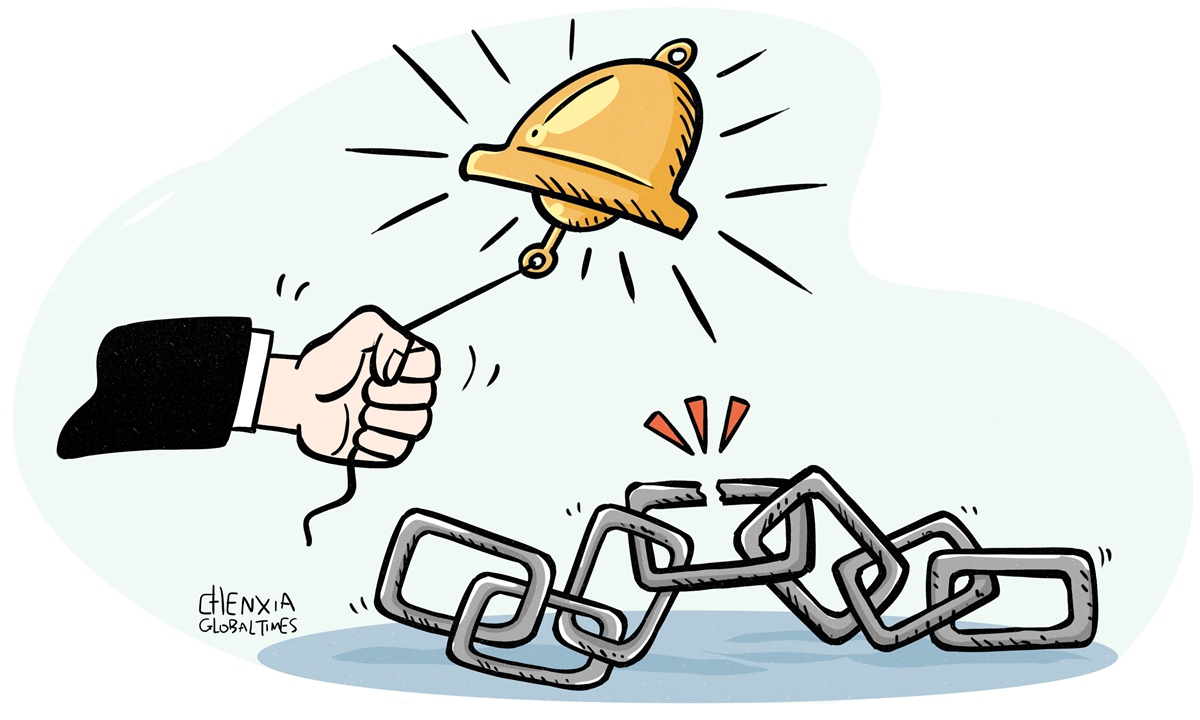
China EU decoupling. Illustration: Chen Xia/Global Times
On September 16, European Commission President Ursula von der Leyen delivered her annual State of the Union address. She placed particular emphasis on the so-called "China shock," claiming that the EU's trade imbalance with China has reached a so-called "tipping point" and threatening that the EU will use "all the tools" at its disposal to rebalance its economic and trade relationship with China.
This came shortly after European Commissioner for Trade and Economic Security Maros Sefcovic issued what was described as an "ultimatum" to China, marking another instance in which EU leaders have put the so-called "China-EU trade imbalance" squarely on the table.
Von der Leyen described the goods trade deficit as "1 billion euros a day" and said it had reached a "tipping point," while asserting that a "second China shock is looming" and "leads to deindustrialisation in the industrial heartlands of Europe." This rhetoric may have some mobilizing appeal in the European Parliament, but it does not withstand close scrutiny.
Eurostat data show that the EU's goods trade deficit with China was about 359.8 billion euros in 2025. Yet under that same statistical framework, the EU has maintained a long-standing surplus in services trade with China. In addition, profits earned by European companies that manufacture in China and then sell their products around the world flow back in large part to their European headquarters. Cutting the value chain in half, using import values alone for political mobilization, and then placing the entire blame for "industrial hollowing-out" on China is not a diagnosis. It is scapegoating.
The roots of the pressure on European industry are not mysterious. Energy prices have remained elevated due to geopolitical conflicts, the pace of the green transition has been out of sync with industry's ability to absorb the costs, and Europe lags behind China and the US in R&D investment and capital-market efficiency. Fragmented internal markets, slow approval processes, and rigid labor costs are the more tangible factors than the so-called "Chinese overcapacity." The EU certainly has policy tools at its disposal, including anti-dumping measures, anti-subsidy measures, safeguard measures, and so-called supply-chain diversification tools. But the more aggressively they are used, the higher the costs of intermediate goods for downstream European companies, the more consumers have to pay, and the narrower the channels for exports to China become.
More concerning is the timeline itself. The EU summit in June this year gave the European Commission a dual mandate: Dialogue must produce results while defensive tools are prepared at the same time. Sefcovic set October as the deadline for "concrete results," and von der Leyen raised the rhetoric further in her State of the Union address. This looks more like a political rhythm in Brussels aimed at demonstrating results domestically while increasing pressure externally. Calling "de-coupling from China" "de-risking" does not make the risks disappear. Those risks may just return to European factories and electricity bills in a more expensive form.
The EU simply cannot afford to decouple from China. Europe needs the Chinese market to absorb high-end equipment, luxury goods and professional services, as well as stable supplies of key raw materials. China, in turn, needs Europe's technical standards, brand distribution channels and regulatory expertise. Von der Leyen said, "Words are good. But deeds are better." That applies to both sides. Rather than using China as a political scapegoat, von der Leyen and other EU leaders would do better to make use of existing China-EU communication mechanisms and focus on practical, facts-based cooperation. That is what could actually help address the challenges Europe faces today.
RELATED ARTICLES