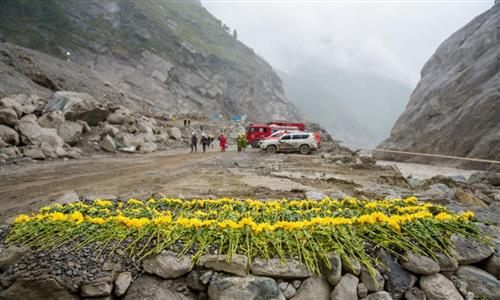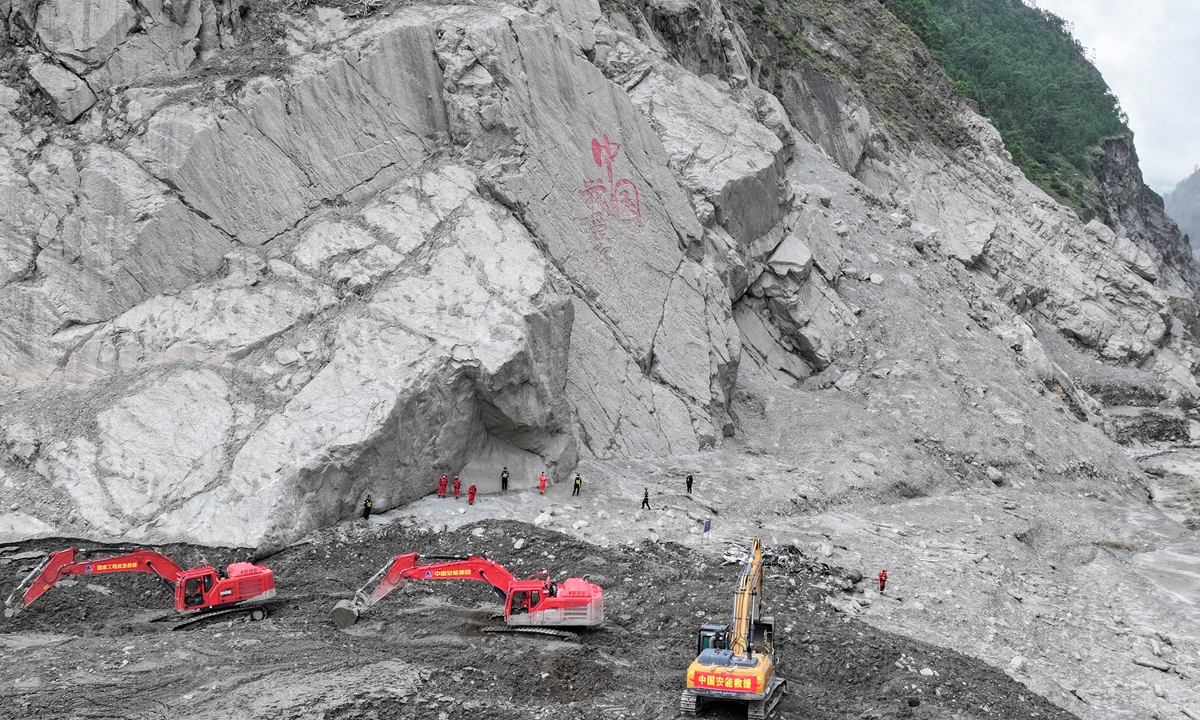
Eleven days have passed since the mudslide disaster hit Gyirong, Southwest China's Xizang Autonomous Region, on August 26, with rescue and relief efforts continuing. The photo shows excavators, loaders and other heavy equipment operating in the core disaster-hit area of Gyirong Port. Photo: VCG
On August 26, 2026, a massive mudslide occurred on Mountain Langtang Lirung.
The mudslide was so massive that it created a seismic signal initially reported as a magnitude 5-plus earthquake. The collapsed material, having dammed the Lhende Khola river system, suddenly burst through and sent a flash-flood surge across the China-Nepal border at Rasuwagadhi within a matter of minutes.
This mudslide was a disaster that brought suffering to both sides of the border. Hundreds of Chinese nationals went missing when the Gyirong customs area was swept away by the torrent. As of September 16, 1,403 bodies have been recovered in areas hit by the mudslide in Nepal, and the number of people missing has risen to 6,150. The devastation was felt on both sides, and the grief was shared by the people of the two countries. Chinese rescue personnel, working alongside their Nepali counterparts, were also involved in rescuing workers trapped inside hydropower tunnels.
During this distressing time, a few malicious elements were using the tragedy to sow seeds of distrust between the two neighboring countries by spreading false information or disinformation about the origin of the flood. Just after the flood, some media outlets widely reported that the disaster had originated in Xizang region.
On August 27, the Chinese Embassy in Nepal shared an image labeling two claims as "Fake News" on X.
The embassy said the truth was that "an earthquake or earthquake-like glacier collapse occurred on the Nepali side on the morning of August 26, 2026, triggering huge mudslides which caused significant casualties and left people missing on both the Nepali and Chinese sides of the Gyirong-Rasuwagadhi border region." The Chinese statement was subsequently corroborated by satellite images from the area.
Beyond Nepal, some media outlets, including those in India, reported the flood as a "China-made" disaster. Even senior political analysts described the catastrophe as having been caused by infrastructure construction in the Xizang region and alterations to the Himalayan river system. This allegation was so absurd that it hardly needs to be rebutted.
If China had prior knowledge of the flood, it could have saved the lives of its own people. Why would it not have evacuated its officials and other people from the affected area? This baseless statement was categorically denied by a Chinese Foreign Ministry spokesperson.
This kind of misinformation and disinformation will not help anyone. Such allegations can be dismissed easily within a matter of hours, but they can nevertheless create a degree of discomfort and distrust among the concerned parties.
Since the Himalayan region is shared by Nepal, China and India, among other countries, cooperation is essential. Glacial melting and flooding can occur at any time, and climate change has accelerated such events. The Himalayan mountains are extremely fragile, and events such as the August 26 mudslide and flood may occur more frequently in the future.
There should be greater cooperation among the countries associated with the Himalayas. Rather than spreading malicious allegations and accusations, these countries should work together to share hydrological data and establish an early-warning system. In such disaster situations, urgent messages can be delivered in time and precious lives can be saved. It should be noted that China has been sharing such data with Nepal regularly.
Countries adjoining the Himalayas share a common future. The mudslide affected all three countries. The flood created havoc in China and Nepal. Hundreds of people died in China and thousands died in Nepal. Bodies washed away by the mudslide were also found in India and were handed over to Nepal. Massive numbers of fish washed away from Nepali rivers were caught on the Indian side, although authorities warned about the hazards associated with eating the fish. This shows how closely these countries are intertwined by nature.
Therefore, instead of spreading malicious rumors and allegations and poisoning the atmosphere, the concerned countries should take concrete steps to minimize the damage from such disasters in the future. The countries connected by the Himalayas should work together to establish a shared hydrological data network and a cross-border early-warning system across the Himalayan region. Such cooperation is urgently needed.
The author is the chairperson of the Nepalese news website dayitwabodh.com. opinion@globaltimes.com.cn
RELATED ARTICLES