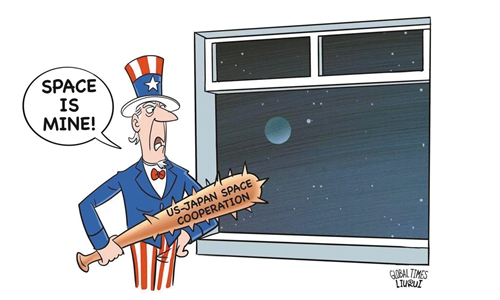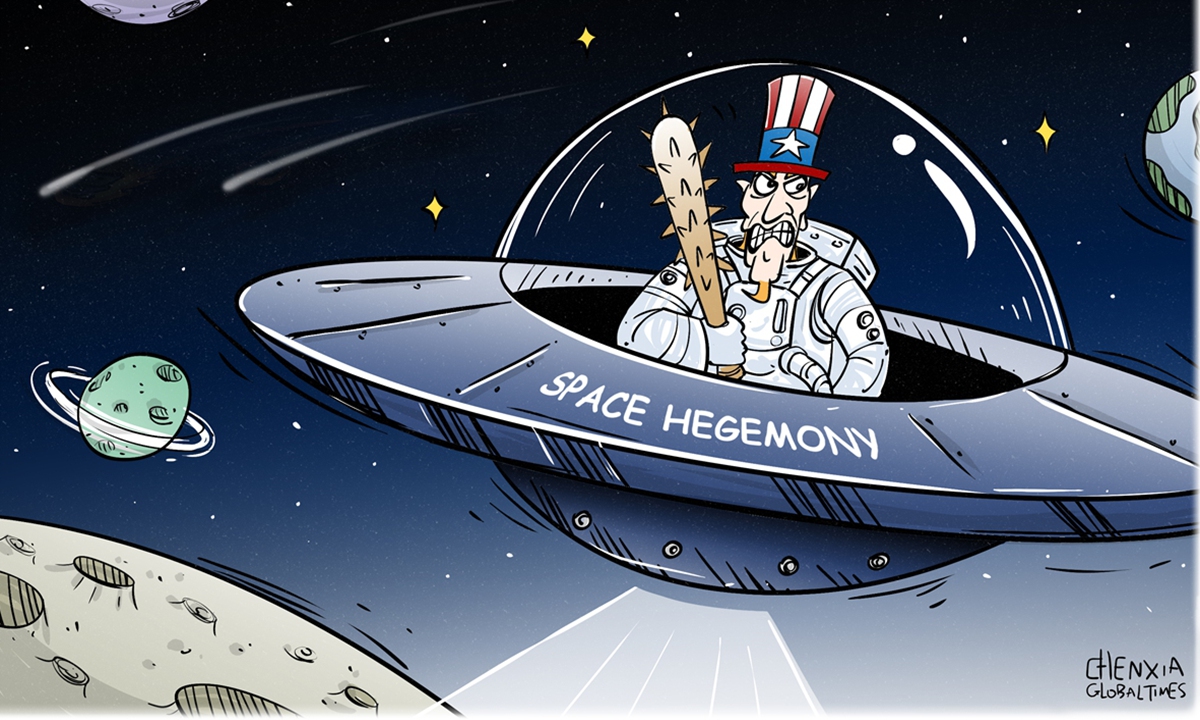
Militarizing space. Illustration: Chen Xia/GT
The old script of bloc‑confrontation on Earth is being replicated by the US in cislunar space.
According to the Associated Press, Dan Caine, chairman of the US Joint Chiefs of Staff, stated publicly on Wednesday that American troops need to prepare for combat not only in Earth's orbit but around the moon. Caine further claimed that the US military should adapt now so it "is prepared to fight, endure and win ... From the seabed to cislunar space."
By explicitly bringing the lunar vicinity into its battlefield conceptualization, coupled with Washington's public acknowledgment two days earlier that it has deployed on‑orbit space weapons, senior US military officials are sending a highly aggressive and dangerous signal.
As early as 2019, the US officially established the Space Force. In 2025, it unveiled the "Golden Dome" space-based missile defense program, dubbed "Star Wars 2.0." Gregory Gagnon, commander of the US Space Force's operational forces, defended the expansion of the country's space capabilities by arguing that "potential adversaries have been seeking to extend warfare into space." Such arguments amount to nothing short of "a thief crying stop thief."
As a signatory to the 1967 Outer Space Treaty, the US should uphold its spirit: Celestial objects such as the moon are to be used "exclusively for peaceful purposes," nuclear weapons cannot be placed in space and countries are "liable for damage caused by their space objects."
Yet Washington has taken the lead in setting up an independent Space Force, publicly acknowledged the deployment of offensive space weapons, and continuously extended its operational concepts toward lunar orbit. Such repeated crossing of regulatory red lines seriously undermines outer‑space governance.
Caine seeks to justify such military buildup by pointing fingers at other countries: Maintaining unmatched space superiority is a top military priority, Caine said, as "adversaries such as China and Russia make massive investments in space weapons" and other capabilities that can "threaten American satellites."
A Chinese expert said that this reflects the US military's habitual mindset of preemptively defining adversaries: If there is no enemy, create one; if there is no battlefield, designate one. Such logic of proactively stoking confrontation poses grave dangers for global security.
Behind the US' exaggeration of external threats lie very real domestic budgetary considerations. The expert noted that the US' new fiscal year begins on October 1, and the proposed defense budget for Fiscal Year 2027 amounts to a historic $1.5 trillion, which is currently the subject of intense debate in Congress. A major purpose of Caine's claims about the risks of space warfare in Earth-Moon orbit is to exaggerate external threats, secure a larger share of the military budget from Congress, and pave the way for the massive defense budget. "Threats from adversaries" are just the lines; securing the budget is the real script.
Driven by dual strategic calculations both domestically and internationally, the US is seeking unrestrained space hegemony. As it continues to expand its Space Force, Washington is planning to deploy various new weapons systems in space, aiming to transform the realm of deep-space exploration into a frontline of military rivalry among major powers; America's military adventurism is bound to fuel a global space arms race.
Once the Earth-Moon space becomes a theater of confrontation, no country's space assets will be able to remain unscathed. Once the fuse of an arms race is lit, the destruction brought about by the risk of war will be borne by the entire world.
Humanity's journey into space is driven by scientific progress. It should not be reduced to a powder keg for great-power rivalry. The US is mired in numerous governance challenges. Instead of working to resolve its own problems, it is inciting an arms race, going so far as to push the Earth-Moon space toward militarization. Such hysterical hegemonic impulses are spreading the risk of instability across the globe.
Space is not the private property of any single country, and lunar orbit certainly should not become the next battlefield. It is in the common interest of all humanity to stop fueling fantasies of space warfare and return to the path of peaceful exploration in outer space.
RELATED ARTICLES