Two generations of an American family forge a century-long connection with a town in Northwest China through medicine, memories and enduring affection
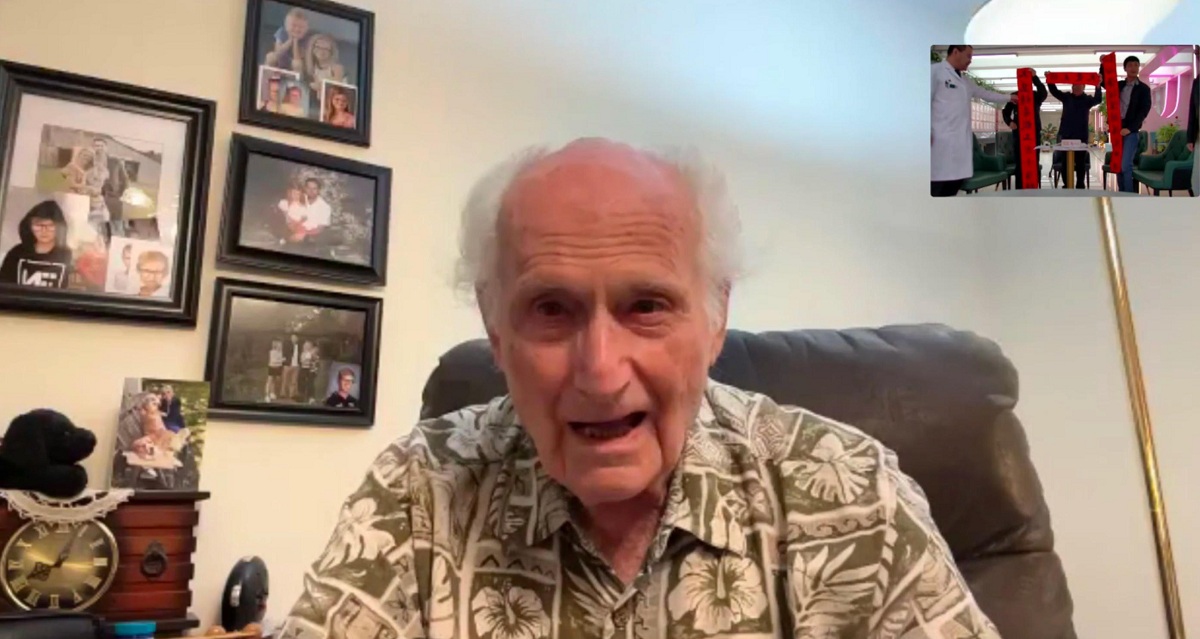
Photo: Huangyuan County Integrated Media Center
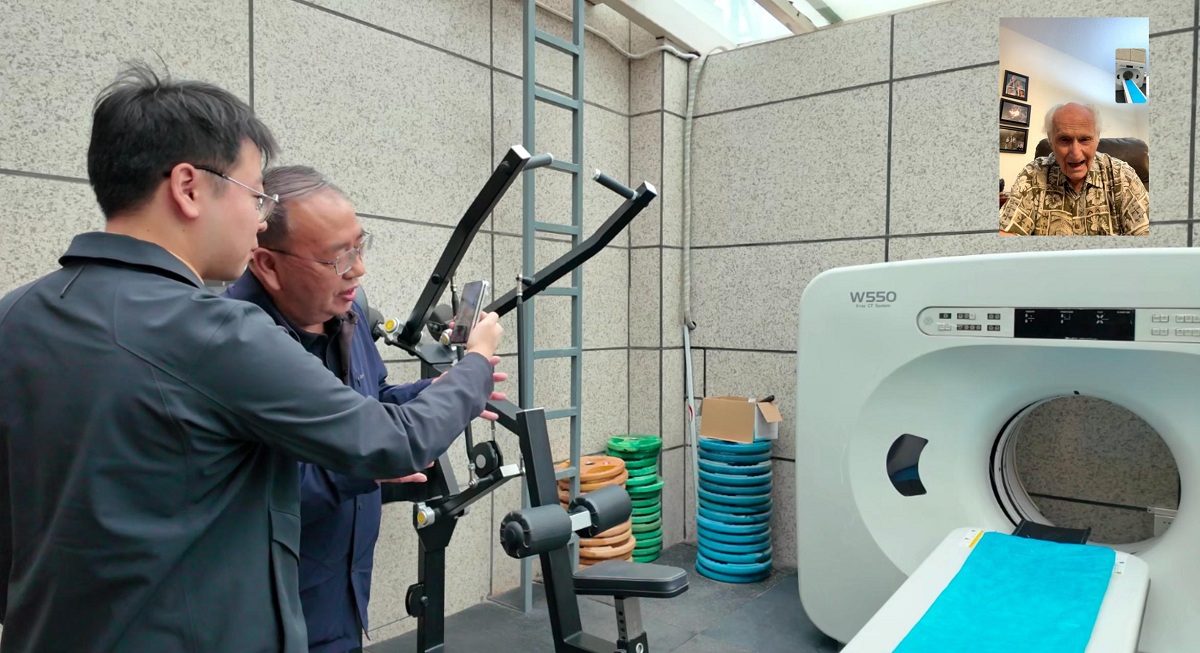
Photo: Yang Qihong/people.cn
Across two generations of an American family, Victor Plymire put down roots in Huangyuan, Northwest China's Qinghai Province, for nearly 30 years; his daughter Mary Ann Plymire's final wish was to be laid to rest in Huangyuan; and his son David V. Plymire regarded Huangyuan as his only hometown and raised funds to donate medical equipment worth more than 6 million yuan (about $895,000).
On September 10, across the Pacific in Springfield, Missouri, the US, 95-year-old David V. Plymire sat at home and opened the photo album Imprints. In a panoramic photograph of Dan Gar Ancient Town in Huangyuan taken in 1942, six children stood on a hillside.
"This is me. I was in my teens then. 'Nao' [I] will always be a kid from Huangyuan," David said in an authentic Huangyuan dialect during a video conversation, pointing at the photograph.
At the other end of the screen was Huangyuan in Qinghai. Wang Shikang, former president of Huangyuan County People's Hospital, called out in the Huangyuan dialect, "Brother David, we've got hand-grabbed mutton ready for you."
Across the screen, David's eyes reddened slightly and his voice trembled a little. "Whenever I have a moment, I miss everyone," he said.
Li Lin, former director of the Huangyuan County Health Bureau, also leaned toward the camera. "Mr Plymire, we haven't seen you for more than 10 years. None of us can forget you."
In Huangyuan, Mr "Big Nose" is well known. "The big-nosed American loves Chinese niangpizi (a local cold snack). He adds chili and vinegar, and gets chili all over his nose…" Wang recited a nursery rhyme that people in Huangyuan still sing today. Hearing it, "Big Nose" David laughed.
Why did an American born in New York find his way into a Huangyuan nursery rhyme? The answer begins with a story spanning more than a century, in which two generations of an American family forged ties with China.
Roots in Huangyuan
In 1932, just after turning one year old, David crossed the ocean with his father, Victor G. Plymire, and arrived in Huangyuan in Qinghai. Victor had first come to China in 1908, living in places including Gansu Province and Qinghai before making his home in Huangyuan.
In the eyes of Huangyuan residents, Victor was "one of our family." Modest and sincere, he respected the customs of local ethnic groups, worked hard to learn Chinese and the Tibetan language, and used his knowledge of Western medicine to provide free diagnosis and treatment to people of different ethnic groups.
Entering the clinic Victor once operated, one can lift a concealed door in the floor and descend a steep, narrow wooden ladder into the basement. Overhead are thick log beams bearing marks left by axes and chisels. Blue-brick walls surround the space, with only a small ventilation window.
During bandit unrest before the founding of the People's Republic of China in 1949, it was here that Victor helped innocent Huangyuan residents withstand the turmoil.
David spent more than a decade in Huangyuan from young adulthood. Every plant and tree there felt dear and familiar to him. Later, he reluctantly left Huangyuan with his family. He subsequently lived for more than 30 years in places including China's Hong Kong, before eventually settling in the US state of Missouri.
For David, the eastern foothills of the Qinghai-Xizang Plateau and the headwaters of the Huangshui River were his only hometown. The longer he was away, the deeper his longing became. To keep his accent of Huangyuan local dialect from fading, he would talk to himself in front of a mirror every day, "otherwise, after enough time, I would forget it."
Giving back to his hometown
In 1987, after 38 years away, David finally set foot in Huangyuan again. Asked by reporters how he had felt when he returned that year, David was silent for a moment before saying, "Before I came back, it had been almost 40 years since I had seen my hometown or my family."
He found his childhood friend Qin Cizhe, and both were deeply emotional when they met. David stepped into the old house where he had once lived, his eyes filled with tears. Seeing his former neighbors and friends, and the streets and lanes he had dreamed of for decades, the homesickness buried deep in his heart immediately turned into action.
He wanted to do something practical for his hometown. Li recalled, "He visited many places and first turned his attention to hospitals that were desperately short of advanced equipment."
In March 1989, David and his sister Mary Ann bought an ultrasound scanner in Hong Kong for HK$150,000 (about $19,100), at a time when such equipment was among the items most urgently needed by county-level hospitals.
How did they bring it back? There were no express delivery or logistics services available to them. David carried the machine by plane from Hong Kong to Xi'an, Shaanxi Province and then from Xi'an to Huangyuan.
From that day on, he never stopped.
Wang first came into contact with David in 1988. The two exchanged dozens of letters and became close friends. Over the following more than 30 plus years, David traveled between the US and Huangyuan more than 20 times.
In letters to Wang, David mentioned more than once that he had managed to save some money. In one letter, he wrote that he had more than $8,000 on hand, saying, "It isn't doing much good sitting here with me. It would be better to donate it to the hospital and use it where it is needed."
Wang said, "He was not actually wealthy. Every cent came from friends, foundations and other sources. He was putting the money into Huangyuan."
In 1999, David ordered a CT scanner worth $350,000 for Huangyuan County Hospital. At the time, it could be considered a "luxury." "We badly needed one, but we knew it was too expensive and felt embarrassed to ask," Li said.
After David learned what they were thinking, he found himself in a difficult position, but after returning home he still worked hard to make it happen. "The money had originally been intended as a donation elsewhere. He persuaded the people at the foundation, and in the end it was donated to Huangyuan."
David made three trips, and in June 2000 the CT scanner arrived in Huangyuan. The People's Hospital of Huangyuan became one of the few county-level medical institutions in Qinghai Province to have a CT scanner at the time.
After the CT scanner arrived, David bowed deeply to the machine and said in the most authentic Huangyuan dialect, "This CT scanner must serve the people of my hometown well."
"Every time I see that photograph, I become inexplicably emotional and feel like crying. What he did was not easy - it was extraordinarily difficult!" said Huang Jiong, the current president of Huangyuan County People's Hospital.
Li remembered accompanying David on one occasion to several township health centers in rural areas. "Conditions at township health centers were poor at the time. If local people had even a minor ailment, they had to travel to the county seat or even the provincial capital for an examination. Not only was it a long journey, it was also expensive. David was distressed by what he saw," Li recalled. "Without hesitation, he found a way to raise $10,000, bought four ultrasound machines and distributed them to four township health centers."
With the ultrasound machines, doctors at the health centers could carry out basic examinations. Common conditions such as cholecystitis and gallstones could be detected locally, and patients whose results indicated a problem could then be referred to the county hospital. Li said, "The equipment may have been small, but it made a huge difference at the grassroots level."
Statistics show that medical equipment donated to Huangyuan county by David, his family and friends was worth more than 6 million yuan. The list included ultrasound machines, gastroscopes, ECG monitors, fully automated blood cell counters and anesthesia machines, among others. During the video call, Huang told David that the hospital now receives 300,000 outpatient visits a year, while Huangyuan county has a population of only a little more than 100,000. "Behind this are your tremendous efforts and selfless dedication," Huang told him.
During the video link, a reporter asked David, "What has sustained you and kept you doing this all these years?"
David replied, "There is a feeling in my heart that I simply have to do it, because these are all my family. Some people say I have made a great contribution to my hometown. I say that what you do for your hometown cannot be regarded as a contribution. It is our duty. You cannot simply not do it. It is only natural."
At one donation ceremony, he said sincerely, "What I do for Huangyuan county hospital is simply fulfilling my duty to my own family. Please, I beg you, don't use the word 'contribution' anymore."
What David brought to Huangyuan went beyond medical equipment.
David said he received his earliest education in Huangyuan and understood deeply what knowledge meant to children on the plateau. He worked through various channels to arrange for foreign teachers to come to Huangyuan and provide training for primary and secondary school English teachers.
Always 'in my heart'
Victor was an accomplished photographer who took hundreds of photographs documenting the social life and landscapes of Gansu, Qinghai and Xizang at the time, leaving behind precious historical visual records. David gradually donated hundreds of his father's valuable old photographs to Huangyuan county. Using the photographs as a foundation, Huangyuan county organized experts and scholars to compile and publish the photo album Imprints. The album was included in national archival records, filling a gap in Huangyuan county's historical photographic archives. Through the lens of an American, a small city in western China preserved a century of memories.
On the same land are traces even deeper than photographs. In 1927, Victor's first wife and his son John died of smallpox in Huangyuan and were laid to rest on a hillside north of the county seat. In 2016, David's sister Mary Ann died in Canada. Her final wish was for her ashes to be brought back to Huangyuan. Her family honored her wish and brought her ashes back.
During the video link, a reporter told David that Huangyuan residents had continued to maintain the cemetery over the years and that a tree was now growing beside it. "This tree has become a testament to people-to-people friendship between China and the US, symbolizing the deep bond between the people of Huangyuan and you. We believe this tree will keep growing better and stronger." David's voice choked with emotion as he replied, "Thank you to the people of Huangyuan for taking such good care of the cemetery. I am deeply grateful."
In summer, wildflowers bloom and pasture grass grows thick across the hillside, where several members of the family rest forever in Huangyuan.
In 1998, the Huangyuan County People's Government awarded David the title of "Honorary Citizen of Huangyuan County." In 2003, the Qinghai provincial government awarded him the title of "Honorary Citizen of Qinghai Province." In 2013, Huangyuan county held its first selection of the "Most Beautiful Huangyuan People," and David was elected with a high number of votes as its first international honoree.
Whenever David returned to Huangyuan, what he missed most was the food of his "hometown" - niangpi, yogurt and hand-grabbed mutton. "He was never particular about anything. He stayed in small guesthouses and would not let us pay a cent," Li said. He dressed simply, was gentle and kind, and communicated with local residents without any sense of distance. "Some dialect expressions that even Huangyuan locals rarely use anymore are still part of his speech," Li said.
Today, at the age of 95, David is no longer able to return to Huangyuan because of his physical condition. He has bladder cancer and poor eyesight. But whenever he speaks by phone with old friends in Huangyuan, the flavor of home comes through immediately in his fluent Huangyuan dialect.
At Huangyuan County People's Hospital, David's story has been written into the hospital's history. Huang said that the first lesson for new employees is to hear his story. The hospital is planning a hospital history museum, where all the equipment donated by David, the letters exchanged over the years and the old photographs will be put on display. "Otherwise, our generation may know the story, but the younger people who come after us will not. If we as hospital employees cannot even do this, we would be letting Mr Plymire down," Huang said.
At the end of the video link, a reporter asked David: If you could say one thing to the people of Huangyuan now, what would you most want to say? Looking into the camera, he spoke slowly, word by word: "All of you will always be there, and I will never forget you. I wish all of you good health and happiness in everything. Do not forget me. You will always be in my heart."
From Victor Plymire setting foot on Chinese soil in 1908 to David Plymire "returning" to his hometown of Huangyuan through a screen in 2026, two generations and more than a century have passed, yet the longing for home across the Pacific has never faded.
This article was compiled and translated by Global Times reporter Shan Jie and Xie Wenting based on an article published by the People's Daily on September 18, 2026.
