ARTS / CULTURE & LEISURE
Minning, China’s exemplar town for inclusive growth
Fujian-Ningxia cooperation offers lessons for developing countries


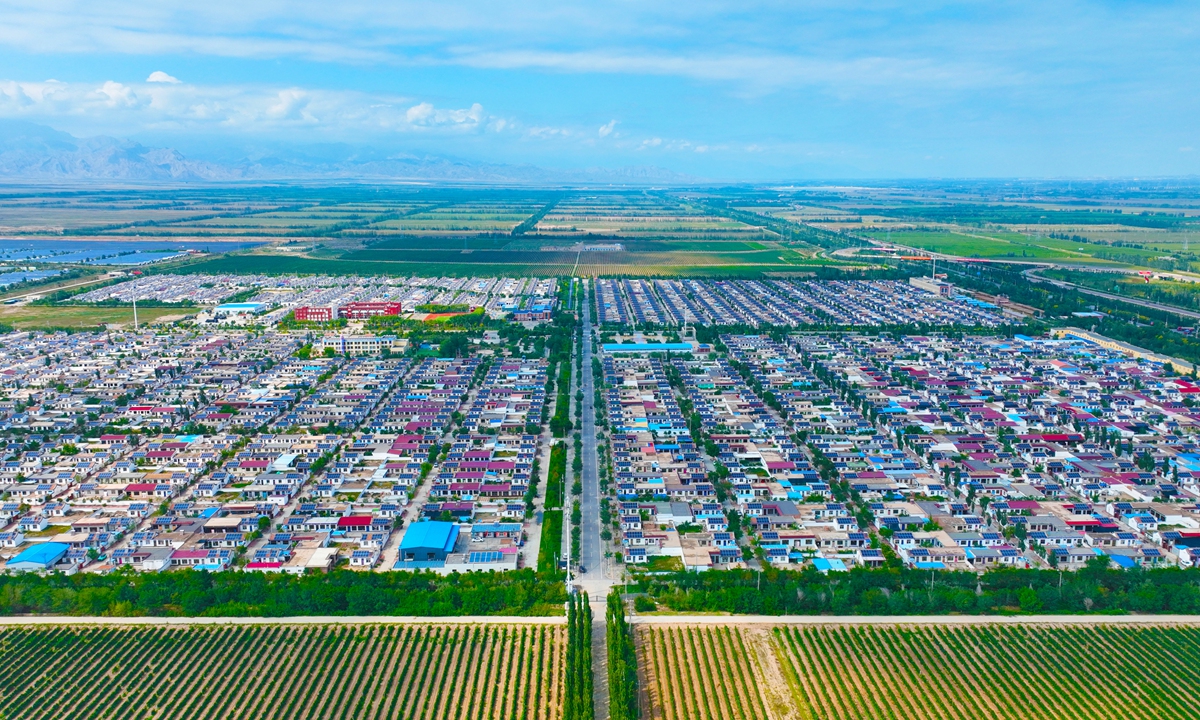
An aerial view of Minning, Northwest China's Ningxia Hui Autonomous Region Photo: VCG
Minning is a town named after a partnership. "Min" comes from Fujian Province in Southeast China, while "Ning" refers to Northwest China's Ningxia Hui Autonomous Region - bringing together a prosperous coastal province and an underdeveloped inland region more than 2,000 kilometers away.
Xi Jinping, then deputy Party chief of Fujian Province and head of Fujian's leading group for paired assistance to Ningxia, visited Xihaigu in Ningxia 29 years ago.
The visit prompted Xi to personally advance the paired assistance initiative between Fujian and Ningxia, as part of the country's east-west poverty alleviation collaboration program launched in 1996.
In 1997, construction began on Minning village on barren land near Yinchuan, the Ningxia regional capital. Over the following decades, irrigation, technical support and investment helped turn the once-empty site into a hub for wine grapes, mushrooms, goji berries and livestock farming.
The experience was revisited at a symposium on the theory and practice of Fujian-Ningxia cooperation held in Yinchuan on September 15. Li Shulei, a member of the Political Bureau of the Communist Party of China Central Committee and head of the Publicity Department of the CPC Central Committee, attended and delivered remarks, the People's Daily reported.
Participants at the symposium called for continued efforts to summarize the experience of Fujian-Ningxia cooperation, strengthen regional coordination and develop industries suited to local conditions.
At the general debate of the 76th session of the United Nations General Assembly in September 2021, China proposed the Global Development Initiative, calling for countries to work together to guide global development toward "a new stage of balanced, coordinated and inclusive growth."
Today, seen in this broader international context, the development of Minning offers a local example with wider relevance for inclusive growth.
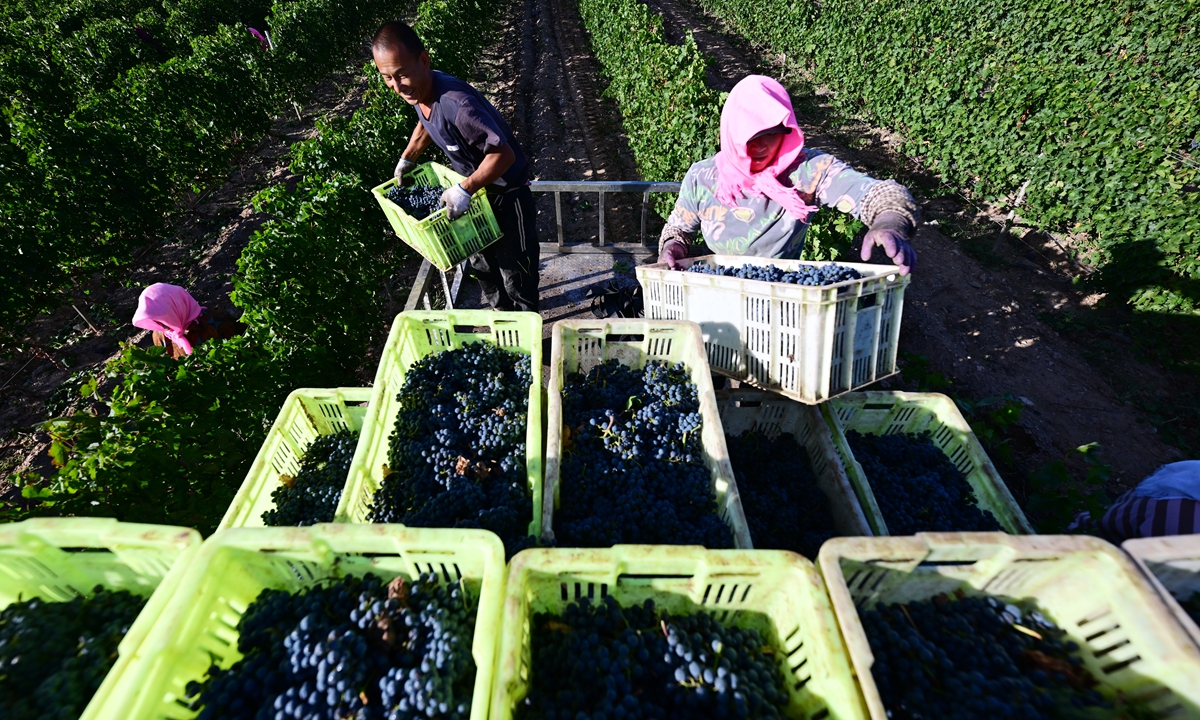
Local people pick and load grapes at a vineyard in Minning. Photo: VCG
A model takes root
During the Global Times visit to Minning, young representatives from Asia, Africa and Latin America were walking through a vineyard on the edge of the Gobi Desert, learning how wine grapes could be grown on land once regarded as wasteland.
However, back to 1997, only 13 households initially agreed to leave the drought-stricken mountains of Xihaigu and travel more than 400 kilometers to the new settlement. Some finally made the journey by three-wheeled motorcycle, while the earliest arrivals had only tents when they reached the site, the Global Times learned from local residents.
Irrigation and the settlers' first harvests subsequently encouraged more families to move. Vineyards, mushroom cultivation, livestock farming, food processing and tourism gradually emerged alongside the expanding community.
These industries brought jobs as well as new sources of household income. A vineyard developed by Fujian entrepreneur Chen Deqi had provided employment for more than 3,000 local farmers over 14 years, many of whom had previously lived in poverty. Their monthly incomes exceeded 3,000 yuan ($447), Chen told the Global Times.
Over the past decades, wave after wave of officials from Fujian traveled thousands of miles to provide aid and put down roots in the Gobi Desert with assistance funds being put to use, and projects advancing in an orderly fashion.
The broader transformation can be seen in Minning's population and income figures. Minning has transformed from a village of just over 8,000 residents into a town of more than 60,000 now. Annual per capita income has surged from less than 500 yuan in the early days to over 20,000 yuan in 2025. The total industrial output value passed the 1-billion-yuan mark, according to a People's Daily report on September 15.
"I saw many villagers in Minning growing ornamental flowers in their courtyards. They said that now that life is better, they also want to pay attention to the quality of life. These stories are moving and should be told to more foreign audiences so they can see China's development and changes," Batur Nejawi (Bao Yun), a Moroccan translator of the TV series "Minning Town," was quoted by the People's Daily as saying.
"Many foreigners, like me, admire China's achievements and want to know the secret of its rapid development," she said.
"From what I observed during my visits to both Fujian and Ningxia, sustainable development is not simply about giving communities financial aid, but about enabling them to generate their own opportunities," Muhammad Zamir Assadi, director of the China Desk at Pakistan's Lord Media Network, told the Global Times on Saturday.
"The long-term element of this approach is what makes it meaningful," he said. Industrial cooperation, skills training, technology transfer, workforce development and access to wider markets can help less-developed regions establish sustainable industries and strengthen their local economies, he noted.
Assadi described the relationship as a two-way process: Less-developed regions contribute resources, local knowledge and economic potential, while their partners provide investment, technology, experience and market connections. Over time, he said, such cooperation can produce stronger industries, more jobs and higher household incomes.
Echoes around the world
At Votualevu College near Nadi, Fiji, Chinese agricultural expert Lin Xingsheng crouched on muddy ground and showed students how to harvest a fully grown oyster mushroom. The students were several weeks into an agricultural technology course when Global Times reporters visited the greenhouse in 2023.
"I'd like to apply this skill at home," 17-year-old student Taufa Tupou told the Global Times. The demonstration center provided technical training and mushroom-growing bags, allowing students to continue cultivating mushrooms after completing the course.
Fanny Fiteli, founder of Fiji's Mama's Mushroom, told the Global Times that mushroom cultivation had enabled women in rural communities to earn income and gain a stronger position within their families.
At a nearby livestock farm, workers bundled freshly cut Juncao grass before chopping it into feed. During Fiji's dry season, the grass helps farmers maintain supplies of fodder for cattle, sheep and goats.
The grass's journey to Fiji leads back to Fujian-Ningxia cooperation. Developed by Chinese scientist Lin Zhanxi in Fujian, Juncao technology uses grass instead of timber as a substrate for mushroom cultivation. In the late 1990s, it was introduced to Ningxia's Xihaigu region, where agricultural specialists trained farmers and helped connect their produce with markets.
The technology is now used in more than 100 countries and regions, according to media reports.
Just as Fujian and Ningxia built new opportunities through cooperation, China is sharing development experience and practical solutions with other developing countries.
Over the years, China's commitment has been repeatedly demonstrated through a range of projects, such as the Luban Workshop, the program of "Access to Satellite TV for 10,000 African Villages" and the "Africa Solar Belt" program, each widely embraced by locals.
More broadly, the Global Development and South-South Cooperation Fund has supported more than 180 projects in over 60 countries, benefiting more than 30 million people. The projects cover poverty reduction, food security, climate adaptation, industrialization, health, digital connectivity and vocational training, according to the Progress Report on the Global Development Initiative 2025.
On the Fujian farm, the cut stalks were carried away in bundles, ready to become feed during the next dry season - part of a green thread running from Fujian to Ningxia, and onward across mountains and oceans.
RELATED ARTICLES