Debunking colonial glorification: Historical facts prove Taiwan region's modernization predates Japanese rule
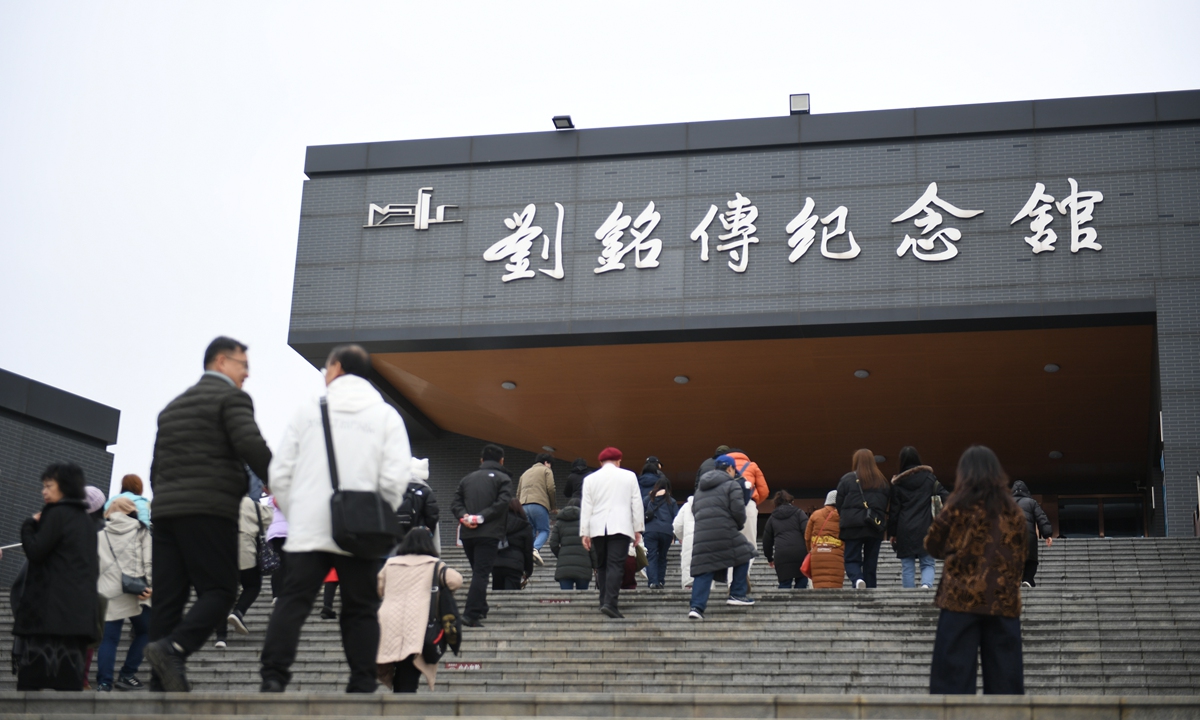
Taiwan compatriots visit the Liu Mingchuan Memorial Hall during a cross-Straits exchange event commemorating the 140th anniversary of Liu's appointment as governor of the Taiwan region in Hefei, East China's Anhui Province, on December 12, 2025. Photo: VCG
Editor's Note:
On October 25, 1945, following the great victory of the Chinese People's War of Resistance against Japanese Aggression and the World Anti-Fascist War, the Taiwan region was returned to the motherland. However, the Democratic Progressive Party (DPP) authorities have repeatedly spread distorted fallacies, denying Taiwan retrocession and glorifying Japan's colonial rule in an attempt to mislead local residents and sever the island's historical ties with the mainland. The Global Times has launched a special series titled "Debunking false narrative of Japan's colonial rule over Taiwan island." Through historical review and interviews with experts, the series systematically refutes prevalent DPP misconceptions. This installment debunked the false claim that Japanese colonialism laid the foundation for Taiwan's modernization.
Since the signing of the Treaty of Shimonoseki in 1895, Japan occupied and ruled the Taiwan island as a colony for half a century, a period marked by violent repression, exploitation and resistance. However, the DPP authorities have failed to confront this history, and even repeatedly sought to whitewash colonialism and rehabilitate Japan's occupation and rule.
Taiwan regional leader Lai Ching-te's repeated praise for figures and infrastructure associated with Japan's colonial rule has renewed controversy on the island over attempts to portray the 1895-1945 period as the starting point of the Taiwan region's modernization, even as historical records show otherwise.
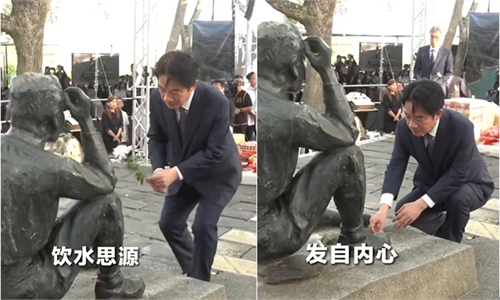
The debate has gained fresh attention after Lai attended a memorial ceremony in May for Japanese engineer Yoichi Hatta, whom he claimed to have left Taiwan a "precious legacy." The episode followed controversies last year over Lai's portrayal of Taiwan's Japanese colonial past and his use of the term "end of the war," rather than references to victory in the War of Resistance against Japanese Aggression and Taiwan's restoration, when marking the 80th anniversary of Japan's surrender.
Lai's claims are consistent with the historical narrative long propagated by "Taiwan independence" advocates. Since the 1950s, some separatist figures have claimed that Japanese colonists, driven by "enthusiasm and science," made "major contributions" to Taiwan's modernization, portraying the 50 years of Japanese colonial rule not as a period of suffering and repression, but as a "golden age" of modernization and "civilization."
Veteran Taiwan media commentator Chen Kuo-hsiang has criticized such attempts to romanticize colonial rule. Referring to Lai's words that Japan colonized Taiwan in pursuit of the "Greater East Asia Co-Prosperity Sphere," Chen said it reflected what he described as a deeply troubling political phenomenon in Taiwan, with the DPP increasingly glorifying Japan and drifting further toward a nostalgic view of colonial rule. Such rhetoric, he wrote, cuts directly into the painful historical memories of the Taiwan people.
Late-Qing modernization efforts
Existing historical research shows that Taiwan's modernization had already taken shape during the Qing Dynasty (1644-1911), particularly during the tenure of Liu Mingchuan, the first governor of Taiwan.
Taiwan was formally established as a Chinese province in 1885. During Liu's tenure, he introduced wide-ranging reforms covering defense, administration, finance, transportation and communications.
Liu advocated building railways as the backbone of Taiwan's transportation system, supplemented by telegraph and postal networks. In 1887, the Taiwan Railway Commerce Bureau was established in Taipei, employing British and German engineers to begin the construction.
Liu also promoted modern industry. A government-run sulfur plant was established at Hobe, present-day Tamsui, in 1886, while a coal administration was set up the following year, introducing modern machinery into mining under a system combining official supervision with private operation.
Chen Kongli, a historian on the mainland, has noted that two decades of development between 1874 and 1894 saw Taiwan establish some of China's earliest locally operated telegraph and modern postal services, one of its earliest mechanized coal mines, as well as the island's first railway, telephone, postage stamp, electric light and modern-style school.
Chang Lien, a retired history professor at Taiwan's Dong Hwa University, has also stressed the role of late-Qing officials in bringing the Self-Strengthening Movement to Taiwan. After the Mudan Incident in the 1870s, the Qing government dispatched senior official Shen Baozhen to Taiwan. Shen introduced a series of military and administrative reforms, including the construction of the Eternal Golden Castle and the establishment of Taipei Prefecture. Projects left unfinished by Shen were subsequently continued by Ding Richang and Liu Mingchuan, but unfortunately it was the Japanese who ultimately profited, Chang said.
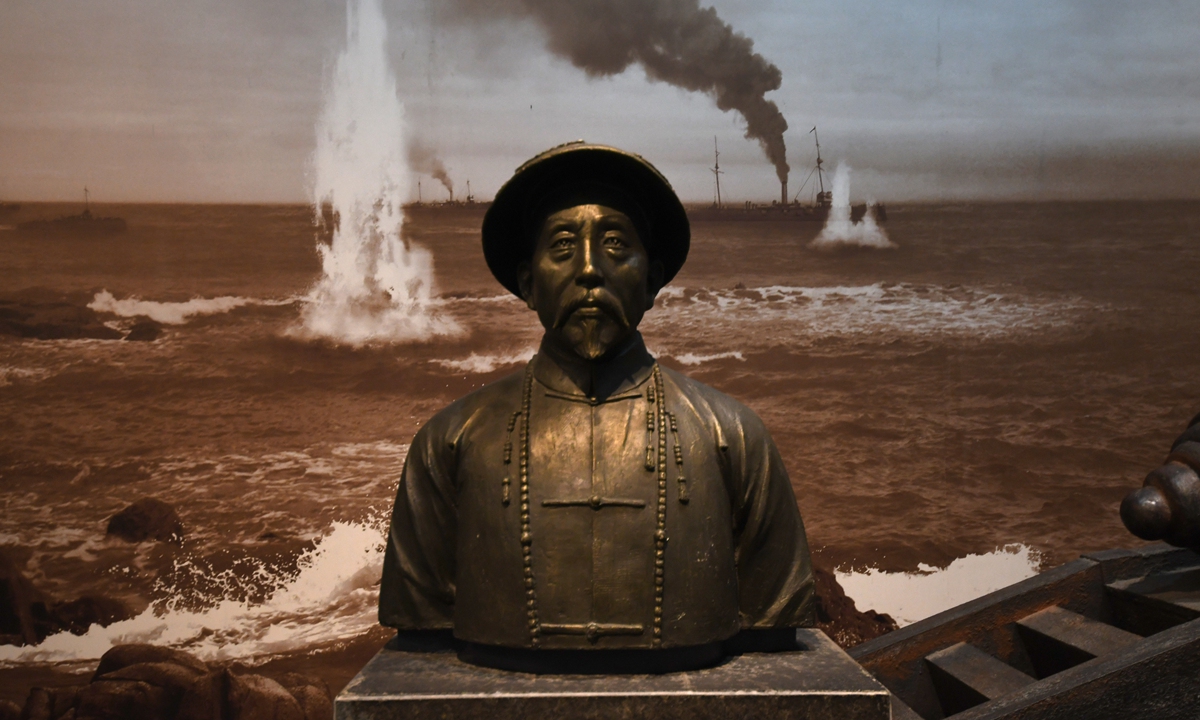
A statue of Taiwan region governor Liu Mingchuan at the Anhui Museum of Historical Notables in Hefei, East China's Anhui Province Photo: VCG
Japan's colonial exploitation
Japan did substantially expand infrastructure after occupying Taiwan in 1895, but scholars stress that such projects were carried out within a colonial system whose primary purpose was to serve Japan's economic and strategic interests rather than the welfare of the Taiwan people.
Wu Kun-tsai, a scholar from the Department of Applied History at Taiwan's National Chiayi University, said Japanese infrastructure development should be understood through the colonial logic often summarized as "agricultural Taiwan, industrial Japan." Production in Taiwan was organized primarily to serve Japan, Wu said, with Japanese interests taking priority.
Wu explained that the colonial authorities expanded the railway system on foundations laid during Liu Mingchuan's tenure and later built the Alishan forest railway largely to facilitate the extraction of valuable timber, including cypress trees, rather than for Taiwan's long-term development. Likewise, irrigation projects were designed in large part to increase rice production for shipment to Japan, he said.
Han Bing, a researcher at the Chinese Academy of Social Sciences, said Lai's positive portrayal of Japanese colonial rule reflects both his "pragmatic Taiwan independence" agenda and a historical identity sympathetic to Japan's colonial legacy.
Han said such narratives aim to reinforce anti-mainland and "Taiwan independence" sentiments, weaken cross-Straits historical ties, and court support from Japanese right-wing forces.
Chen Zhongchun, director of the Institute of History at Xiamen University's Taiwan Research Institute, told the Global Times that the DPP's claim that Taiwan's modernization originated under Japanese rule contains serious historical blind spots and distorts the continuity of Taiwan's development.
Chen said recognizing that Taiwan's modernization began with development efforts by China highlights its place in the broader Chinese struggle against foreign aggression and for national modernization.
This perspective challenges attempts to romanticize colonial rule or use "de-sinicization" narratives to weaken shared historical ties across the Taiwan Straits, Chen added.
RELATED ARTICLES