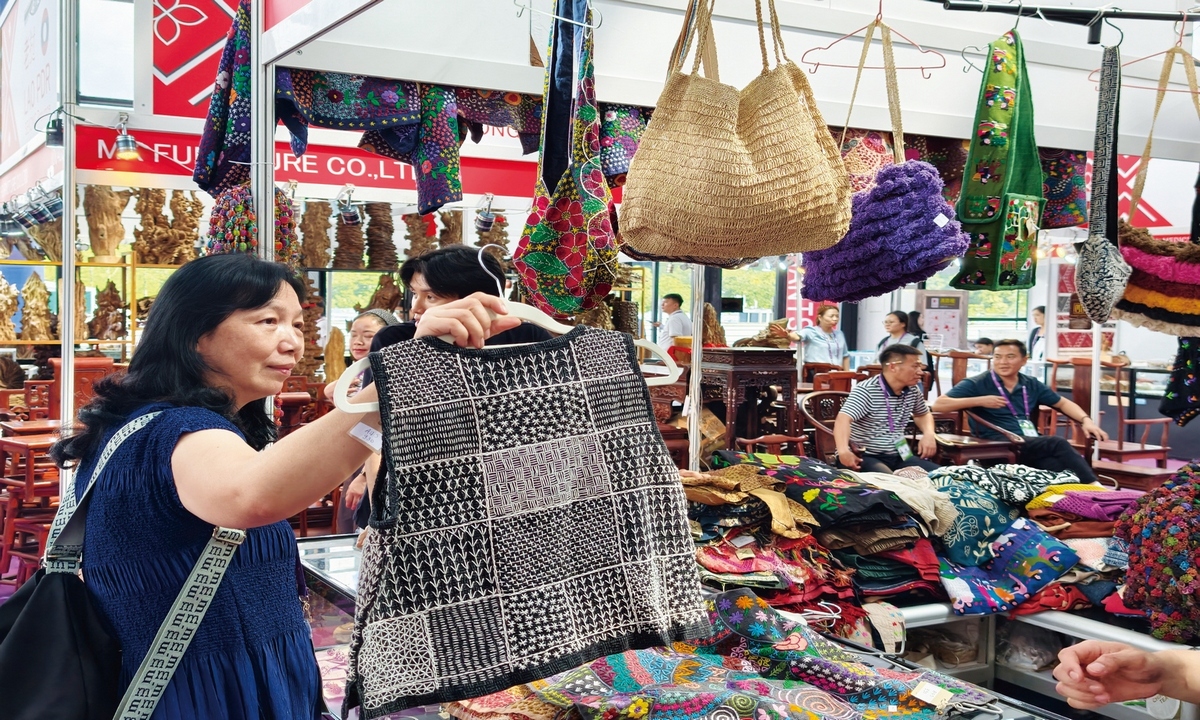
Visitors shop for Laotian specialty products at the exhibition area of the 23rd China-ASEAN Expo in Nanning, South China's Guangxi Zhuang Autonomous Region, on September 17, 2026. Photo: VCG
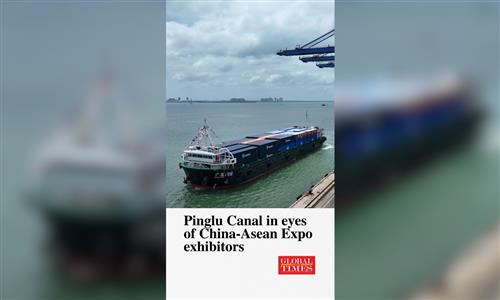
The Pinglu Canal connects the Xijiang River – a part of the Pearl River basin – with the Beibu Gulf. It is a great modern canal project linking rivers and seas. The opening of the Pinglu Canal will not only significantly reduce logistics costs, but also promote the economic development of neighboring countries, providing a strong boost to the vigorous economic and trade exchanges between China and ASEAN.
China’s investment in Thailand has grown rapidly in recent years. As the world’s second-largest economy, China has for many years been not only Thailand’s largest trading partner, but also ASEAN’s largest trading partner.
Thailand has signed free trade agreements (FTAs) with 18 countries and regions around the world, and China is the largest trading partner among Thailand’s 18 FTA partners. Statistics show that from January to June this year, bilateral trade between Thailand and China reached $91.51 billion, accounting for 21.5 percent of Thailand’s total foreign trade.
Rapidly developing cross-border trade requires a sustained, stable, reliable and effective transport and logistics network. For many years, ASEAN-China cross-border trade has flourished, and the logistics industry has become key to the smooth development of international trade.
In addition to land transport, the China-Laos Railway and Lancang-Mekong River shipping also play important roles. The opening of the Pinglu Canal can be regarded as an important component of the China-proposed Belt and Road Initiative (BRI), and it will certainly play a positive role in upgrading logistics and transport in the region. Its effect can be described as “adding wings to a tiger.”
The connection between the Pinglu Canal and regional water transport networks will not only improve logistics efficiency and reduce costs, but also drive economic development in neighboring regions. Through the Pinglu Canal, Thailand’s Laem Chabang Port and Guangxi's Qinzhou Port can further expand the potential for export shipping, creating benefits for multiple parties and further strengthening economic and trade relations between China and ASEAN.
The canal serves as a game changer in the regional shipping landscape. Its opening will help expand business opportunities in the region, promote the improvement of the China-ASEAN regional industrial chain, form a closer regional logistics network, and strengthen connectivity between China’s western inland areas and the ASEAN market. Also, in the future, there will be great room for cooperation and exchange between China and ASEAN in port construction and upgrading, including improving the use of artificial intelligence (AI) and digital technology in port management, laying a more solid foundation for expanding the import and export business of countries in the region.
Contrary to some beliefs, the opening of the Pinglu Canal is by no means a one-way transport channel benefiting only one country. Rather, it is a friendship corridor that brings broad benefits to cross-border trade between China and ASEAN countries, and it will certainly meet the rapidly growing demand for imports and exports among countries in the region.
It can be foreseen that the important pillars supporting China’s future economic growth will be new growth drivers such as AI, the digital economy, equipment manufacturing, and high-tech manufacturing. In recent years, the technological content of Chinese investment in Thailand has been rising steadily.
In the case of the Pinglu Canal, as the grand project turbocharges trade between China and ASEAN, the role of Laem Chabang Port will become more prominent. Port terminals will need to improve their capabilities in digitalization, AI, robotics, and related technologies to meet modern port standards. This, of course, requires close cooperation between Thai and Chinese enterprises in investment and construction to further improve port operational efficiency.
While much attention is currently focused on cargo trade, the canal’s opening will also bring new opportunities for cross-border tourism. The sight of international tourists sailing on cruise vessels upstream into Guangxi or downstream to the sea would itself reflect the canal’s important role in boosting cultural and tourism development and people-to-people exchanges in the region.
The author is a senior expert at Thailand's Kasikorn Bank. bizopinion@globaltimes.com.cn
RELATED ARTICLES