Chinese Vice Premier to visit US for trade talks: MOFCOM
A stable China-US relationship to provide greater certainty for intl community: expert
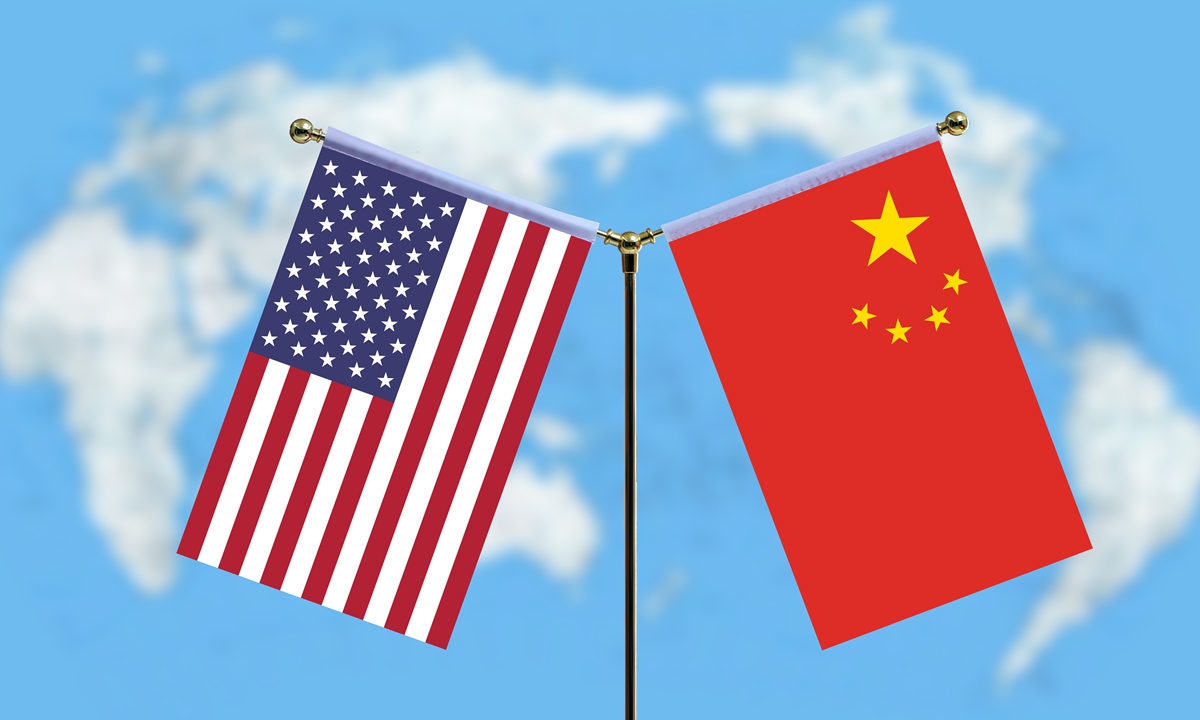
Chinese and US flags Photo: VCG
Chinese Vice Premier He Lifeng will lead a delegation to the US for economic and trade consultations with the US side from September 19 to 23, the Ministry of Commerce (MOFCOM) announced on Saturday.
The two sides will hold consultations on economic and trade issues of mutual concern, guided by the important consensus reached by the two heads of state, MOFCOM said.
The upcoming economic and trade talks came amid recent interactions between China and the US across diplomatic, economic and trade fields. On Thursday, Chinese Foreign Minister Wang Yi spoke by phone with US Secretary of State Marco Rubio.
Chinese experts said that this round of economic and trade consultations will help further consolidate the implementation of the outcomes achieved in the previous trade talks in South Korea in May, address the respective concerns of China and the US, and manage differences. They also noted that a stable China-US relationship will provide greater certainty for the international community.
More cooperation needed
The upcoming talks mark the latest exchange after China and the US achieved positive outcomes in economic and trade consultations in May in South Korea, including tariff arrangements, resolving non-tariff barriers and promoting two-way trade including in agricultural products.
"This round of China-US economic and trade consultations will further help cement the positive outcomes of the bilateral trade talks held in South Korea in May," He Weiwen, a senior fellow at the Center for China and Globalization, told the Global Times on Saturday, noting that it is expected to provide a more predictable environment for businesses and markets in both countries.
He Weiwen said that China-US economic and trade consultations across previous rounds have yielded constructive outcomes. This mechanism provides a regular and professional channel for communication, enabling both sides to exchange views candidly, manage differences, and reduce uncertainty.
Among the outcomes in the economic and trade talks in May, the two sides said they will establish trade and investment councils to address their respective concerns in trade and investment cooperation. Through the trade council, the two sides will discuss issues such as tariff reductions on specific products, and have agreed in principle to lower tariffs on products of respective concern on an equivalent scale, according to MOFCOM.
Regarding the latest progress in consultations on a reciprocal tariff reduction framework arrangement that would cover $30 billion worth of products from each side, MOFCOM spokesperson He Yadong said on Thursday that the Chinese and US economic and trade teams are maintaining close communication on issues including tariff reductions.
He Weiwen noted that tariffs are a central issue in China-US trade. As the world's two largest economies, the two countries conduct trade on a huge scale, and tariff adjustments directly shape business costs, market access, supply chain stability, and the interests of businesses and consumers on both sides. "If they can, through mutual respect and equal consultation, strike a balance that addresses each other's concerns, it will not only support healthy bilateral trade but also bring greater certainty to the global economy," the expert said.
Foreign trade between the two countries also maintained stability in recent months. As of August, China's imports and exports with the US had grown for five consecutive months, with cumulative trade totaling 2.76 trillion yuan in the first eight months, up 1.3 percent, China's customs data showed.
Meanwhile, with AI technology advancing rapidly, China-US cooperation on AI security and governance has also become a focus of public attention.
Huo Jianguo, former head of the Chinese Academy of International Trade and Economic Cooperation under MOFCOM, told the Global Times on Saturday that China-US cooperation on AI matters greatly — it is both a practical necessity and a rational choice.
"As two major AI powers, the two sides can work together on AI co-governance, standard-setting, balancing development constraints with facilitation, and broadening technology adoption, helping steer AI toward more standardized and fair competition," Huo noted.
Amid mounting geopolitical tensions and growing geoeconomic fragmentation, a stable China-US trade relationship can not only benefit both peoples and but also inject scarce certainty and stability into the global economy, help uphold the global trade order, protect industrial and supply chains, and support world economic recovery, Chinese analysts noted.
Continued engagements, exchanges
The upcoming economic and trade talks come amid continued contacts between the two sides.
Chinese Foreign Ministry spokesperson Guo Jiakun said on Friday that China and the US are maintaining communication on arrangements for interactions between the two heads of state within this year.
And during the phone talks with Rubio on Thursday, Wang Yi said that China-US relations have for some time generally moved forward along the track of constructive strategic stability charted by the two heads of state, which helps meet the expectations of the international community.
Noting that head-of-state diplomacy is the anchor of China-US relations, Wang said the two sides should prepare for the next stage of high-level exchanges in a spirit of equality, respect and mutual benefit, strengthen communication, advance cooperation, manage differences, respect each other's core interests, and send a positive message that the two countries are committed to advancing a constructive bilateral relationship of strategic stability and jointly promoting world peace and development.
In late August, when meeting US Ambassador to China David Perdue, Wang called on the two countries to earnestly implement the important consensus reached by the two heads of state and remove disruptions and overcome obstacles to high-level exchanges, according to Xinhua.
As another positive exchange between China and the US in the cultural field, China received 64 pieces (sets) of Chinese cultural artifacts, artworks, and paleontological fossils by the US on September 16 and 17, which "demonstrates the broad prospects for building a constructive China-US relationship of strategic stability," Chinese Foreign Ministry said on Friday.
More sincerity needed
However, at the same time, Washington has kept making petty moves against China from tariffs to technology.
On September 8 local time, several US agencies jointly issued an advisory accusing Chinese AI companies of conducting "industrial-scale" distillation to obtain capabilities from US frontier models and recommending defensive measures for US firms. China later voiced firm opposition to the recent US announcements, calling the accusations groundless and without legal basis.
Moreover, the US signed into law on Friday local time measures to strengthen sanctions against Russia and Iran, which allows the US to impose so-called "secondary tariffs" of up to 100 percent on third countries that import Russian oil or natural gas, with analysts believing that China will be one of the targets of the US tariffs.
In response, MOFCOM slammed the US move, saying that China reserves the right to take all necessary measures to firmly safeguard its national sovereignty and development interests, and hopes the US side will maintain the stability of economic and trade relations through dialogue and consultation.
China has shown consistent sincerity in resolving differences with the US, and the US side should match that with concrete actions and moves in the same direction, He Weiwen said, noting that only if both sides take a rational and pragmatic approach and deliver on the consensus already reached can misunderstandings be reduced and escalation avoided.
"In today's complex international environment, the world needs China-US cooperation in key areas more than ever. From keeping global industrial and supply chains stable and advancing AI security and governance to tackling climate change and driving world economic recovery, China-US coordination can generate positive spillovers and offer the international community greater certainty," He, the expert, added.
RELATED ARTICLES