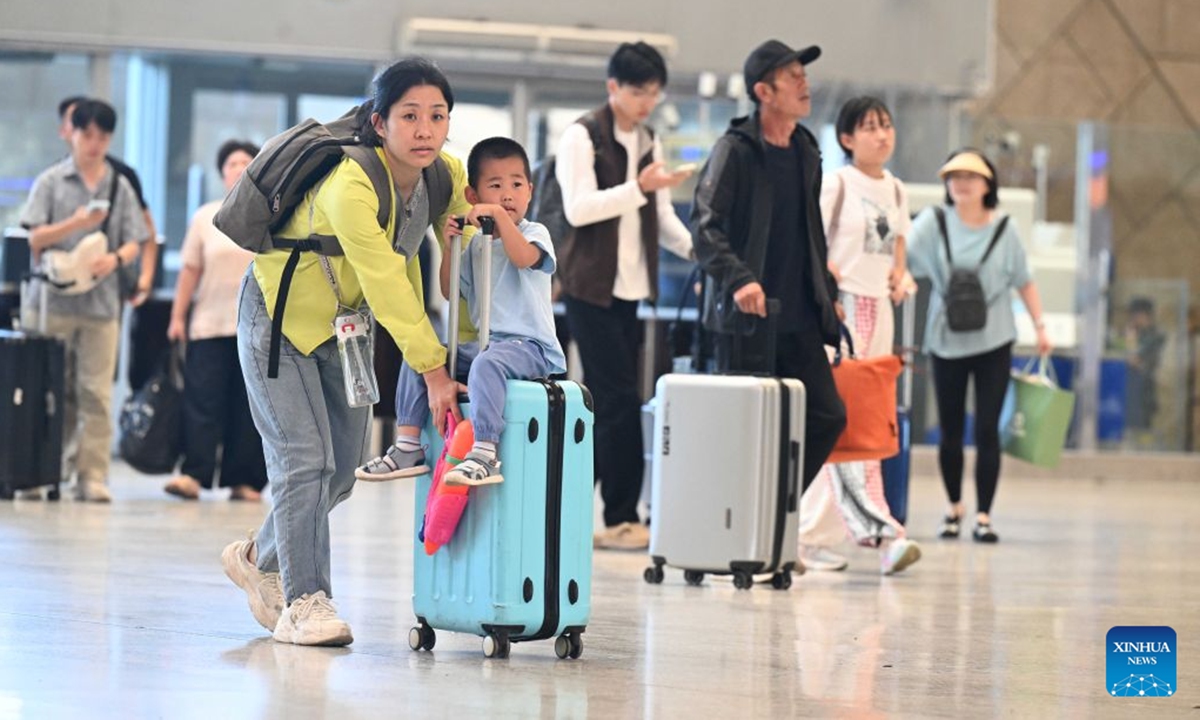
Passengers wait to check in at the waiting room of Shijiazhuang Railway Station in Shijiazhuang, north China's Hebei Province, Aug. 31, 2026. The 62-day summer travel rush officially concluded on Monday. (Photo by Chen Qibao/Xinhua)
Beijing's market regulators said on Saturday that they have launched investigations into four online hotel and travel booking platforms, in order to ensure the healthy and sustainable development of the industry.
Some platforms have leveraged their advantages in traffic and algorithms to raise hidden costs through practices such as high commissions, forced bundling, opaque data practices and low-price promotions. Such practices have undermined fair competition, harmed businesses' interests and hindered improvements in service quality, according to the official WeChat account of the Beijing Municipal Administration for Market Regulation.
Formal investigations have been launched into Hangzhou Taomei Aviation Service Co, Tongcheng Network Technology Co, Tujia Online Information Technology (Tianjin) Co and Beijing Sankuai Information Technology over suspected violations of relevant laws and regulations, according to the Beijing market regulator.
The accommodation and catering sectors play an important role in stabilizing employment, boosting consumption and improving people's livelihoods, it said, stressing that the industry is currently at a critical stage of transformation and urgently needs stronger regulation and enforcement.
In response to the authorities' move, the China Hospitality Association said on Saturday that it supports market regulators in investigating platforms suspected of unfair competition and practices that harm businesses' rights and interests.
Such efforts will help clarify regulatory boundaries, hold platforms accountable and create a level playing field for law-abiding businesses, said the CHA.
The association also called for greater transparency in platform rules and algorithms. Specifically, platforms should proactively disclose their transaction rules and provide legally required information on key issues such as search rankings, traffic allocation, commission rates and promotional activities, in order to protect businesses' right to information and fair transactions, said the association.
Hotel prices in some domestic cities have seen clear fluctuations ahead of the upcoming Mid-Autumn Festival and National Day holidays, with rates rising sharply in some places. For example, an executive king room at one hotel was priced at 321 yuan ($45) in mid-September, while the same room type at the same hotel was listed at 799 yuan for October 1, according to media reports.
The latest move came after China's State Administration for Market Regulation, together with the Ministry of Culture and Tourism, held an administrative guidance meeting with online hotel booking platforms on September 15, urging them to fulfill their compliance responsibilities, prevent and address competition risks, and maintain a healthy and orderly tourism market.
Representatives from online travel platforms such as Meituan, Douyin, JD.com, Trip.com, Tongcheng Travel and Fliggy attended the meeting.
China's hospitality industry has been booming recently. The 2026 China Hotel Industry Development Report showed that the value added of China's accommodation and catering sector reached 2.6 trillion yuan ($365 billion) in 2025, up 4.9 percent year-on-year. The country had 593,000 operating accommodation facilities with more than 20.51 million rooms, including 18.74 million hotel rooms, accounting for over 91 percent of the total. The industry's overall scale has surpassed its previous peak, according to the report.
Global Times
RELATED ARTICLES