Pinglu Canal to bring benefits for generations to come: Malaysian think tank expert
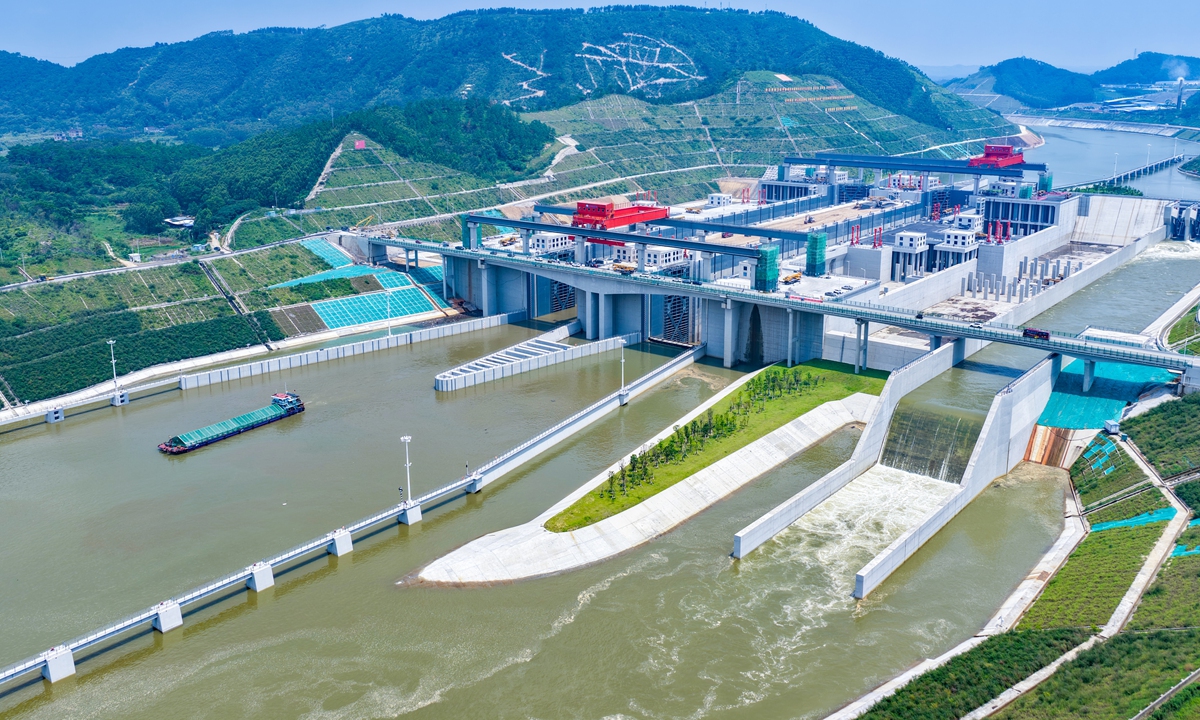
A vessel sails along the Pinglu Canal near the Madao hub. Photo: Courtesy of Pinglu Canal Group
The opening of the Pinglu Canal on September 16 marked a significant milestone in China's efforts to connect its southwestern hinterland with the sea. The 134.2-kilometer waterway links the inland shipping network in South China's Guangxi Zhuang Autonomous Region with the Beibu Gulf, providing a shorter route to overseas markets, particularly those in Southeast Asia.
However, the canal's significance goes well beyond its immediate transport benefits. Viewed through the lens of China's long history of canal building, it is a major infrastructure project with the potential to reshape regional economic ties for generations to come.
China has a long history of canal building. The Grand Canal, greatly expanded during the Sui Dynasty, connected northern and southern China, profoundly shaped the country's economy then, transportation networks and urban development.
Although the Pinglu Canal differs from the ancient Grand Canal in scale, technology and historical context, it embodies the same underlying idea: waterways can reshape regional transport networks and promote economic development. By improving the movement of goods and strengthening connections between different regions, such projects can create opportunities that extend beyond transportation itself.
The opening of the Pinglu Canal brings immediate benefits to Guangxi and southwest China. By providing a new route to the sea, it can help lower transportation costs, promote industrial development and strengthen connections between the southwestern hinterland, the Beibu Gulf and ASEAN's maritime economy.
Yet a canal does not serve merely to boost economic growth in any given year. If the Pinglu Canal continues to function effectively in the decades ahead, it could influence the industrial landscape of Guangxi and Southwest China, strengthen economic ties between China's western and coastal regions, support logistics development at Beibu Gulf Port, and facilitate trade between China and ASEAN.
These potential changes are interconnected. Improved transport links can create more favorable conditions for industrial development, while closer economic ties can generate further demand for trade and logistics services.
Of course, these long-term benefits will need to be demonstrated by the canal's operational data and the economic development of the regions it serves in the years ahead.
Lasting link between Southwest China, ASEAN
From Malaysia's perspective, what deserves attention is not simply the fact that China now has another route to the sea. The more important question is whether closer industrial, logistics and trade ties can develop between the southwest Chinese market and ASEAN's maritime economy. This is where the canal's potential long-term historical significance lies.
China and member states of the ASEAN have a long history of cultural and economic ties. A key aspect of their economic relations is the complementarity in regional production networks. ASEAN countries produce raw materials, components and intermediate goods, which are then exported to China for further processing into finished products. China and ASEAN are therefore not just trading with each other but are part of the same interconnected global production and supply chains.
Economic cooperation is the strongest bond between China and ASEAN. China has been ASEAN's largest trading partner since 2009, while ASEAN has been China's largest trading partner for six consecutive years. In the first seven months of 2026, bilateral trade rose 24.7 percent year-on-year to $744.41 billion, accounting for 21.8 percent of China's total foreign trade during the period, according to official Chinese data.
At a time when global economic fragmentation risks are rising due to major-power geostrategic competition, the stability and predictability of China-ASEAN cooperation have become increasingly valuable, serving as the ballast of regional stability and prosperity.
Against this backdrop, the Pinglu Canal offers a new transport link that could support these existing economic ties. By providing southwest China with more direct access to the Beibu Gulf, it has the potential to facilitate the movement of goods between China's inland regions and Southeast Asian markets.
The canal is expected to shorten the shipping distance between China's southwestern hinterland and ASEAN by about 560 kilometers and reduce logistics costs by 18 to 30 percent, according to Guangxi regional authorities. These projected savings illustrate the immediate transport advantages of the new route.
Viewed in this broader historical context, the Pinglu Canal is not merely a transport project, but a major national infrastructure undertaking of far-reaching strategic significance. While people today can see the practical results of its opening, future generations may look back and see how a single waterway helped transform the fortunes of a region and foster closer economic ties between Southwest China and ASEAN.
This article is based on a Global Times interview with Koh King Kee, the president of the Centre for New Inclusive Asia, a Malaysia-based think tank. Koh is a long-time observer of China-ASEAN cooperation.
RELATED ARTICLES