ARTS / CULTURE & LEISURE
Over 2,000-year-old royal tomb unearthed in NW China, possibly belonging to adoptive grandmother of Qinshihuang
By Published: Sep 20, 2026 06:55 PM

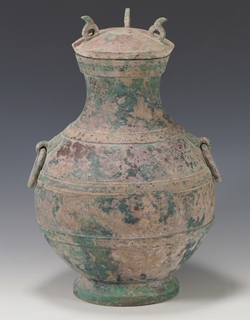
A bronze vessel unearthed from the Shangzhaoyao Qin Mausoleum in Northwest China's Shaanxi Province Photo: Courtesy of Shaanxi Academy of Archaeology
Chinese archaeologists have uncovered a high-ranking royal mausoleum dating back to the late Warring States Period (475BC-221BC) in Northwest China's Shaanxi Province, with substantial evidence suggesting it might be the burial place of Queen Dowager Huayang, the adoptive grandmother of Qinshihuang, China's first emperor who unified China for the first time more than 2,200 years ago, according to a press release that the local archaeological authority sent to the Global Times on Sunday.Known as the Shangzhaoyao Qin Mausoleum, the site is located in the Weicheng district of Xianyang city, Shaanxi Province, less than 60 kilometers from the Mausoleum of Qinshihuang as the crow flies.
It was first identified in 2018 when the Shaanxi Academy of Archaeology conducted cultural heritage surveys to support the expansion of the Xi'an Xianyang International Airport. Further systematic excavations and supplementary explorations launched in 2022 had fully clarified the complete layout and structural features of the ancient cemetery.
Distinguished by a unique square-shaped "double-ring" layout, the well-preserved mausoleum complex encompasses comprehensive imperial burial facilities, including outer and inner boundary ditches, inner enclosure walls, a central main tomb, accessory tombs, sacrificial pits and auxiliary burial pits, the press release noted.
The large-scale cemetery spans approximately 600 meters north-south and 580 meters east-west, with structured gateways and watchtower foundations remaining at the openings of boundary ditches and enclosure walls.
A total of 45 accessory tombs and 15 affiliated burial tombs are neatly arranged in the northern outer cemetery, among which five are equipped with horse and chariot burial pits and seven have independent boundary ditches. Additionally, 62 sacrificial pits are orderly distributed in the northwest section, forming a standardized sacrificial area for ancient imperial rituals.
Archaeologists have retrieved 258 sets of cultural relics from the site, covering pottery, bronze, iron, jade, agate and glass artifacts. Most pottery wares are fine gray clay vessels, including tripods, boxes, kettles and jars, many stamped with inscriptions marking local handicraft workshops in the Qin State.
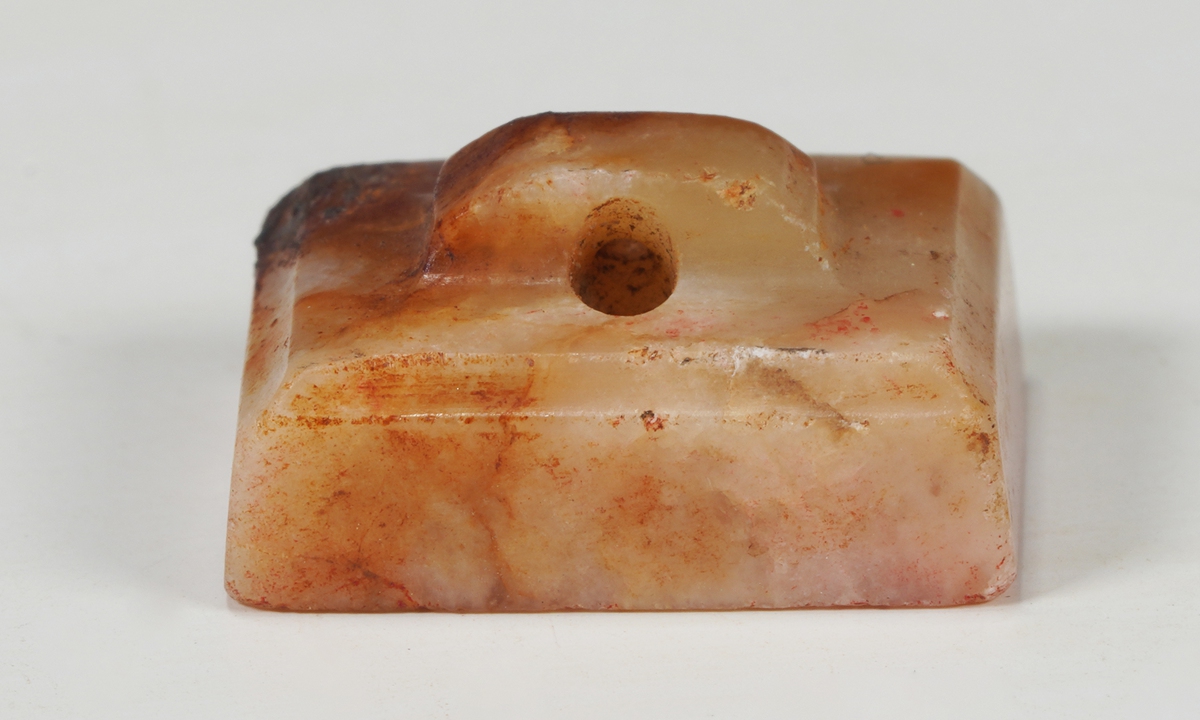
A jade artifact unearthed from the Shangzhaoyao Qin Mausoleum in Northwest China's Shaanxi Province Photo: Courtesy of Shaanxi Academy of Archaeology
A notable bronze tripod unearthed from an affiliated tomb bears the inscription "Song Clan," offering valuable clues for studying social clans and ritual systems of the late Warring States Period.Radiocarbon dating of human bones from the accessory tombs pinpoints the site's chronological range between 389BC and 208BC.
"Combining the imperial-level tomb structure, standardized cemetery layout and typological characteristics of unearthed artifacts, we confirmed the Shangzhaoyao site is a late Warring States mausoleum of Qin monarch rank," Zhao Hanqing, a research fellow at the Shaanxi Academy of Archaeology, told the Global Times.
The Shangzhaoyao Mausoleum shares highly consistent architectural designs and layout with the adjacent Sijiazhuang Qin Mausoleum, indicating they were built during roughly the same period and their tomb owners likely had close political or kinship ties, Zhao noted.
Based on historical records and Qin imperial burial regulations of the Warring States Period, researchers infer the tomb owner was Queen Dowager Huayang. A noble descendant of the Chu State's Mi clan, Queen Dowager Huayang was the principal wife of King Xiaowen of Qin and adoptive mother of King Zhuangxiang of Qin, Qinshihuang's father.
She rose to core political power in the Qin court. According to Records of the Grand Historian, she was buried in the Shou Mausoleum alongside King Xiaowen after her death in 230BC.
Archaeologists noted the new finding fills key gaps in the chronological sequence of Qin royal mausoleums in Xianyang. It provides crucial physical evidence for studying Qin imperial burial systems, regional political evolution and cross-state cultural exchanges in the late Warring States Period, while offering new perspectives to unravel the identities of unconfirmed royal tombs on the Xianyang Plateau, the press release noted.
RELATED ARTICLES