China’s first private marine research vessel starts sea trial, costs $22.4m crowdfunded by 37 fishermen
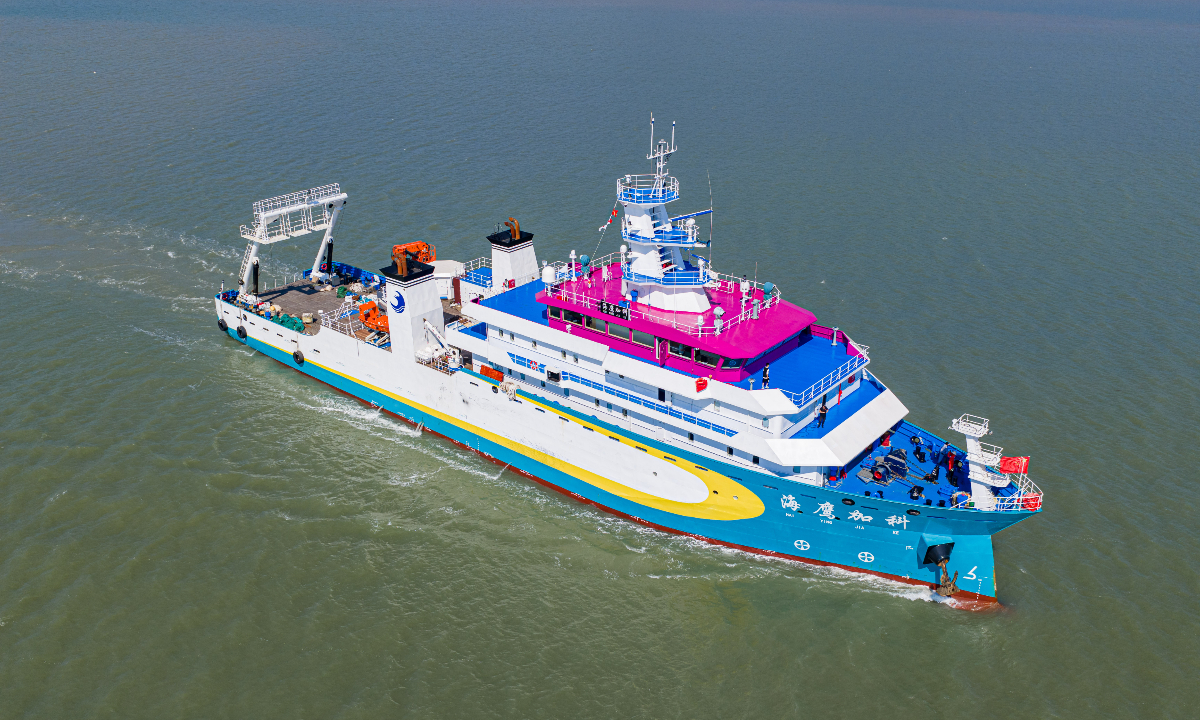
Haiying Jiake scientific research vessel departs from Cushatou Wharf in Wenling, East China’s Zhejiang Province for sea trials on September 19, 2026. Photo: IC
China’s first privately funded scientific research vessel, Haiying Jiake, began its maiden sea trial in Wenling, East China’s Zhejiang Province on Saturday, making the initial step toward far-sea missions.
With the certification for unrestricted global navigation and the capacity to break through thin ice, the vessel can conduct marine research in the open ocean and polar regions, serving as a model for private investment in deep-sea research and marine surveys, Shanghai-based thepaper.cn reported on Sunday.
The vessel was built with 150 million yuan ($22.4 million) crowdfunded by 37 local fishermen in Wenling, breaking from the tradition of state institutions-dominated marine scientific research and filling a gap of private-sector participation in the construction of high-end marine research vessels.
In early 2024, Cai Yunjie, a Wenling fisherman and head of a shipping company, came up with the idea after having learned that a lack of vessels is hindering China’s deep-sea exploration. Under his initiative, 36 other local fishermen pooled their funds and invested in the project, raising a total of 150 million yuan.
Construction of the Haiying Jiake vessel began in March 2025, and after nearly 14 months, it was launched in May 2026. Its name evokes the image of a sea eagle soaring above the ocean.
The vessel is 82 meters long and 15.2 meters wide, with a full-load displacement of 3,500 metric tons. It has a top speed of 14 knots, a range of up to 10,000 nautical miles and an endurance of more than 60 days. It is designed to meet international standards for professional oceanographic research.
During the six-day sea trial, technicians will test the vessel’s propulsion, navigation, communications, wind and wave resistance, and lifesaving and firefighting systems, with a focus on the positioning accuracy of its DP-2 dynamic positioning system and the performance of its research equipment at sea.
The sea trial is a mandatory pre-delivery inspection supervised by China Classification Society marine surveyors. If all tests are passed, the vessel could receive its operation certificate as early as mid-October.
When operational, the vessel will be leased to universities and research institutions for marine resource surveys, seabed mapping and marine life surveys, while also expanding into commercial services for offshore wind farms and sub-sea engineering projects.
Global Times
RELATED ARTICLES