Visit to Line 1 of the Bogotá Metro not for 'show': Chinese ambassador responds to ex-mayor's criticism
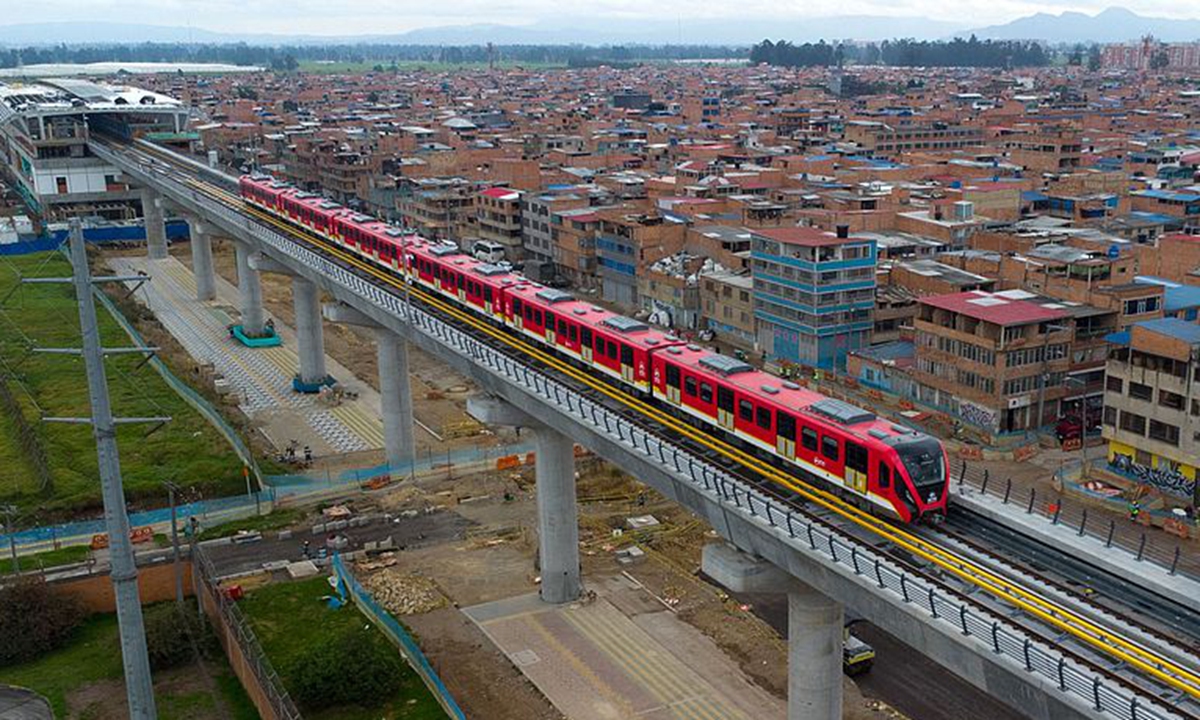
An aerial view shows initial test runs with passengers on the first line of the Bogota Metro in Bogota on May 29, 2026. Photo: VCG
"We have never presented the Bogotá Metro as a gift from China or as property of the Chinese Government," stated Chinese Ambassador Zhu Jingyang in response to former mayor Enrique Peñalosa, addressing the recent debate surrounding a diplomatic site visit to Line 1 of the Bogotá Metro.
According to the website of the Chinese Embassy in Colombia, Ambassador Zhu toured Line 1 on September 17, celebrating the megaproject's progress alongside guests from various Colombian sectors. The embassy noted that the visit highlighted the results of pragmatic, mutually beneficial cooperation between China and Colombia.
Former Mayor Peñalosa raised questions about the tour on social media, describing the event as a "show" on his X account, according to Colombian news outlet SEMANA. He claimed that because Bogotá contracted the project commercially using public funds, the Chinese Embassy had no authority or standing to invite local politicians or claim ownership over municipal infrastructure.
In a direct rebuttal, Ambassador Zhu responded to Peñalosa by clarifying the contractual and diplomatic realities of the project, saying his presence not as a claim of ownership, but as a standard duty to support major public-private investments.
"We have never presented the Bogotá Metro as a gift from China or as property of the Chinese Government. It was a commercial contract undertaken by Bogotá. That is not in dispute," Zhu said.
"The contract may be commercial. Executing and investing in the largest transportation system of a city is never a handover over the counter. Visiting the work and explaining its progress does not equate to claiming ownership, nor to inviting as the owner," Zhu said.
In a follow-up interview with SEMANA, Peñalosa confirmed that he had been invited on the tour but rejected the invitation, reiterating that the ambassador lacked the standing to issue invitations for a municipal project. He also pointed to local political rivalries as a driver for his refusal.
"And second, because I certainly did not want to legitimize Claudia López's involvement in the construction of the metro, after she tried to kill the project for petty political reasons," Peñalosa told the outlet.
Commenting on the verbal debate online, Pan Deng, director of the Latin America and Caribbean Region Law Center at the China University of Political Science and Law, told the Global Times that it's normal in Latin American politics for different leaders to hold opposing views on specific projects or diplomatic events, and even to make emotional or extreme statements," Pan said. "Because of this, we shouldn't over-interpret these situations or blow contradictions out of proportion, nor should we let biased, one-sided commentary skew our understanding."
Pan noted that early bidding for Bogotá Metro Line 1 was officially launched during Peñalosa's term, during which Peñalosa highlighted experiences from Chinese urban transit and expressed a readiness to draw on China's urban development experience.
His comments are by no means a rejection of the project itself, nor do they reflect his overall perception of China or bilateral relations," Pan explained.
Cui Shoujun, a professor at Renmin University of China's School of International Studies, noted that when the Embassy and Chinese enterprises showcase construction milestones, they are fulfilling a basic duty to respect the public's right to know while adhering to standard transparency practices for international concession projects.
Progress on the ground has been celebrated by local government. On Saturday, the Bogotá city government celebrated the latest construction breakthrough for Line 1, stating: "Change is happening! In our city, our home - Bogotá, we are proud to celebrate the breakthrough progress of Bogotá Metro Line 1."
On September 2, Colombian President De la Espriella also inspected the construction site and took a test ride on a trial train, the People's Daily reported.
In 2019, a consortium formed by China Harbour Engineering Company (CHEC) and Xi'an Rail Transit Group won the bid for Bogotá Metro Line 1, according to the People's Daily.
Spanning a total design length of 23.96 kilometers and scheduled for commercial operation in 2028, the line will connect critical sectors across central, southern and northern Bogotá, directly benefiting roughly 2.9 million residents upon completion.
RELATED ARTICLES