BUSINESS / CHINA NEOMAKE
China moves from 'world's factory' to 'innovation hub'
World Manufacturing Convention opens in Anhui, showcasing hard-tech strength
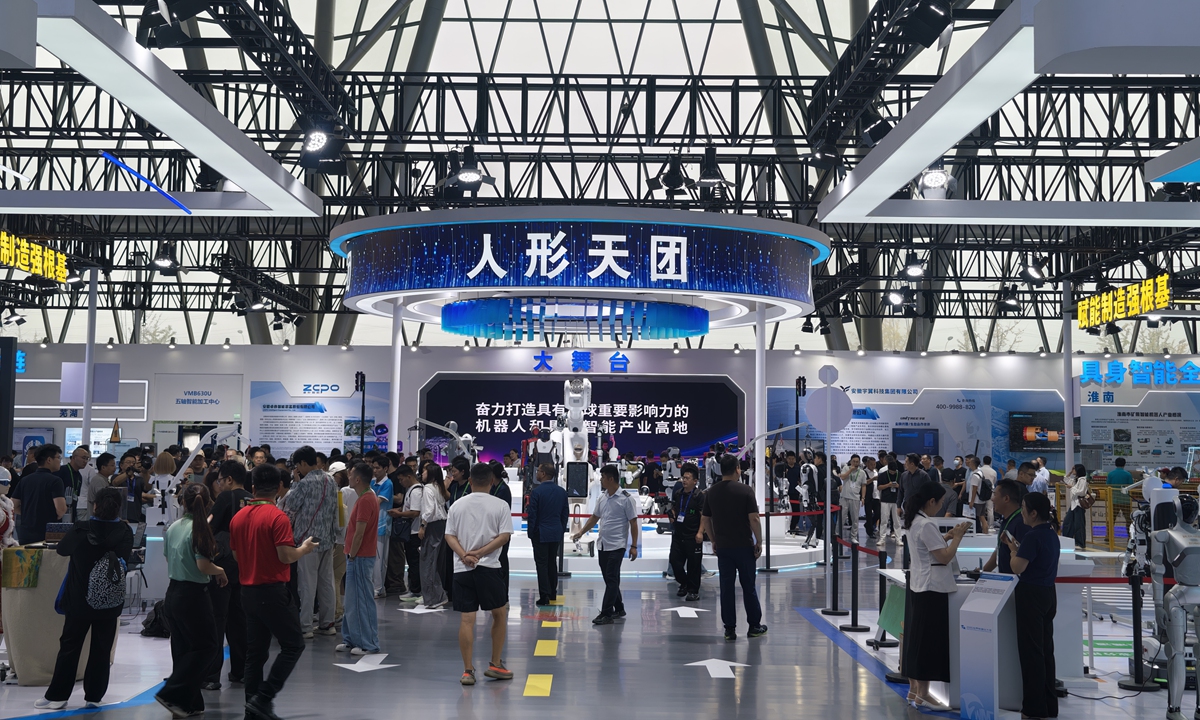
Visitors tour the humanoid robot zone at the 2026 World Manufacturing Convention in Hefei, East China's Anhui Province, on September 20, 2026. Photo: Tao Mingyang/GT
Humanoid robots, memory chips, and next-generation batteries shared the spotlight across 10 themed exhibition zones at the Hefei Binhu International Convention and Exhibition Center on Sunday, as the 2026 World Manufacturing Convention (WMC) opened in Hefei, capital of East China's Anhui Province, drawing more than 2,000 guests from home and abroad.
The Global Times noticed that many of the star exhibits come from local players. Once known for washing machines and other home appliances, Anhui is now home to memory chipmaker ChangXin Memory Technologies (CXMT), battery producer Gotion High-Tech, and AiMOGA, the robotics business of automaker Chery. Hefei also hosts China's "artificial sun" fusion research facilities and cutting-edge quantum computing research.
"Anhui is a typical example of a province whose overall industrial upgrading has been driven by the rise of manufacturing," Tian Yun, a veteran economist, told the Global Times on Sunday. Once unremarkable among China's six central provinces, Anhui now outpaces traditional manufacturing heavyweights such as Henan, Hubei, and Hunan in industrial momentum, Tian said.
As a leading platform for global manufacturing exchanges and cooperation, the WMC has become a barometer of China's industrial transformation. With the UK as the guest country of honor and Southwest China's Sichuan Province as the guest province, this year's convention has attracted more than 500 foreign representatives. More than 40 companies from countries including the US, France, and Russia are exhibiting in the 70,000-square-meter venue, according to the organizer.
The Hefei convention comes just days after a national conference on advanced manufacturing was held in Beijing from September 16 to 17 - the first national-level conference themed around advanced manufacturing.
"The back-to-back convening of these two conferences shows that advanced manufacturing is being prioritized at an unprecedented pace and level," Chen Jing, vice president and research fellow at the Society for the Study of Technological and Strategic Trends, told the Global Times.
The focus has shifted to sectors representing new quality productive forces, including AI, embodied intelligence, quantum technology, biomanufacturing, and the low-altitude economy, while openness goes hand in hand with efforts to strengthen industrial chains, Chen said.
"Centered on 'AI plus manufacturing' and the integration of the digital and real economies, China aims to seize the commanding heights of the next round of industrial revolution," he said.
Tian sees a bigger shift is underway. After more than 30 years of development, Chinese manufacturing has climbed from the lower and middle tiers of what was once a single global pyramid to the high end, and the global industrial landscape is set to take on a clear "twin-peak" structure, he said.
"China's achievements in industrial upgrading, at both the national and local levels, offer a practical reference for countries around the world," Tian said.
Hard tech takes center stage
At the opening ceremony of the 2026 WMC, Luo Xiaodong, vice president of CXMT, announced the mass production of its fifth-generation DRAM technology platform, unveiling the platform for the first time and marking a new breakthrough in process scaling.
The new platform allows CXMT to fit finer circuits onto its chips, narrowing the gap with the world's most advanced mass-produced memory technologies. Each wafer now yields at least 50 percent more chips than with the previous generation, making the products more energy-efficient and cost-competitive. Two new memory products for smartphones and other portable devices based on the platform are already in mass production, according to a statement CXMT sent to the Global Times.
CXMT also showcased its LPDDR6 chip in an offline exhibition for the first time, which entered mass production in August and first went into commercial use in Xiaomi's 18 Fold smartphone.
Gotion High-Tech debuted its G-Yuan smart battery at the convention. The battery can add 500 kilometers of driving range with just nine minutes of charging and offers a range of more than 1,000 kilometers on a full charge. Beyond high-end electric cars, it can also power flying vehicles and high-performance robots, a representative of the company told the Global Times at the convention.
For Chery, moving into robotics is a natural step. "Today's smart car is, in fact, a robot on four wheels," Xia Peng, executive deputy general manager of AiMOGA, told the Global Times at the convention. More than 90 percent of their supply chains overlap, Xia said, from gear transmissions and domain controllers to lidar and cameras, allowing the robots to build on the strength of the automotive industry.
Asked what the manufacturing conferences signal, Xia said the direction is clear. "Whether at the national level or across society, everyone is encouraging intelligent manufacturing," he said. "With the guidance at the national level, we very much hope to be part of it."
'Very bright' future
For foreign participants, China's steady push for high-end manufacturing is opening up room for complementary cooperation. Peter Wilson, British Ambassador to China, told reporters on the sidelines of the convention that the future of cooperation between the UK and Anhui is "very bright."
"China has some of the best electric vehicle technology in the world," Wilson said, adding that the UK is keen to learn from the best examples of Chinese manufacturing.
Wilson said the UK welcomes Chinese investment, which creates jobs and brings more research and development cooperation, and hopes Chinese carmakers will not just sell cars in the UK but also produce them there. "The key thing for us is about creating an environment in which Chinese companies can fly in the UK," he said. "There is a huge energy in Anhui, which is matched in the UK, because we both want to do things together."
Abou Dosso, Cote d'Ivoire's ambassador to China, said he came with Ivorian businesspeople hoping to build business-to-business ties with Chinese companies. "It's an important place because of innovation," he said, calling the convention a "very, very big event."
Asked about China's push for high-end manufacturing such as robots and intelligent vehicles, the ambassador said, "This is the future, and for us, it is very important." African countries have growing confidence in China, which shows more respect for them, he said, expressing hope that Africa and China will move forward together in this industrial revolution so that Africa can "have a place on the train."
Tian said China's manufacturing rise has brought new opportunities to developing countries once at the lower end of manufacturing. Chinese companies have set up processing plants in resource-rich regions of Africa, helping local economies shift from exporting raw materials to exporting processed products.
Torge C. Brandenburg, head of Connectura, a German consultant company, who is leading a delegation of small- and medium-sized enterprises from northwestern Germany that offers services to Chinese companies expanding into Europe, said such conferences help participants exchange ideas, make connections, and open up new opportunities. A former Volkswagen employee who has known Anhui for 25 years, he had attended the first meeting between Volkswagen and Anhui-based automaker JAC.
He said China and Germany are both strong in robotics and AI and can contribute to each other through efficiency.
Volkswagen grew in China through joint ventures, Brandenburg said, noting that he wants to bring a similar idea to the European Parliament: that Europe should do what the Chinese government has done over the past 30 years. "If somebody wants to get into the market in China, you have to make a joint venture with a Chinese company," he said.
"The world's market is big enough for both of us, China and Germany," Brandenburg said. "We need competition, but the market is large enough for both of us."
Tian noted that China's manufacturing achievements have not happened behind closed doors. "They have been achieved through continuously expanding opening-up and actively promoting international cooperation," he said. "This also shows China's willingness to take on the responsibility of leading global manufacturing chains in a new direction."
RELATED ARTICLES